



 61 / 208

[
] 61
P
eople
:
social
inclusion
,
green
jobs
,
education
between the three are cyclical and quality of output improves
with iteration. This results in graduates with first class skills and
thinking, excellent research products and services, and best prac-
tices in sustainability that will make USM a university of world
class standing.
Community, industry and policy engagements
For more than a decade, the key thrust in promoting sustain-
ability has been to work closely with industry, community and
policymakers through various knowledge transfer programmes.
USM will act both as a knowledge base by enhancing the knowl-
edge of society through knowledge generation – dissemination
and transfer, with knowledge a major output and service – and
as a knowledge-based institution, making use of specific knowl-
edge as an important input, tool or feedstock, to generate desired
outcomes and products. Operating in these capacities requires
USM to deliver as one, focusing not just on knowledge and skills,
but intangibles such as values, ethics and morals. Graduates enter-
ing our industries will have both planet and people in focus as
they seek to make profits, providing the fundamental basis for a
‘green economy’ and ‘green growth’ which is becoming the metric
of sustainable development. An inclusive community commitment
with a ‘bottom billion’ focus is essential and needs a ‘head, heart
and hand’ approach, the hallmark of graduates from a ‘humaniver-
sity’ – a university valuing human well-being, not just
material prosperity.
A core commitment to education for sustainable devel-
opment (ESD) is developed through three branches of
activity: teaching on sustainable development, research
related to the corporate sector and community initia-
tives addressing ethical challenges of sustainability.
12
By implementing this model using best ESD practices,
initiatives addressing the overall global challenges of
sustainability can be integrated with efforts to meet
industrial, business and ethical challenges. A holistic
approach includes faculties involved in industry, busi-
ness and the economy, as well as faculties relating to the
human community and its culture, ethics and spiritual-
ity. This expanded sustainability implementation model
shows the centrality of ESD in promoting education
in its broadest form to build capacity for overcoming
major ecological, economic and social challenges in a
coherent and interdisciplinary way.
Some examples help illustrate how the university
is pursuing its mandate to work with community,
industry and policymakers. In community engage-
ment, for example, a number of projects are ongoing,
including one focused on people suffering from cleft
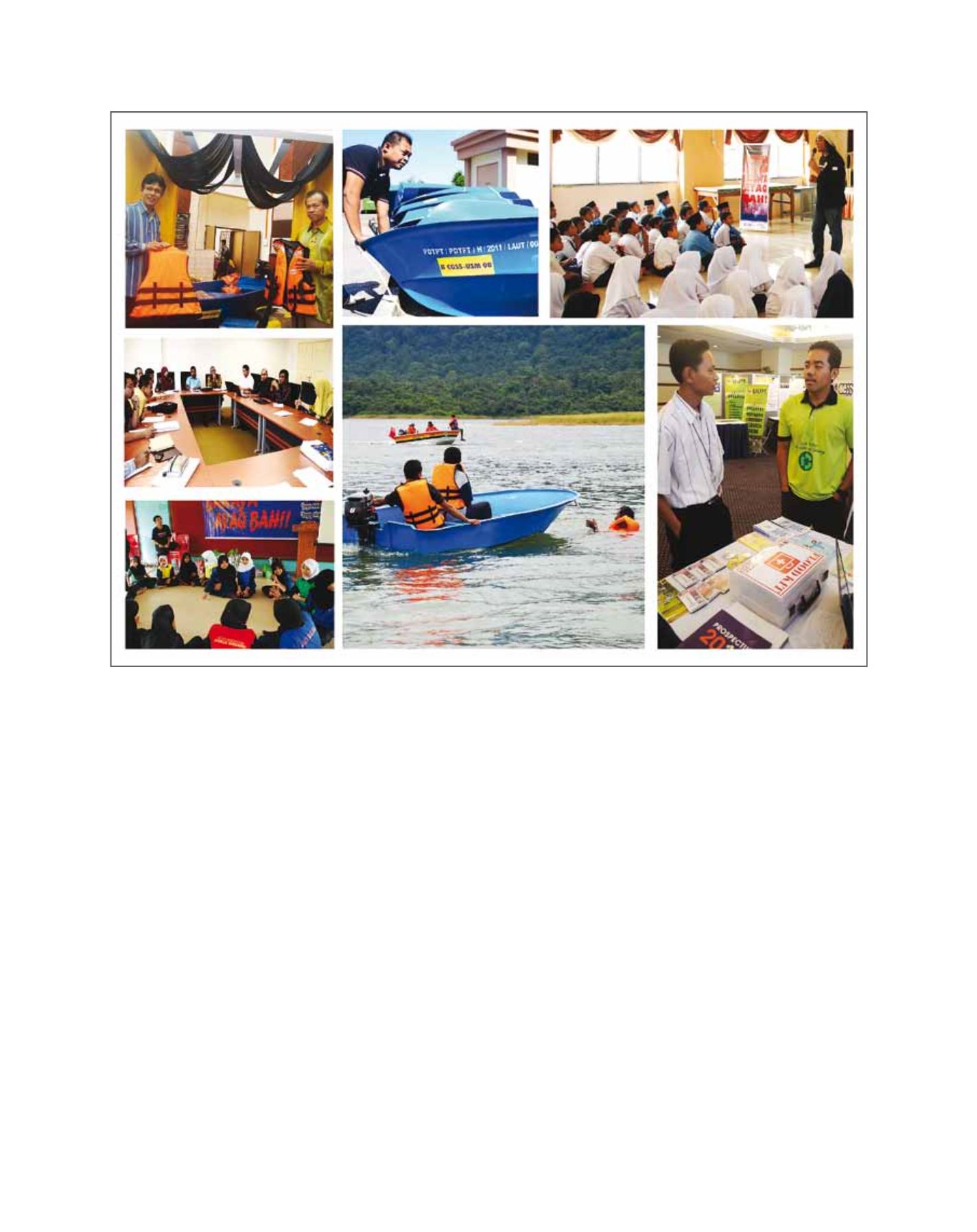
Promoting community based adaptation approaches using life jackets, boats and emergency kits provided by the project
Image: Universiti Sains Malaysia