



 62 / 208

[
] 62
P
eople
:
social
inclusion
,
green
jobs
,
education
lip and palate (in developing countries, millions of children and
adults suffering with unrepaired clefts are subjected to social
stigma). USM medical staff, collaborating with Mercy Malaysia,
have worked with healthcare partners in Indonesia, Malaysia and
Bangladesh to conduct free reconstructive surgery. Six missions
to Dhaka Community Hospital from 2008-2011 resulted in the
successful treatment of 338 children and adults.
Focused on one rural and one urban community, a project by
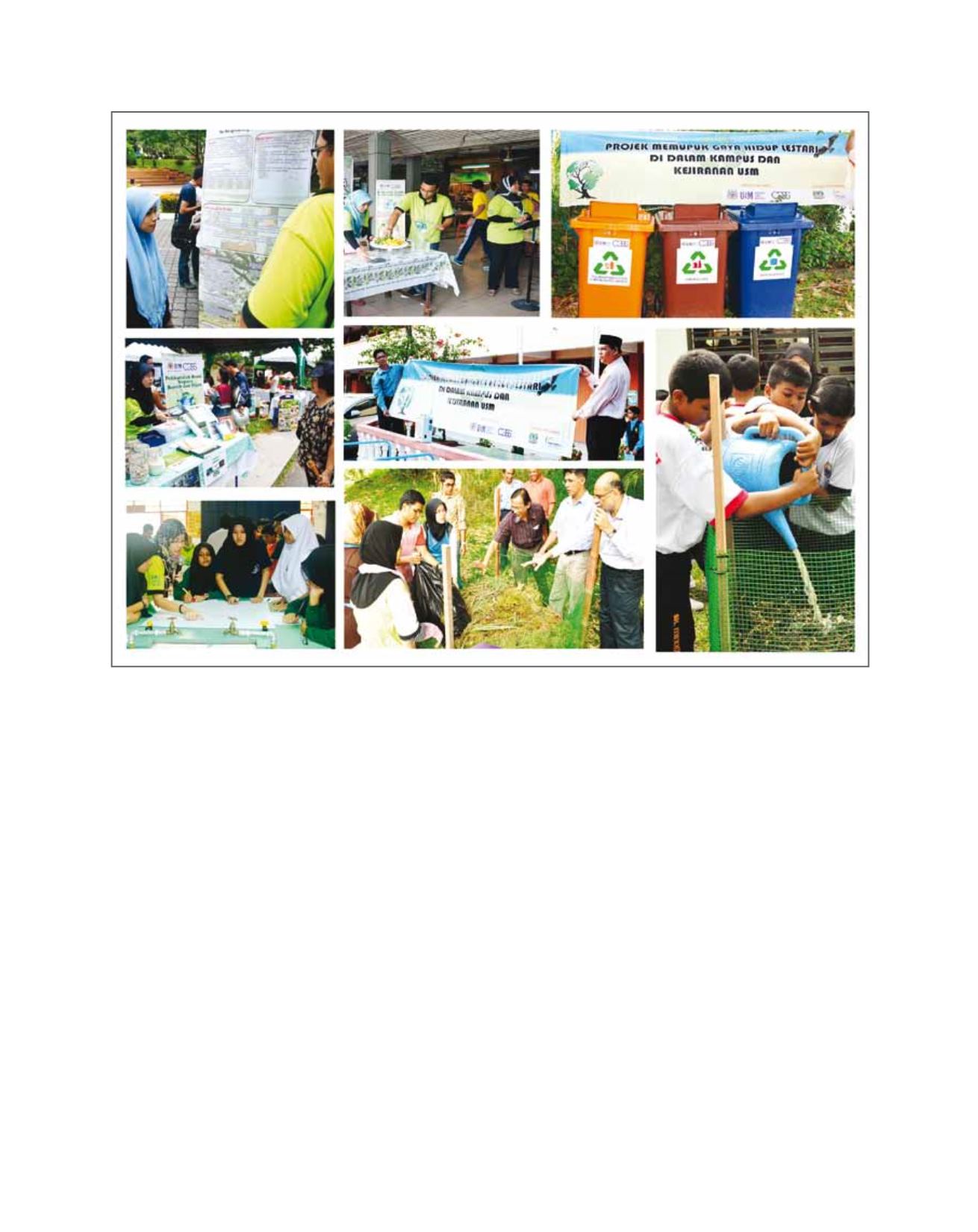
CGSS@USM entitled ‘Delivering Sustainability Excellence’ incorpo-
rated two components. The first, aimed at reducing climate change
and flood-related food security challenges in Kuala Nerang, used
the Vulnerability and Adaptation Assessment methodology to iden-
tify groups most in danger of food insecurity and empowered them
through adaptation measures. The second, Enhancing Sustainable
Living within Universiti Sains Malaysia and its Neighbouring
Communities, promoted collaboration on integrated waste manage-
ment, recycling and awareness-building by working with USM staff
and students on campus, as well as students at six local schools,
customers of a hypermarket, those living in nearby residential areas
and industries located within 8 km of the Minden campus. The third,
Balik Pulau, is an ongoing project focused on developing a model
sustainable village close to the university. It aims to help commu-
nities reconnect to their resources to promote human well-being
by enhancing social and political empowerment, community self-
reliance and self-determination. Under the heading
of industry engagement there are a number of other
project examples. One is an interactive, multi-faceted
collaboration between university academics, students,
industry management and personnel at USM. The Centre
for Education and Training on Renewable Energy and
Energy Efficiency (CETREE, USM) conducted a nation-
wide project in collaboration with Philips Malaysia, the
Philips-CETREE energy-efficient mobile show home.
The home’s diesel-powered engine was adapted to accept
used cooking oil as a fuel substitute and electricity was
supplied through fully solar power. Its five knowledge
kiosks – general knowledge on renewable energy,
energy-efficient electrical equipment, solar heating, solar
electricity and biomass fuel generation – were used for
demonstration projects and community education. The
collaboration with Philips included a Simple Switch
campaign designed to highlight the economic savings
of switching to energy-efficient lighting. A pledge wall
gave students and others the opportunity to commit to
an energy-efficient lifestyle. The ENDEAVOR-Mobile
project is an Android-based teleradiology platform for
image analysis and visualizisation that brings the power
of computing into the healthcare field. A team of USM
Hands-on training for composting and recycling
Image: Universiti Sains Malaysia