



 64 / 208

[
] 64
The impact of climate change
on sustainable development in
Latin America and the Caribbean
Walter Vergara, Division Chief, Climate Change and Sustainability, Inter-American Development Bank
C
limate change has significant impacts on development.
1
These impacts are of such magnitude that the economic
consequences of efforts to adapt to the new climate
conditions while reducing the global carbon footprint to prevent
further damages are likely to be among the main driving forces
for the global economy this century.
Given the current pace of greenhouse gas (GHG) emissions and the
poor prospects for immediate and drastic reductions, a rise of at least
2
o
C in the course of this century is now expected. Further, there is
an expectation that some adverse climate feedback effects that are
not yet properly foreseen
1,2
will develop during the century. These
may include tipping points for forest stability, marine ecosystem
integrity and water regulation. Climate change of this magnitude
will have significant negative effects on economic activities, social
conditions, ecosystems and individual species.
1
The quest for
sustainability in the face of these changes is likely to become ever
more challenging.
In particular, the effects of climate change
3
are likely
to impact heavily on Latin America and the Caribbean,
where there remains a substantial, but intrinsically
fragile, natural capital and where there are a number of
climate-sensitive eco-regions. These areas are being char-
acterized to reflect the relative vulnerability of dependent
populations (not only humans) to climate impacts.
4
Although there are uncertainties with regard to exact
physical impacts, there is widespread agreement
5
that
impacts fromclimate change, even under significantlymore
modest emission scenarios, will affect the functioning and
integrity of key ecosystems worldwide. This will add to the
stress already resulting from local anthropogenic effects,
according to the 2007 Millennium Ecosystem Assessment.
The combined effects represent an unprecedented challenge
to the global biosphere and while these impacts are being
felt globally, some regions will bemore affected than others.
Some of the key problems facing the region include:
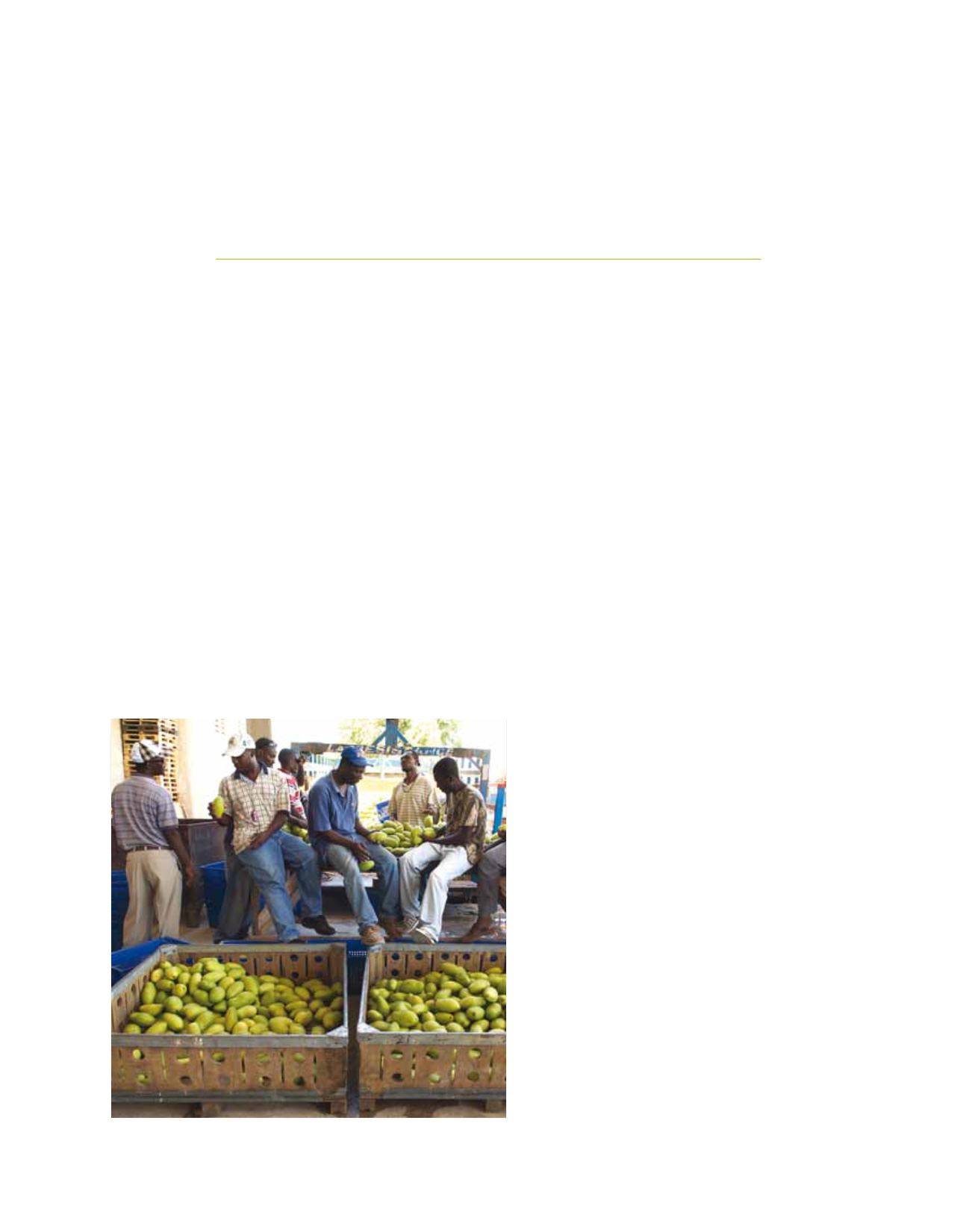
• Impacts on agriculture caused by warming and by
reduction of relative humidity of soils, as well as by
changes in intensity of rainfall
• Accelerated sea level rise and increased sea surface
temperature
• Increased frequency and intensity of extreme
weather events in coastal zones
• Additional exposure to tropical vector diseases
caused by increases in temperatures and changing
climate conditions
• Glacier retreat due to a significant temperature
anomaly in the Andes
• Potential rainforest dieback.
These physical impacts have substantial economic and
social consequences. The long-term consequences of these
changes may limit development options in the future and
affect the prospects for sustainable development.
Many of these impacts can be monetized, or quanti-
fied in economic terms. However, a significant share
of the impacts is felt by ecosystems and the damage
inflicted is more difficult to evaluate. Although the
economic services provided by these systems can be
quantified, many effects are borne by numerous other
species with little or no chance to adapt unaided to
rapidly changing environmental conditions.
E
nvironment
:
air
,
water
,
oceans
,
climate
change
Crops are affected by warming and reduced soil humidity
Image: Catiamme Tijerina