



 65 / 208

[
] 65
E
nvironment
:
air
,
water
,
oceans
,
climate
change
unlikely that the carbon budgets of these nations will show
significant changes in the future and even if they do, the
net global impact will be negligible. Therefore, whatever
occurs in these countries has limited global relevance, even
if drastic improvements in energy efficiency and land-use
change are achieved. Setting apart countries with low emis-
sions is important because this is a global problem caused
by absolute increases in GHG concentrations.
To address the threat of climate change to sustainable
development prospects, a significant adaptation effort
is required. Such an effort will not only minimize net
impacts but will, at the same time, adjust the level of
services required from nature, at a level consistent with
the effects of climate on the regional natural capital.
Addressing the challenge at a policy level requires
efforts to enact and promote policies that will lead to
the development of mechanisms and tools for better
accounting of future adaptation and estimating costs
and the benefits of adaptation measures. Policies should
encourage the valuation of natural capital assets in any
development project that has potential impacts on the
natural resource base. Fiscal policies should be adopted
to encourage advance and contingency planning to
minimize adaptation costs through investment in early
response measures, including those needed to provide
for the future costs associated with sea level rises.
Finally, it is necessary to enact national development
policies that prioritize adaptation to climate impacts as
an instrument to strengthen sustainability.
The opinions expressed in this publication are those of
the authors and do not necessarily reflect the views of the
Inter-American Development Bank, its board of directors,
or the technical advisors.
We require the methodologies and tools to estimate such costs,
but these need to be acknowledged upfront and efforts should be
undertaken to develop policies and instruments that would allow
us to properly consider the costs of adaptation for natural capital.
On the other hand, with about 5 per cent of the global share, the Latin
America and Caribbean region is a modest emitter of fossil CO
2
emis-
sions, reflecting an overall low energy-intensive regional economy. But
if one counts all GHG emissions, including those from land-use change,
the regional share increases to about 11 per cent of the global count.
This is due to the comparatively large share of global deforestation and
large emissions of CH
4
and N
2
O associated with agricultural activities.
However, the regional carbon footprint can be misleading. While
most countries in Latin America are indeed low-carbon economies
(as their emissions are well below 1 per cent of global emissions), the
region has some very large carbon emitters: countries with high rates
of deforestation, non-intensive carbon economies and countries that
are in the process of transition induced by structural changes.
Also, most countries in the region (20 out of 32) are low-carbon
economies – defined as those with a carbon footprint of less than
45 million tons of carbon dioxide equivalent (CO
2
e) per year (less
than 0.1 per cent of global emissions) – most of which also have low
carbon intensities. Small economies with negative rates of deforesta-
tion (Uruguay, Panama, Costa Rica and most Caribbean nations) are
mainly in this category. Together, these countries have a total CO
2
budget of less than one-quarter billion tons of CO
2
e (about 0.5 per
cent of global emissions).
Coincidentally, many of these low emitters are among the most
vulnerable countries, including islands and some Andean nations,
which are affected by some of the most intractable climate impacts
(sea level rise, intensification of extreme weather events, impacts
from glacier retreat and rapid warming of high mountain habitats).
Further, either because of their limited populations or as a consequence
of the carbon structure – typically consisting of low-carbon power and
transport sectors and modest rates of land-use change – it is highly
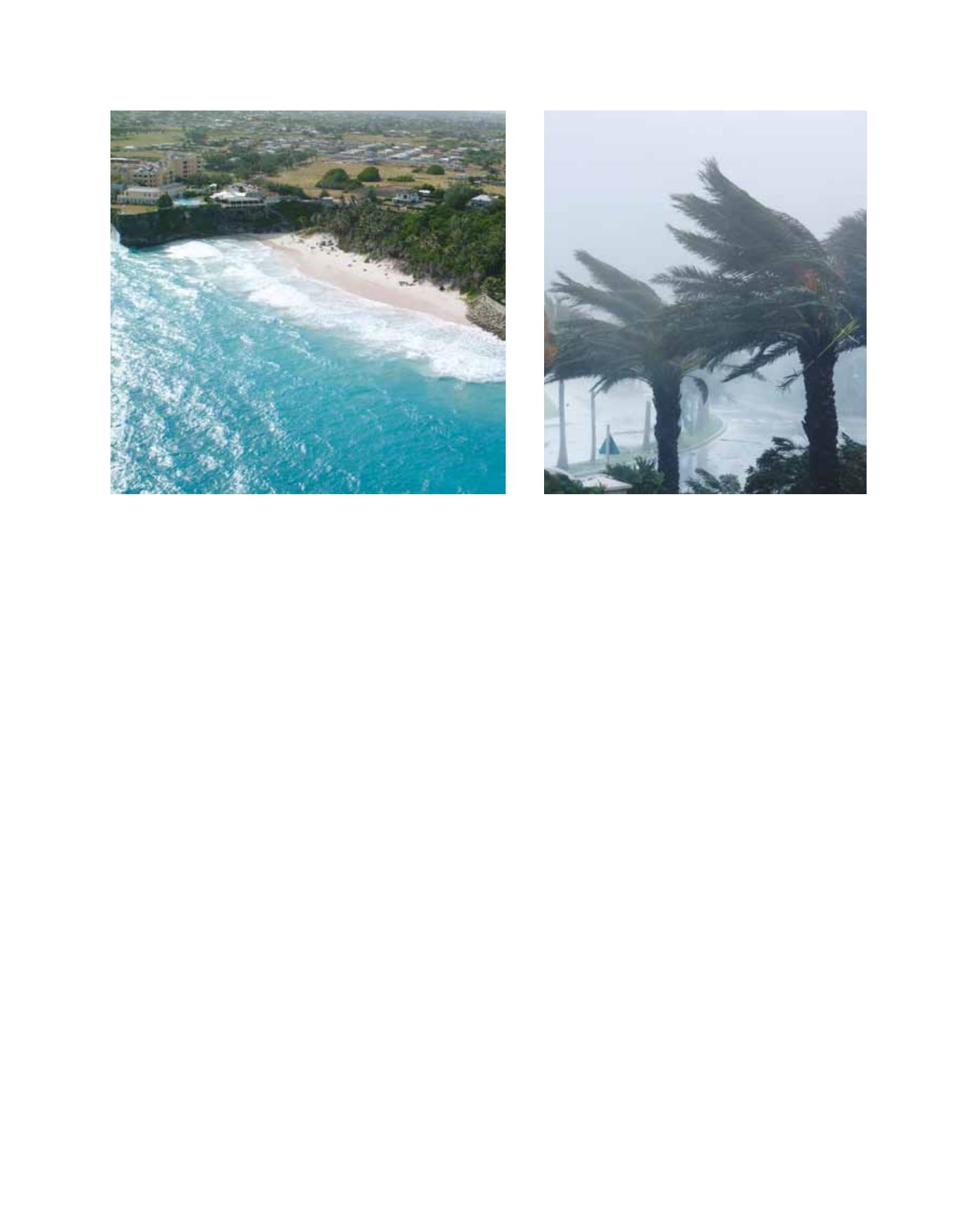
Rising sea levels affect coastal areas
Coastal zones are affected by increases in extreme weather events
Image: Willie Heinz
Image: Willie Heinz