



 71 / 208

[
] 71
E
nvironment
:
air
,
water
,
oceans
,
climate
change
site polluting spawning areas for shrimps. Nowadays they can gain
cash income by introducing ecotourism and are free from the need
to sell their land, which translates into ensuring the sustainable
coexistence of nature and human beings.
Sustainable forest management
Forests are not only valuable natural resources; they also have
the function of retaining water resources and conserving soil
while absorbing CO
2
to mitigate climate change. Although it is
critical to replace forests by planting trees, it is more important
to ensure, via adequate maintenance and management, that exist-
ing forests are not depleted above current levels. JICA conducts
surveys on the state of forests, develops reforestation technology
to regenerate wooded areas, and works to raise awareness of the
importance of forests and their maintenance and management. In
addition, JICA has extended cooperation on the conservation of
forests, with a view to contributing to the establishment of the
Reducing Emissions from Deforestation and Forest Degradation
in Developing countries (REDD+) programme, which has been
advanced by the international community in recent years as part
of the measures against climate change.
Lao PDR, Indonesia and Brazil: Promoting REDD+ as an Approach to
Mitigating Climate Change
REDD+ is a concept to reduce greenhouse gases emissions or
to maintain or enhance forest carbon stocks by curbing defor-
estation/forest degradation or through forest conservation in
developing countries. JICA is conducting REDD+ projects around
the world. From Policy to Action JICA provides cooperation to
promote REDD+ from three aspects: 1) development of policies,
institutions, and capacities; 2) improvement of technologies for
measuring forest area and forest carbon emissions; and
3) promotion of demonstration activities to reduce
deforestation and forest degradation. Through each
of these approaches, JICA encourages stronger part-
nership among stakeholders in developing countries.
In Lao PDR, which is aiming to restore forest cover-
age ratios that have been declining rapidly in recent
years, JICA has dispatched experts in the forest policy
field who are providing guidance and training to forest
administrators in order to develop their capabilities
in policy formulation and institutional planning in
the forest sector, including REDD+. In Indonesia,
which is faced with the problem of forest fires caused
by drying peatlands and slash-and-burn cultivation,
JICA is involved in a science and technology research
partnership for sustainable development (SATREPS)
in collaboration with related institutions in Indonesia
and Hokkaido University. This cooperation involves
detecting forest fires using satellite images, developing
a prediction model, and establishing a system for eval-
uating forest carbon stock for a REDD+ framework.
Moreover, in Brazil, JICA is providing cooperation
to reinforce controls on illegal logging, which occurs
frequently in the vast Amazon rain forests. JICA is
working to build a monitoring system and strengthen
the capabilities of counterpart personnel so that the
Brazilian Federal Police and the Brazilian Institute
of Environment and Renewable Natural Resources
(IBAMA) can monitor illegal logging through satellite
images. JICA will provide comprehensive cooperation
in this field to Cambodia and Viet Nam as well.
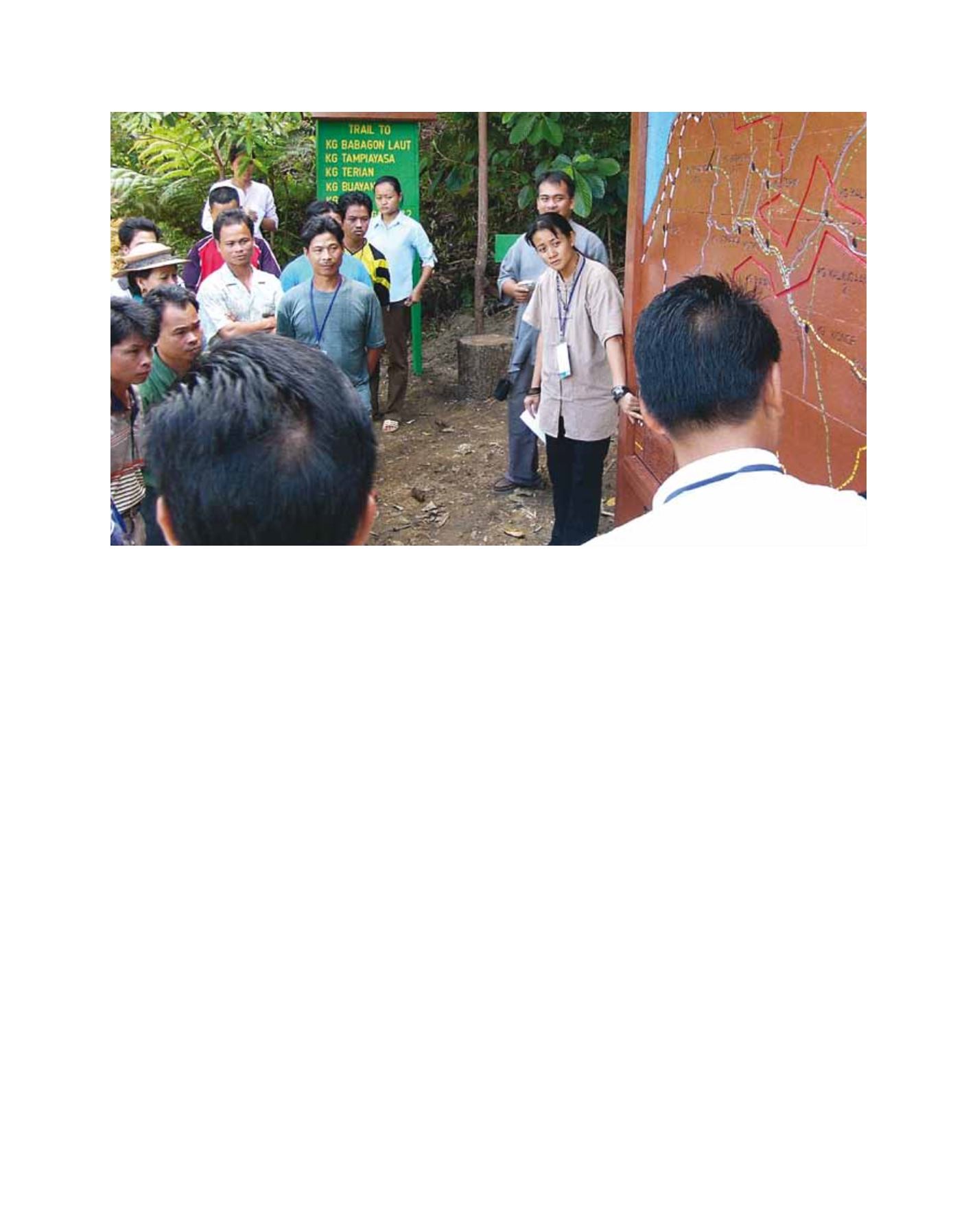
Workshop on state park management with local residents, Malaysia
Image: JICA