



 76 / 208

[
] 76
E
nvironment
:
air
,
water
,
oceans
,
climate
change
Management Plan is an instrument required by law to authorize the
appropriate actions.
During the 1970s, the residents of rural areas had become the
enemies of trees and natural forests, as farmers and farm owners did
not allow the growth of pine (
Pinus occidentalis
) on their properties.
However, the option of managing the natural forests in a sustainable
way has changed this attitude. Today, forest landowners preserve
this resource, as it represents a source of income.
In June 1997, the first forest management plan was started in
the municipality of Restauracion, Dajabón Province, on the border
with Haiti, in the project of the conservation and management of
the Sabana Clara forest. In subsequent years, the first forest inven-
tories and private forest management plans were produced and
harvests began in 2001. From 2003, a boom in forestry activities
was seen in the municipality. At the moment, the area under forest
management in the municipality is 5,797 hectares, distributed
across 193 management plans, making this activity an important
source of income for the 6,938 urban residents and the 8,333 rural
residents of this town.
According to a 2010 study of use and land cover in the Artibonite
River Basin (DIARENA 2011), which analysed satellite images from
2003 and 2010, the area of forest cover in this county experienced
an increase of 12.76 per cent for the period analysed.
Forest management in the area has significantly helped to reverse
the exodus of the rural population to urban centres, as some owners
who had left have returned to carry out forestry activities on their
properties. It should be mentioned that the forestry sector in the
municipality of Restauración generates 1,140 direct
jobs, 900 at the farm (harvesting, reforestation and
other activities) and around 230 in the small industries
that process local timber production.
Also in the study, it was considered important to
know the identity of those who manage their forests,
how and why they take decisions and what ecologi-
cal, social and economic aspects of sustainable forest
management affect individual cases. For this reason,
seven case studies were conducted at forest plantations
located in the municipality.
The surface area of the cases under study varied
between 44 and 315 hectares. All farms under evalua-
tion had managers with at least six years’ experience in
management of their forests. By analysing each case, it
was revealed that farmers and producers had substan-
tially improved their income, earning on average
RD$5,596.62 (US$144.00)/ha/year net income, depend-
ing on the quality of the forest. They were optimistic
about the forest’s potential and aware of its importance
in the production of goods and services for present and
future generations.
Sustainable forest management in forests and the equi-
table distribution of the benefits have become important
tools to fight poverty and create opportunities for the
local communities in the Dominican Republic in their
efforts to achieve sustainable development.
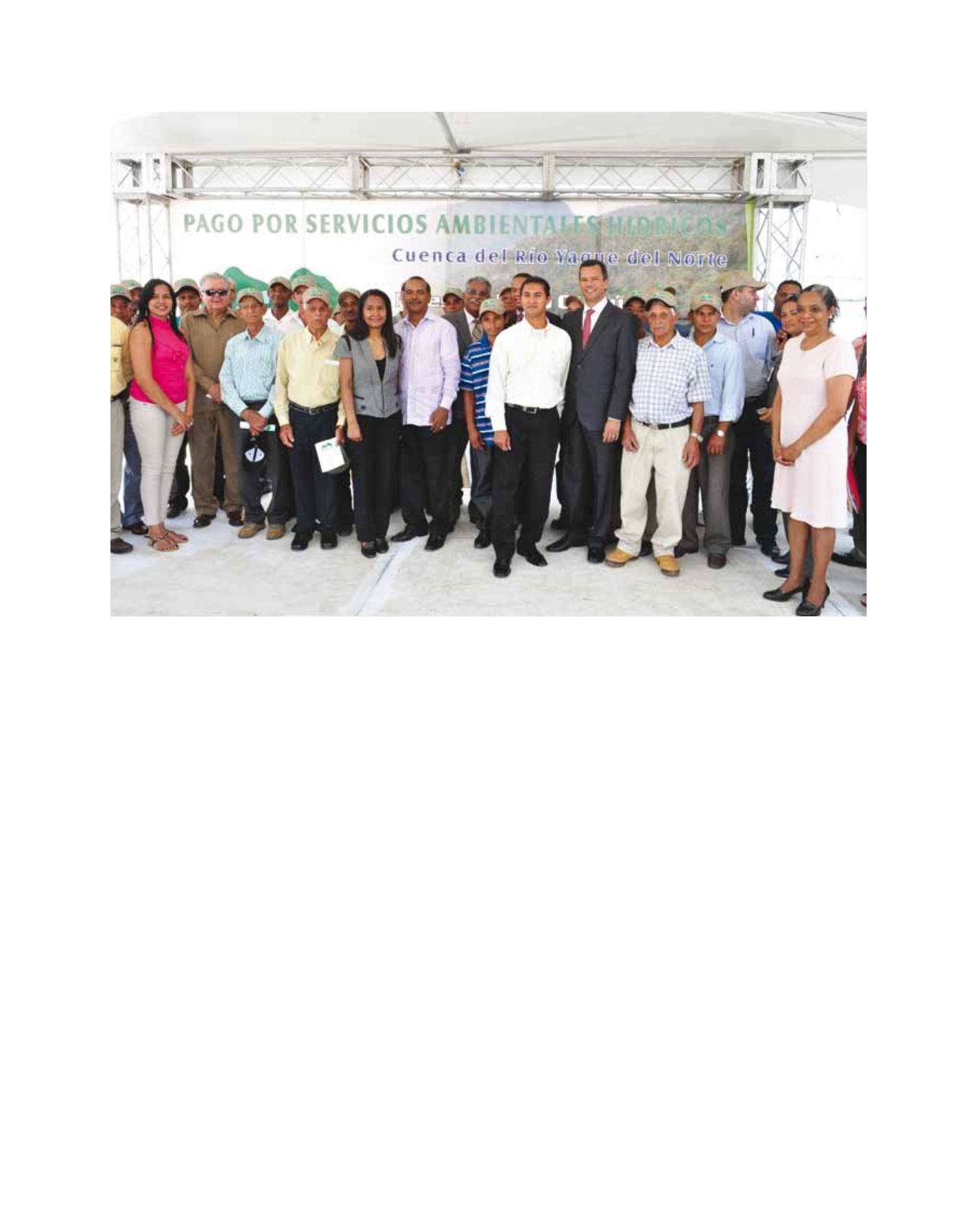
The Yaque del Norte PES project has generated technical knowledge and skills adapted to local conditions
Image: Min for Env & Nat Resources, Dominican Republic