



 79 / 208

[
] 79
E
nvironment
:
air
,
water
,
oceans
,
climate
change
to collect sewage and IWW into two separate pits, and to install onsite
IWW treatment plants.
During 2009-2010, KEPA inspected 125 factories in the W. Shuaiba
industrial area, a suspected source of pollution to the nearby Umm
Al-Hayman residential area. It imposed heavy penalties on 80 facto-
ries violating KEPA environmental laws, regulations and standards.
In order to reach settlement with KEPA, these factories must ban the
discharge of IWW in the national sewage network and rain outfalls,
install onsite IWW treatment units or closed loop systems, and reuse
treated IWW to irrigate aesthetic plants within the factory premises.
KEPA also set a detailed three-phase plan to improve environmen-
tal conditions in the southern region of Kuwait, including:
• Relocating factories with heavy and medium impacts on
pollution to new remote industrial areas
• Installing central IWW treatment plants in these new areas
• Establishing a National Fund for Environmental Compliance
• Evaluating existing environmental conditions and preparing
online monitoring programmes for all factories.
In 2009-2010 the Ministry of Public Works (MPW) upgraded the
Umm Al-Hayman wastewater tertiary treatment plant to treat the
IWW generated from factories.
Remediation of areas damaged by oil burning
Over 600 oil wells in Kuwait’s northern and southern oil fields were
set on fire by retreating Iraqi troops in 1991, and wells that were
not set alight gushed oil over a seven-month period. Around 60
million barrels (mmbbls)
7
of oil were spilled over topsoils in the oil
fields, forming 200-300 oil lakes.
8
Severe weathering and evapora-
tion caused an increase in the viscosity and density of the crude
oil in these lakes, which led to compositional stratification
9
and an
increase in persistent carcinogenic high-ring polyaromatic hydro-
carbon (PAH) content.
10
The latest estimates by the Public Authority for
Assessment of Compensation for Damages (PAAC) show
that the oil lakes cover about 114 square kilometres, and
a total 100 million cubic metres of soils are contaminated
by a heavy oil sludge layer known as tarcrete, under which
a thick layer of crude oil exists.
11
The soils also became
saline due to their flooding with around 1.5 billion gallons
of seawater used in extinguishing oil fires, and suffered
from severe compaction by military machinery.
12
Oil lakes had lethal toxic effects on many species of flora
and fauna. The vegetation cover was completely destroyed
in areas inundated by the lakes, while 25-100 per cent of
plants and animals were killed in areas covered by oil mist.
13
In addition to the oil lakes, over 4 million tons (about
25 mmbbls) of oil fallout from the smoke plumes of
oil-well blowouts and fires were deposited over approxi-
mately 1,000 square kilometres of soil, mainly along
the coastline between Kuwait and Bahrain. The smoke
plumes and soot fallout coated vegetation, reduced the
yield of Kuwait’s main crops, increased acid deposition
and contamination with chemical pollutants such as
PAHs and trace metals, and reduced solar radiation.
14
Groundwater pollution was recorded recently in the
northern deeper water level aquifer (20-30 metres) in
areas contaminated with oil lakes.
15
Cost-effective technologies for treating oil-contaminated soil
In July 1994 and November 2004 the Kuwait Institute
for Scientific Research (KISR), Japan Petroleum Energy
Center and Kuwait Oil Company (KOC) carried out pilot
studies on two sites of oil-contaminated soils and wet
tarcrete sludge contamination in the Burgan oil field. The
sites were successfully treated with four different biore-
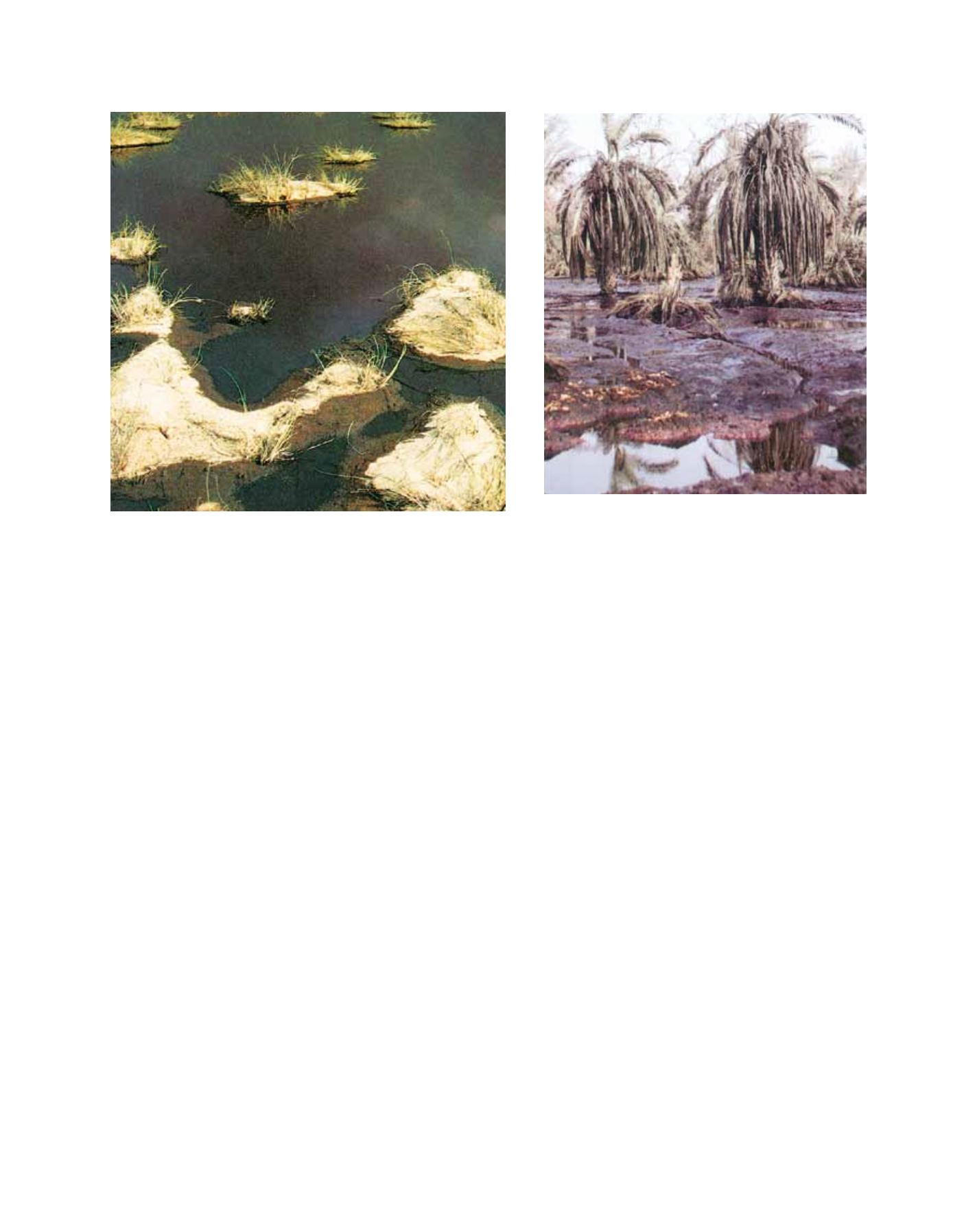
Dead vegetation floating on the surface of oil lakes
Image: Al-Yousifi, A.G. (1998)
Dead palm trees and black soils heavily impacted by oil puddles in a
desert oasis
Image: Al-Yousifi, A.G. (1998)