



 81 / 208

[
] 81
E
nvironment
:
air
,
water
,
oceans
,
climate
change
• A feasibility study by Toyota Tsusho Corporation
to build a Solar Combined Power Station with a
total capacity of 280 megawatts – including 60
megawatts from solar source. The project was
tendered in March 2012
• A pilot study by KISR researchers, in collaboration
with consultant Lahmeyer International, to select the
best solar systems for Kuwait conditions. Based on
the study recommendations, MEW will build the first
power generation plant, with Phase 1 producing 10
megawatts of wind, 10 megawatts of photovoltaic (PV)
and 50 megawatts of concentrated solar power.
28
Green Buildings
In November 2010, KEPA formed the National
Committee of Green Buildings, which gathers together
all governmental ministries and organizations, academic
and research institutes, and private companies and
consultancy/engineering offices dealing with the Green
Buildings (GBs) concept.
The committee aims to lay the foundation for an appli-
cable scope concept for GBs in Kuwait, to establish a
local movement for GBs that are friendly to the environ-
ment, save energy and water and reduce GHG emissions
reducing, and to set a local code compatible with interna-
tional standards and backed by incentives to encourage
investment from individuals and the private sector.
29
As a member of the National Committee, the Kuwait
Municipality formed a committee in July 2011 to review
current construction codes and introduce a new code
for GBs. The National Committee has also formed
working groups to set and implement action plans and
programmes with specific time schedules and establish
GB culture and technology in Kuwait.
30
Goals for sustainability
In addition to the national goals and achievements
described above, a wide range of goals is planned to be
accomplished over the next five to ten years, including:
• Rehabilitating heavily impacted marine areas and
ecosystems
• Developing integrated management programmes/
systems for air quality, coastlines and chemicals
• Developing national schemes/programmes to reduce
GHG emissions
• Rehabilitating 17 closed landfills using modern
methods such as waste-energy technologies
• Ensuring environmental compliance of oil
companies through carefully planned programmes
• Enhancing proven oil and natural gas reserves
• Wide use of renewable energy as the main source of
power generation
• Establishing GB technology.
These goals provide compelling evidence of the
commitment of the State of Kuwait to the sustainable
development of its society and the protection of its envi-
ronment. Indeed, sustainable development has become
a way of life in Kuwait.
• The organic contents of soil in the areas irrigated with
RO-treated wastewater are higher than those from areas irrigated
with groundwater, indicating derivation of additional organic
matter from the treated wastewater.
The authors strongly recommend the use of RO-treated wastewater
in agricultural activities due to its ability to reduce and prevent
the deterioration of soil and groundwater. They also recommend
that the results of their study are used as baseline information for
a comprehensive scheme to conserve water resources, recharge
groundwater aquifers and sustain agricultural activities in Kuwait.
Renewable energy for power generation
The Ministry of Electricity and Water (MEW) provides Kuwait with
electrical power and fresh (distilled) water supplies through five
power and desalination plants (PDPs) built along the Kuwaiti coast-
line. The plants are fuelled mainly by gas oil which is heavy and
high in sulphur content, thus providing a source of air pollutant
emissions, particularly sulphur dioxide.
25
Kuwait has one of the world’s highest per capita power and freshwa-
ter consumption rates, with growing demand for both. The estimated
total additional power load and amount of water required for State
projects up to 2020 are 10,000MG and 250 million imperial gallons per
day (MIGD), respectively.
26
Consequently, the Kuwaiti Government
plans to double the installed capacity to 26,000 MG of electricity and
1,000 MIGD of water by upgrading and building new PDPs.
MEW is also keen to develop alternative clean energy applications
to address the energy shortage, reduce the emission of harmful gases
and conserve energy. It has implemented and/or funded projects
27
including:
• Applying rooftop polyvinyls (PVs) to MEW and MPW buildings
(project tendered March 2011), and to old government and
school buildings (project tendered in March 2012)
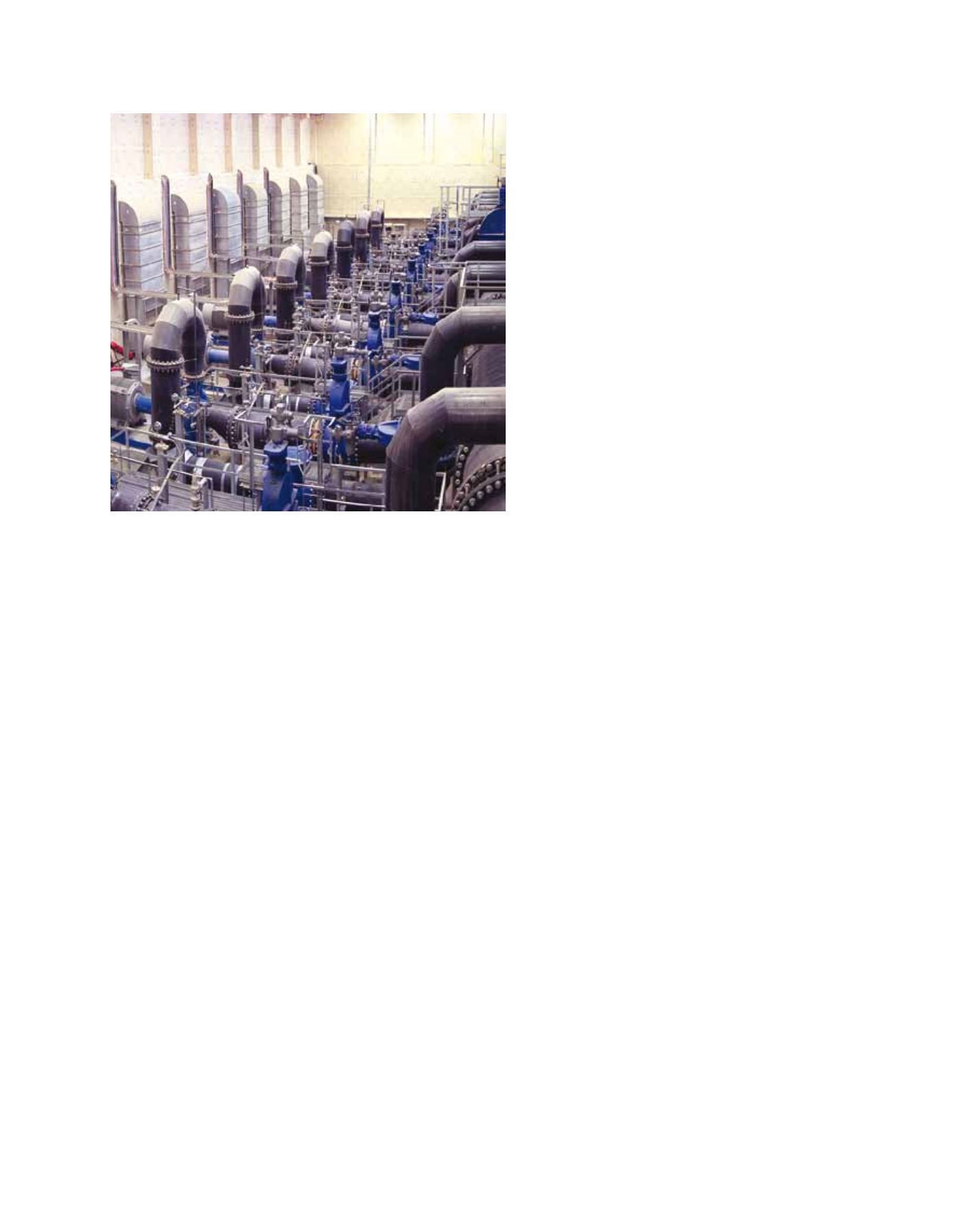
Preliminary treatment and pumping station
Image: new edition of Utilities Developing Company publication (UDC, 2009)