



 75 / 208

[
] 75
E
nvironment
:
air
,
water
,
oceans
,
climate
change
natural resource degradation in the five provinces bordering Haiti
(Montecristi, Dajabón, Elías Piña, Independencia and Pedernales)
and along the Haitian counterpart. This sub-programme includes
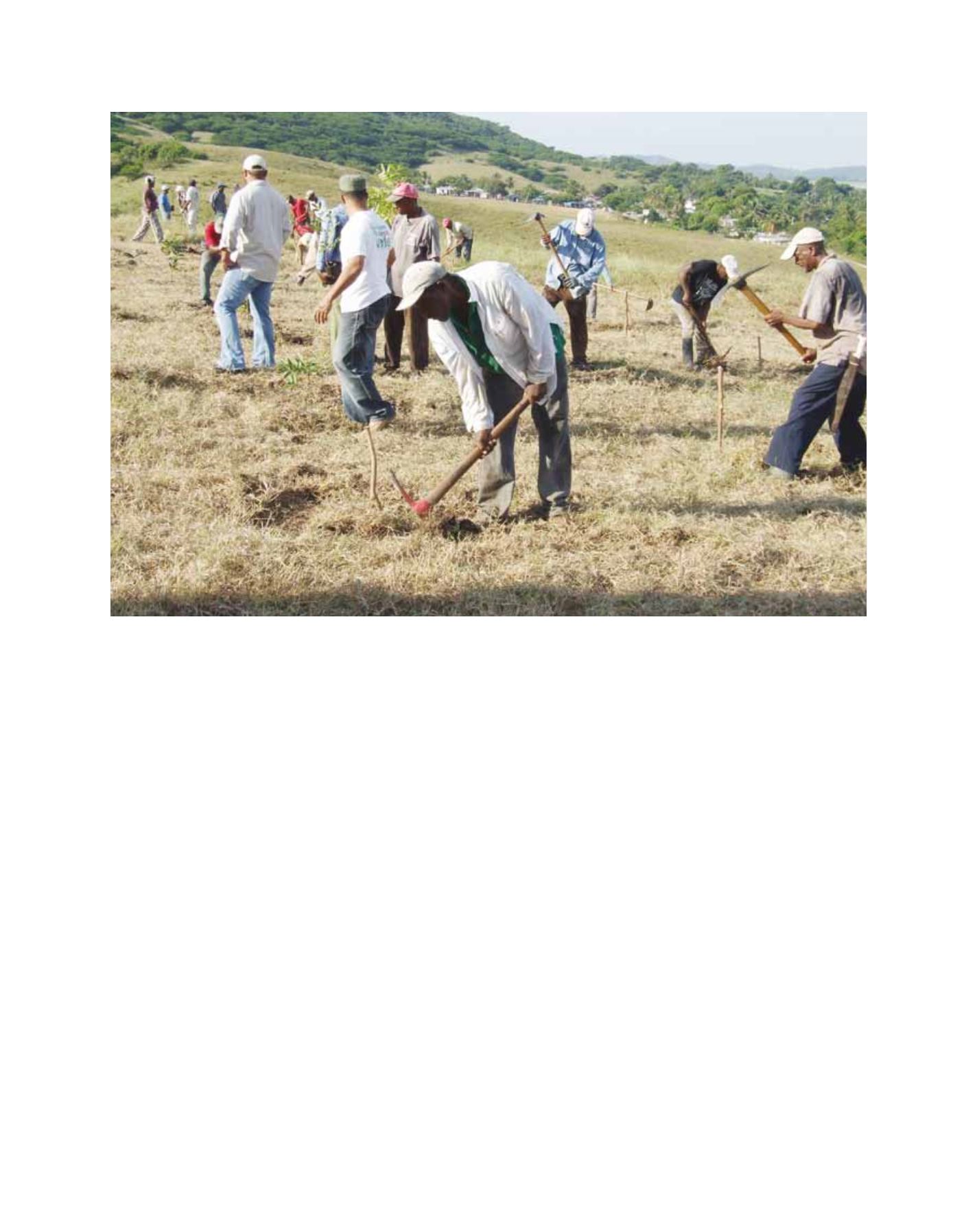
the planting of wood and fruit trees by the brigades working on
both sides of the border, creating green jobs for the future, for both
Dominicans and Haitians. During the period 2008-2011, it resulted
in the reforestation of 28,400 hectares the planting of 34 million
trees and the creation of more than 5,000 green jobs, through
which these people have overcome extreme poverty.
Overall planting carried out under the National Plan Quisqueya
Verde from 1997 to 2011 involved the introduction of 108 million
seedlings over 88,000 hectares. All this has been implemented with
the National Budget funds.
As part of the strategy in the implementation of the Plan, we
have developed a Pilot Payments for Environmental Services (PES)
Project addressing Payment for Environmental Water Basin Services
in the largest water basin in the country, the 7,000 km
2
Yaque del
Norte River.
The objective of PES is to contribute to the conservation of the
Yaque del Norte River through environmental payment services,
in order to maintain the sustainability of the quality and quantity
of the water resources, while collaborating in the improvement of
the living conditions of forest owners who intend to apply conser-
vation practices.
To ensure these services, we have implemented three target areas:
rates of compensation or payments, change in land use (reforesta-
tion) and management to address the issue of pollution.
This initiative has allowed the application of an
agency management model involving the Ministry of
Environment and Natural Resources, the hydroelec-
tric power company and the Santiago Water and
Sewerage Corporation. The second major province in
the country provides financial resources on a volun-
tary basis, up to an annual amount of 10 million pesos
in total for the project.
So far the PES benefits 22 owners and holders of
forested land, under the terms of protection of forests
and agroforestry (coffee), located in the communities of
La Pelada, Los Dajaos and Arroyo El Dulce of the city
Jarabacoa, in the Province of La Vega in the northern
region of the country.
The experience of this project is evidence of the
unity of three public institutions driven by a common
cause in welfare of citizens. It has generated techni-
cal knowledge and skills adapted to the Dominican
reality, allowing for the establishment of a manage-
ment model that can be replicated in other areas of
the country and help establish a national PES for the
Dominican Republic.
Quisqueya Verde provides a framework for the
implementation of national forest policy, in order to
increase and preserve forest resources and promote
sustainable management of natural forests and forest
plantations according to a management plan. The Forest
The Dominican Republic has launched a reforestation project focused on planting two million trees across the country
Image: Min for Env & Nat Resources, Dominican Republic