


 72 / 208

[
] 72
E
nvironment
:
air
,
water
,
oceans
,
climate
change
Environmental management
Environmental issues such as water and air pollution and untreated
solid waste, once considered the problems of developed countries,
now extend to developing countries as well. This threatens the
health and life of humans and other life, and inhibits the sound
development of economic activities. It will be too late to address
environmental issues once our ecosystems and human health are
tangibly damaged. What is needed is an effort emphasizing preven-
tion, and to this end it is important to strengthen the capacity to
respond to environmental issues.
Waste management
JICA supports measures for improving waste management, such as
increasing the administrative service capabilities for the collection,
transportation, intermediate treatment and final disposal of waste, and
improving capacity for drafting management plans and making policy
proposals. Recently, JICA is increasing its support to create a soundmate-
rial-cycle society by promoting the 3Rs (Reduce, Reuse, Recycle) of waste.
Pacific Region: Project for promotion of regional initiative on solid waste
management to reduce the environmental impact in Island countries
The island nations of the Oceania region, where land areas are
small and traditional land ownership systems remain intact, share
the common issue of how to ensure the adequate treatment of solid
waste. In order to disseminate the outcomes of the efforts on solid
waste management that JICA has obtained through cooperation
with the region’s countries, JICA commenced region-wide Technical
Cooperation in February 2011 in collaboration with the Secretariat
of the Pacific Regional Environment Programme (SPREP), with
which JICA had previously established the Pacific Regional Solid
Waste Management Strategy 2010–2015.
Disaster prevention and management
The prevalence and damage of disasters has increased
sharply in the past 30 years or so, as storm and flood
damage, earthquakes, volcanic activities and other
disasters occur across the globe almost daily. People
in developing countries are particularly vulnerable due
to urbanization, which accelerates the concentration of
people in cities and delays the provision of social infra-
structure. Natural disasters do more than claim life;
they directly impact people’s livelihood and aggravate
the poverty cycle. Whereas the previous mainstreams
of disaster assistance were centered more on structural
measures such as construction of dams and levees, there
is also a need for compound measures that emphasize
non-structural assistance such as installation.
Indonesia: Project for safe school reconstruction in devas-
tated areas of earthquake in offshore of Padang in West
Sumatra region
On 30 September and 1 October, 2010, a year after a major
earthquake struck West Sumatra Province, a memorial
ceremony marking the one-year anniversary of the earth-
quake was held with the attendance of the governor of the
province as well as representatives from the governments
of Indonesia and Japan. At the ceremony, the disaster
prevention efforts and the reconstruction plans made
with the cooperation of JICA were introduced, and the
concerned parties reconfirmed the importance of disas-
ter prevention. In addition, the Declaration Marking the
One-Year Anniversary of the Earthquake – for the Sharing
of Lessons Learned from Reconstruction was adopted.
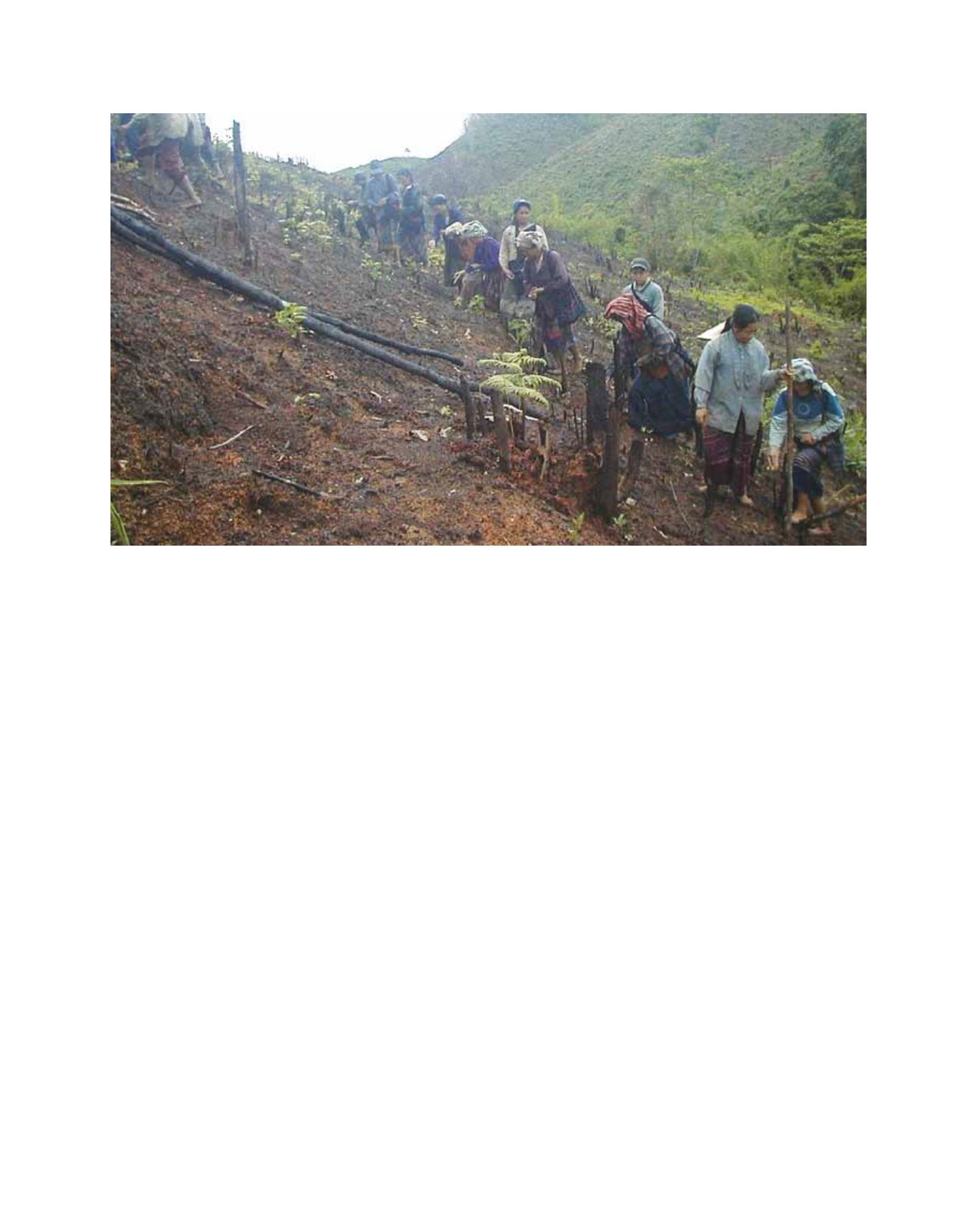
A tree planting activity being conducted by local residents, Lao PDR
Image: JICA