



 68 / 208

[
] 68
E
nvironment
:
air
,
water
,
oceans
,
climate
change
models while considering mitigation and adaptation scenarios
that allow for carbon cycle feedbacks, including global warming.
Building an international research network
We are implementing an international ‘Urban and Regional Carbon
Management (URCM)’ project relating to the development and appli-
cation of spatially explicit land-use change scenarios with particular
reference to Asian megacities. Specifically, we are collecting geographi-
cally delineated data on socioeconomic activity related to energy
demand, population, economy and public infrastructure, carrying out
bottom-up analyses (totalling estimates for different localities) of urban
GHG emissions, developing methods for estimating urban growth and
population density through using remote sensing images, and analysing
the relationship between urban morphology (compactness) and CO
2
emissions. In relation to this, we are building an international network of
researchers in our capacity as the international secretariat for the Global
Carbon Project, an Earth System Science Partnership project being
carried out under the auspices of the International Council for Science.
Future challenges
We are conducting research on land-use change scenarios that
include a geographical distribution perspective and are making our
findings available to researchers involved in global and regional
climate change prediction and impact assessment. From these
initiatives, to the building of a global sustainable society – the
main theme of The United Nations Conference on Sustainable
Development (Rio+20) – we feel it is important to create a research
platform offering information that considers climate
change mitigation and adaptation measures, analyses
the compound impacts of climate change arising from
interactions between land use, water resources and
ecosystems, and provides policymakers with informa-
tion on the implications of different land-use scenarios
based on various sustainability indicators.
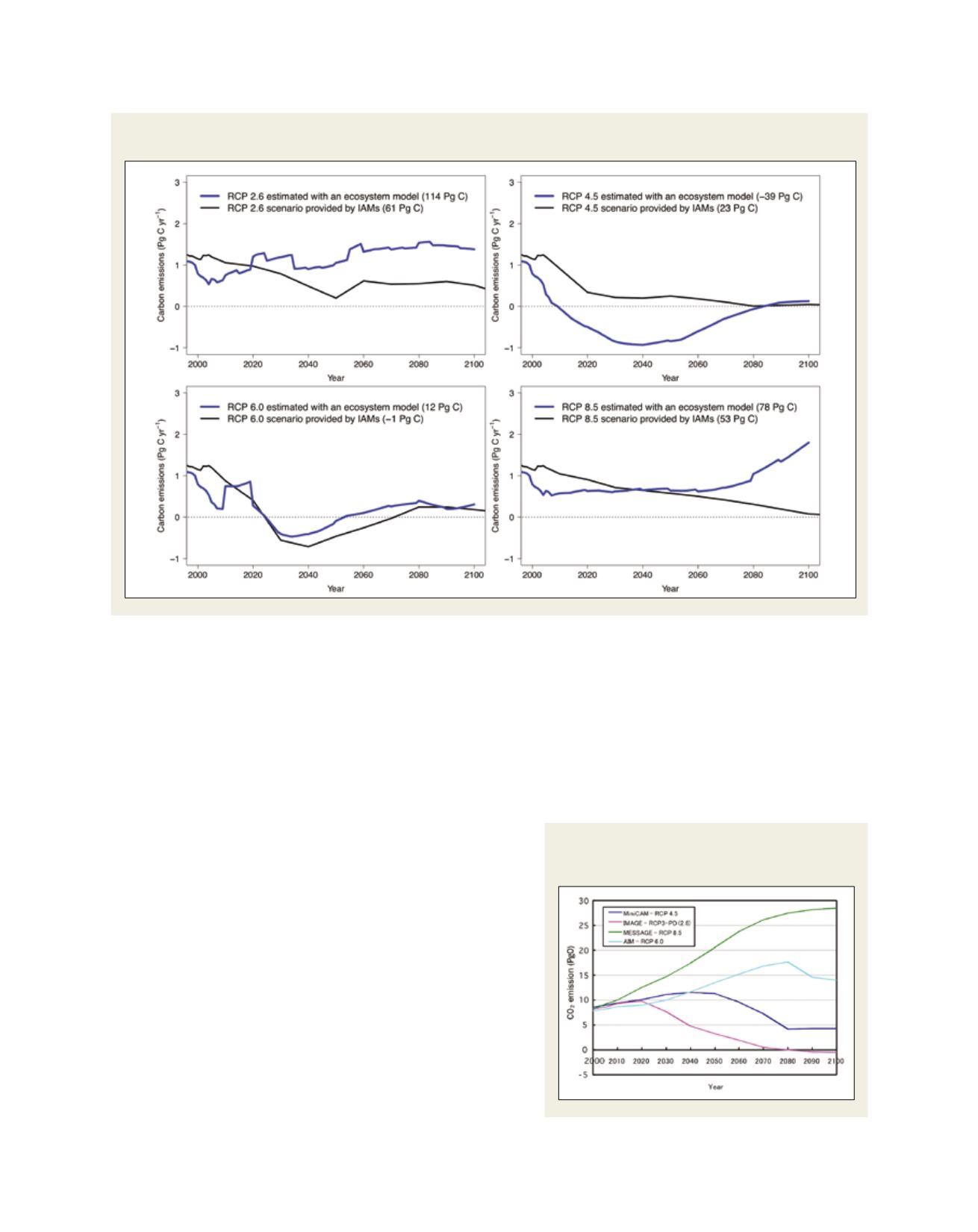
Net carbon emissions from land-use change for each RCP scenario. Values in parentheses of the legends indicate the cumulative
carbon emissions for 2006-2100
Source: NIES
Carbon emission projections of the IPCC AR5 RCP
scenarios. Three scenarios stabilize atmospheric CO
2
by the end of 21st century at different levels
Source: NIES