



 63 / 208

[
] 63
P
eople
:
social
inclusion
,
green
jobs
,
education
this programme is the transfer of ready-to-use knowl-
edge and skills from public universities of Malaysia
to partner industries and communities, for improving
industry performance and community well-being and
providing feedback to the university through graduate
interns, to continually improve the knowledge transfer
process. USM plays a key role in the overall adminis-
tration and implementation of this programme.
Projects and plans
USM has several new and ongoing initiatives to help
achieve its sustainability goals in the short to medium
term. Although there have been no major setbacks in
the implementation of sustainability so far, many issues
require continuous attention and monitoring. The
following are worth noting:
• Having secured autonomous governance, USM
adopted a new constitution in July 2011 to create
a better environment for promoting sustainability.
This constitution created new structures for USM’s
Board of Governors, Senate, Ombudsman and
Student Consultative Assembly
• Major research projects will be initiated by CGSS
to achieve USM’s sustainability goals. In addition,
a Masters Programme in Development Practice
will be offered jointly by CGSS and the Graduate
School of Business as part of an international
network coordinated by the Earth Institute at
Columbia University
• USM will work with the Malaysian Technology
Development Corporation and the Northern
Corridor Implementation Agency to promote halal
vaccines and diagnostic kits, providing matching
grants where appropriate
• A new Science and Engineering Research Centre is
being launched in the engineering campus for multi-
disciplinary research
• Green procurement will be mandated and promoted
in all possible areas
• Strategic amalgamation of internal entities for cost-
effectiveness and efficiency will be pursued where
appropriate
• The campus Sustainability Office at CGSS will be
strengthened so that all USM centres and schools
can be audited for sustainability outcomes.
Acknowledgement
Omar Osman is Vice-Chancellor, USM, Norizan
Md Nor is Director, CGSS and Kanayathu Koshy is
Professor of Sustainability, CGSS. The authors are very
grateful to USM for becoming a partner of the United
Nations Department of Economic and Social Affairs
Future Perfect Project, Christopher Smith for editing the
initial draft, Febbie Farsidilla for graphics assistance,
Professor Dato’ See Ching Mey, Mr Fong Sew Khuan
and Professor Haslan Abu Hassan for providing specific
information for the preparation of this paper and all
others who have assisted, directly or indirectly, but who
remain anonymous.
scientists launched a mobile version of ENDEAVOR in 2011 to give
medical professionals remote access to CT, MRI and X-ray reports,
allowing them to collaborate on diagnosis and treatment.
8
Networking and policy interaction projects include the Asia-Pacific
University Community Network (APUCEN), launched in 2011 by
USM, includes 44 higher educational institutions in 10 countries. It
aims to be a formal platform for the University Community Engagement
Conference first held in Penang in 2009 and next scheduled in Thailand
for 2012. The Global Higher Education Network is another sustainabil-
ity education network that USM launched in 2011. Organized over the
past six years by the university and the Ministry of Higher Education
Malaysia, it is the cornerstone of the Global Higher Education Forum.
The Centre for Global Sustainability Studies (CGSS) at USM
spearheaded the development of the USM Sustainability Roadmap
and Action Plan with a full set of indicators for sustainability assess-
ment and for monitoring and evaluating sustainability projects.
CGSS is also responsible for the development of the Framework
and Roadmap for Sustainability Education for the Association of
South East Asian Nations (ASEAN 2012).
Finally under this heading comes the Knowledge Transfer
Programme (KTP): Launched in 2010 by the Ministry of Higher
Education under its Critical Agenda Programme, KTP supported
a total of 44 projects worth about US$6 million in 2011 under
its two focal areas, industry and community. Overall funding for
the four-year programme is US$40 million with a 30 per cent
co-financing requirement for industry projects. The main feature of
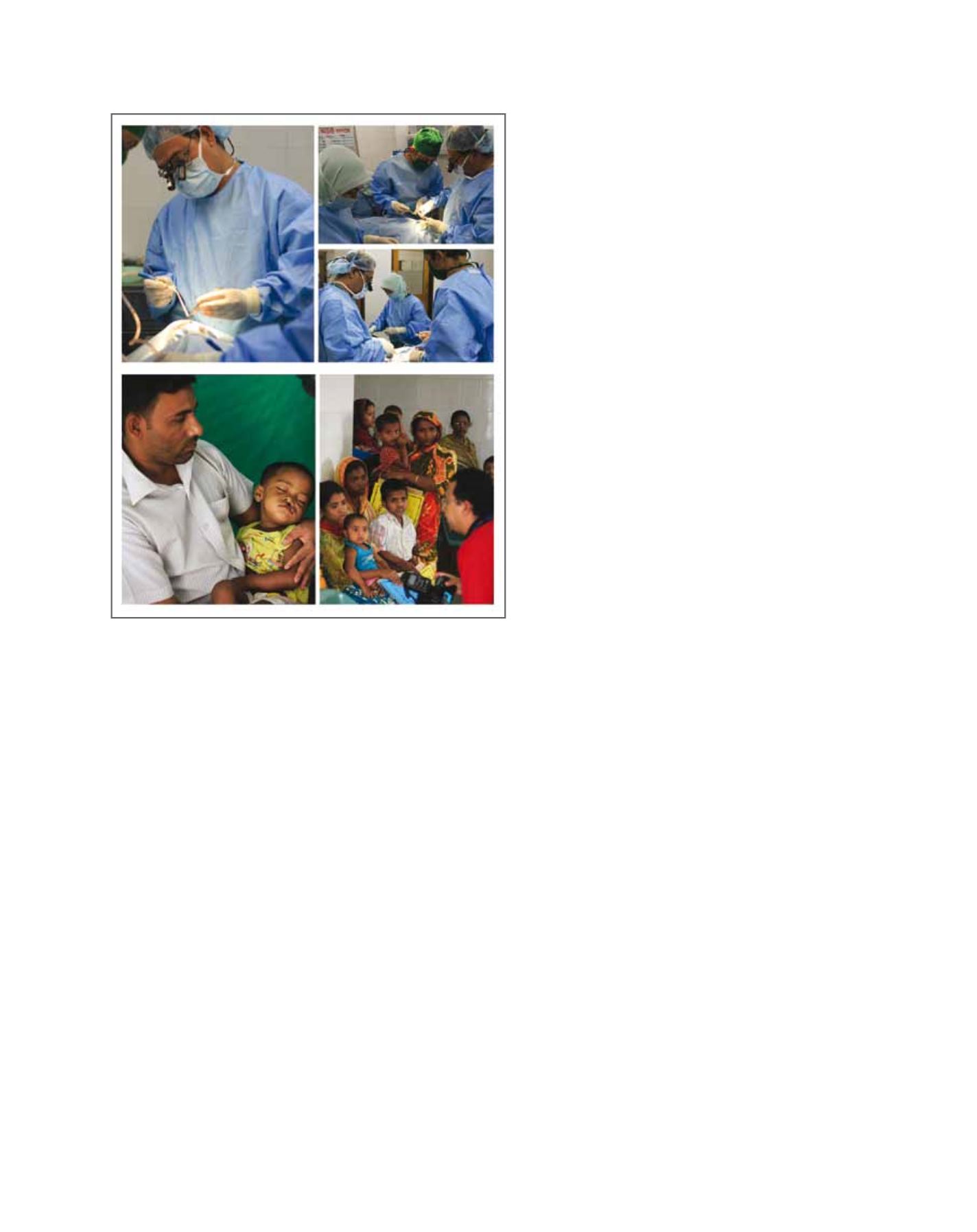
Cleft lip and palate project (CLIPP). Among others, this initiative has included six
missions to Dhaka Community Hospital from October 2008 to October 2011
Image: Universiti Sains Malaysia