



 106 / 168

[
] 106
The Philippines
Prior to 2010, Philippines legislation treated disasters as inevi-
table and was primarily focused on emergency relief, which was
heavily centralized. Therefore very little action was taken by the
Government to reduce the risk of disasters or prepare communi-
ties for an impending hazard. As a result, many people died or
lost valuable assets in the immediate aftermath of a disaster.
In the event of a disaster, the Philippines President would declare
a State of Calamity. As government funds for relief efforts could only
be mobilized 24 hours after this declaration, vulnerable people had
to wait for a disaster to occur before they could get any help.
In 2007, Christian Aid partners engaged government agencies
in formulating the Strategic National Action Plan (SNAP) as the
country’s commitment to DRR; this plan was based on the HFA.
SNAP was a roadmap detailing where the Philippines wanted to
be in ten years’ time. It had a clear direction and set indicators
to measure progress. It was presented to congress as a proposal
for DRR policy.
The DRR Network of the Philippines (DRRNet) – a network
of over 300 actors – was convened in 2008 to advocate for
more national and local commitment to DRR and for law
reforms. Christian Aid partners were instrumental in
convening DRRNet, which includes members from
international and local CSOs, communities, practi-
tioners, academics and government agencies. The
Ateneo School of Government provided key support
by acting as the secretariat and providing a legal
adviser to the network.
The network reached a shared position on reform
and identified key non-negotiables such as:
• the mandatory participation of CSOs in national
and local DRR policymaking
• civil society being recognized as key actors in
supporting the implementation of the law
• a focus on people and community-centred DRR
• decentralization of DRR so that local government,
communities and CSOs could have more respon-
sibility and resources for DRR in their areas.
DRRNet targeted key DRR champions in the Senate to
advocate for these non-negotiables to be incorporated
into the drafts of the new law.
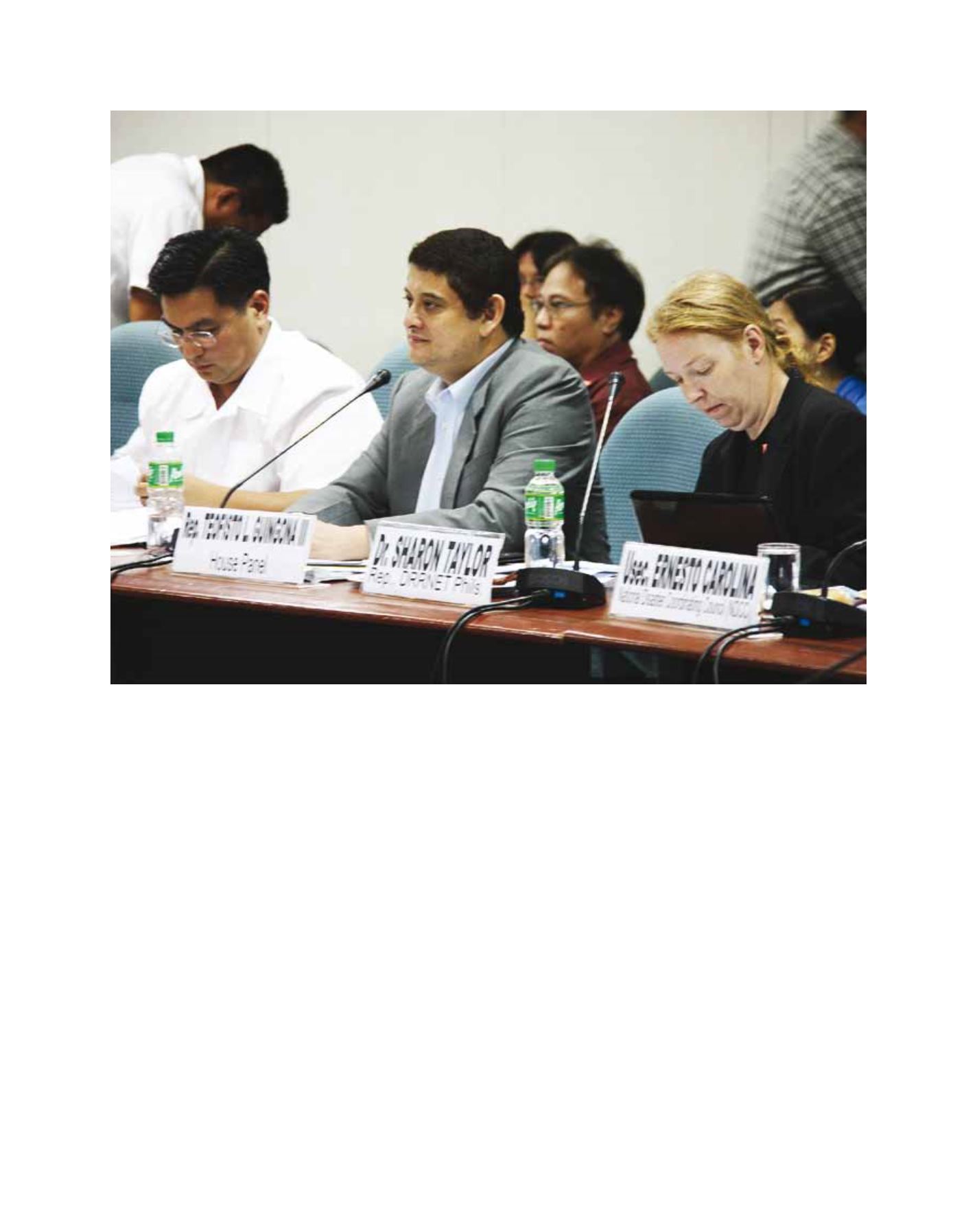
Representative Rozzano Rufino Biazon (left) and Teofisto Guingona III (centre), DRR champions and principal authors of the DRRM Bill in the House of
Representatives, together with DRRNetPhils’ Sharon Taylor (right) participate in the first Bicameral Conference Committee Meeting on the DRRM Bill
held in January 2010 at the Philippine Senate
Image: Allan Vera