


 111 / 168

[
] 111
against the impact of tropical storms, typhoons, sea surge and
tsunamis.
45
For example, it was estimated that in Kien Thuy
District, a four-metre-high storm surge resulting from Typhoon
Damrey (2005), was reduced to a 0.5m wave by extensive restored
mangrove forests.
46
Since the mid-nineties, mangrove afforesta-
tion programmes have been undertaken by the Government,
47
the VNRC and various INGOs. Mangroves have also improved
the ecological environment and ultimately reduced local levels
of poverty.
48
Disaster preparedness and response
The ‘Four on-the-spot’ motto
53
(which advocates providing leader-
ship, human resources, means and logistics on the spot) developed
from experiences in protecting and strengthening the dyke system
in the 1970s. To ensure the safety of the system and reduce the
risk of flooding, leaders needed to be able to organize, coordinate
and mobilize resources at the local level. The motto has since been
expanded into all aspects of DRM and since 2006 it has been a
legal requirement.
There are many examples of small-scale projects undertaken by
the nongovernmental sector in partnership with local government
and the private sector. Combining early warning, preparedness and
infrastructure development, one recent example
54
is the work of
Challenge to Change (CtC), a small British NGO.
55
Joint initiatives for ongoing action
The Government has made significant efforts to reduce disaster
risk through legislation, institutional frameworks and a combi-
nation of structural and non-structural measures.
Knowledge enhancement regarding resilience and
the need to improve livelihoods of vulnerable house-
holds in disaster prone areas is ongoing. The task
of helping communities to build resilience, reduce
vulnerability and adapt to climate change can best be
undertaken through innovative partnerships involving
Government, nongovernmental agencies, the private
sector and local communities themselves.
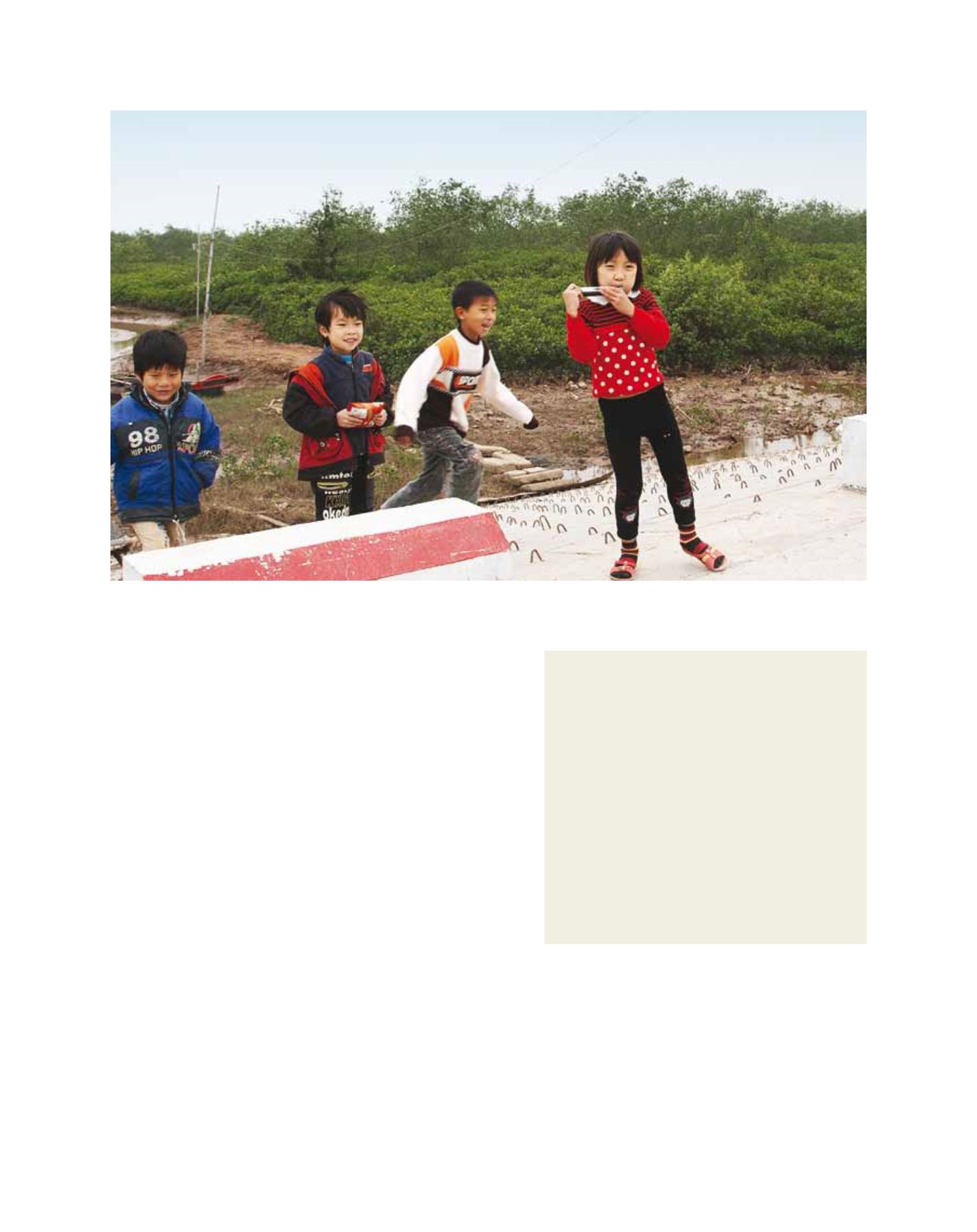
Children playing on the dyke in Dai Hop commune, Hai Phong province, close to a 7-kilometre stretch of dyke protected by 1,000 hectares of mangroves
(planted in 1998)
Image: Dang Van Tao, IFRC, 2011
Safe anchorage for small fishing boats
In 2009, CtC provided technical support for a broad-based
hazard, capacity and vulnerability assessment aimed at
improving safe anchorage during storms for small boats in Da
Nang. In close collaboration with fishing communities, local
government and technical experts, CtC supplied a boat winch in
the Tho Quang harbour of Son Tra District, Da Nang. The winch
directly benefits over 300 fishermen and has indirect benefits
for a further 1,500 people. The project demonstrates how
community initiatives for DRR can complement government
policies and programmes. In this case, the government early
warning system provides warnings 48 hours before a storm,
then 24 hours later and each hour thereafter. The winch
system goes into action at the first signal.
In 2010, officials from Binh Thuan province visited Son Tra
District to learn about the winch design and are now reported
to be constructing and installing similar winches. The
American Red Cross is also funding a cost-benefit analysis of
the winch system, to establish its suitability for scaling up.