


 109 / 168

[
] 109
Several networks for DRM and climate change
have evolved, including the Disaster Management
Working Group,
31
which was initiated in 1999 to
improve information exchange amongst DRM stake-
holders. In 2008, the Climate Change Working Group
was established to provide a forum for NGOs and
INGOs to participate in the climate change debate.
32
The UN Programme Coordination Group for Natural
Disasters and Emergencies (PCG NDE) is co-chaired
by the UNDP and MARD and comprises UN agencies
33
involved with DRM. The objectives of the group are
to ensure effective coordination of UN response and
assistance and to implement the One UN Plan
34
in
a more coordinated and effective manner. The PCG
NDE collects information on known and potential
hazards and vulnerabilities through regular disaster
situation reports.
Over the past few years there have been collabora-
tive efforts between UNDP, UN International Strategy
for Disaster Reduction, MARD and MoNRE to estab-
lish a National Platform for DRR and CCA, providing
a framework to enhance cooperation amongst these
stakeholders, including the Viet Nam Red Cross
(VNRC) and Viet Nam Women’s Union.
main tasks include monitoring the planning and implementation
of disaster prevention and response plans;
29
providing guidance
on disaster response and recovery; early warning dissemination
and damage reporting; and mobilization of human resources and
logistics for search and rescue, disaster response and recovery.
The CCFSC tends to convene primarily in response to natural
disasters. Its ability to focus on and coordinate response among a
wide range of ministries is limited due to its position within the
MARD. Ministries, provinces and districts are responsible for DRM
planning, creating both vertical and horizontal reporting structures
through line ministries and local committees for storm and flood
control at provincial, district and commune level. Also, for disas-
ter damage and needs reporting, two parallel systems operate: one
through the CCFSC structure and the other one through the General
Statistics Office, with structures at all administrative levels.
Disaster risk management is integrated within the 2006-2010
Socio-Economic Development Plan (SEDP) to reduce the number
of people falling back into poverty due to natural disasters. The new
SEDP (2011-2015) offers further scope for increased integration of
risk reduction into all levels of development planning. Joint efforts
by UNDP, the Ministry of Planning and Investment and several
NGOs, notably Oxfam GB at the provincial level, have succeeded
in integrating climate change adaptation (CCA) and disaster risk
reduction (DRR) into the drafts.
30
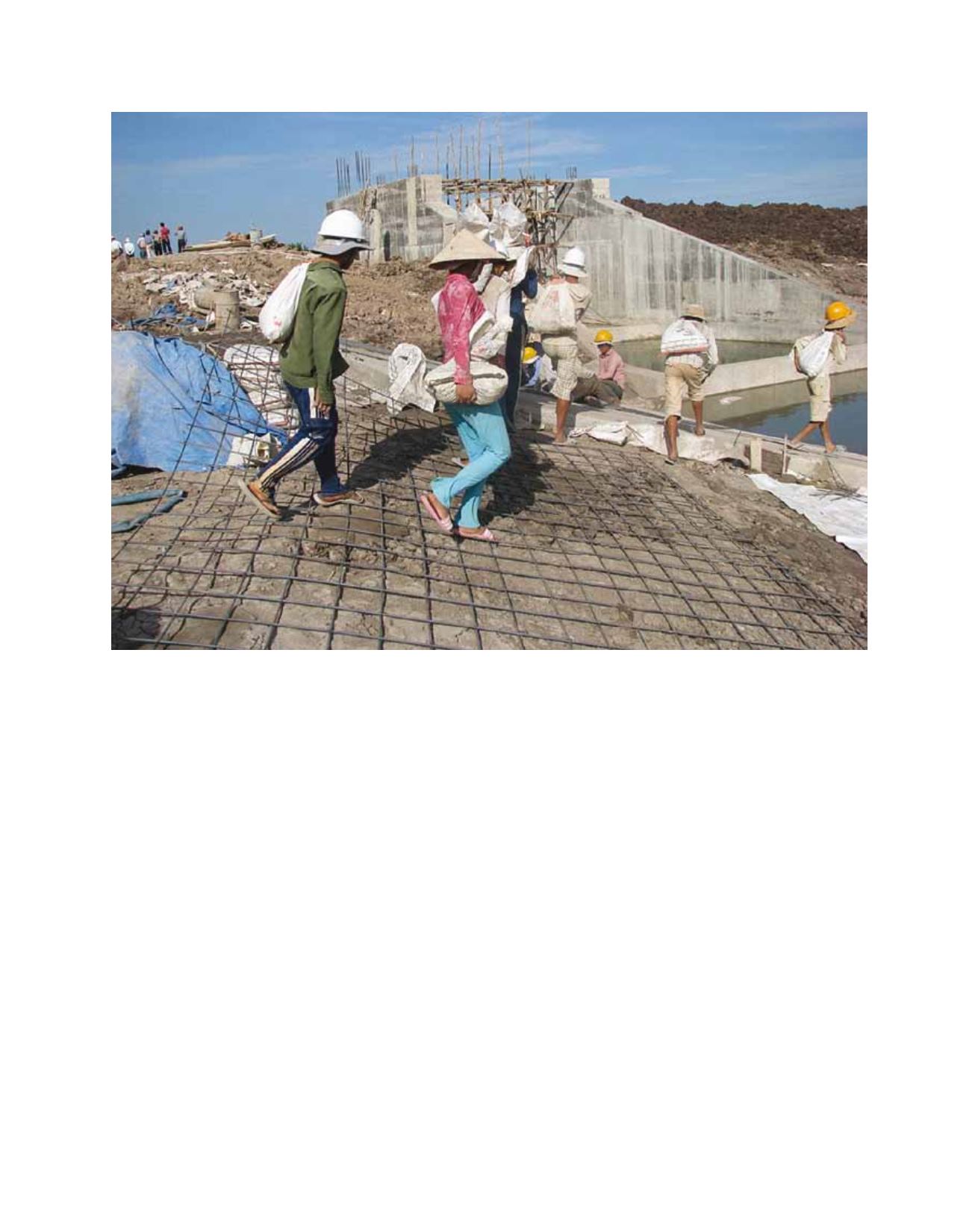
Dyke construction works in Ben Tre province, March 2011
Image: Ian Boyd Fox