


 113 / 168

[
] 113
National Cyclone Risk Mitigation Project (NCRMP)
– Phase 1 of this project is being launched this year
with World Bank assistance of about US$319 million,
covering two important coastal states. Eventually all the
13 cyclone-prone coastal states and union territories
of India will be included. The main objectives are to
strengthen structural and non-structural cyclone miti-
gation efforts. The project has three major components:
• Improvement of the early warning dissemination system
• Investment in mitigation measures, for example
construction of cyclone shelters, roads and bridges,
saline embankments, shelterbelt plantation and
mangrove regeneration
• Technical assistance for hazard risk management
and capacity building.
National Earthquake Risk Mitigation Project
(
NERMP
) –
NDMA has conceptualized NERMP as a comprehensive
project aimed at improving earthquake preparedness
in India, creating an enabling environment for the
preparation and implementation of earthquake risk
management plans and for working toward improved
seismic safety of the built environment in India. The
overall cost of the project is US$406.6 million. The
project will have a huge social impact by:
• Strengthening earthquake preparedness
• Carrying out capacity building of engineers,
architects and masons in earthquake-resistant
construction techniques
further expand this as it strongly feels that the community is invari-
ably the first responder, particularly for quick onset disasters.
NDMA is in the process of establishing the National Disaster
Response Reserves (NDRR) to cater for the emergency relief needs
of 400,000 people, including 150,000 people in the hilly regions, for
use in times of serious disasters.
Guidelines for action
The DM Act has mandated NDMA, among other things, to prepare
disaster management guidelines, on the basis of which the national
and state plans will be prepared. So far, 27 guidelines have been
issued on management of different natural and man-made disas-
ters and some cross-cutting issues. These include guidelines on
management of floods; earthquakes; cyclones; urban flooding;
chemical (industrial) disasters; biological disasters; tsunamis; land-
slides; CBRN emergencies; medical preparedness and mass casualty
management; and psycho-social and mental health care. Many more
guidelines are in various stages of preparation. These guidelines
have been formulated with a participative approach involving all
stakeholders, drawing upon the enormous scientific, technological,
academic and administrative expertise existing in the country and
the collective wisdom of civil society.
Preparedness and mitigation
To give effect to some of the provisions of the guidelines and to
bring in a culture of preparedness, mitigation and response, a
number of mitigation projects have been conceptualized and these
are at various stages of implementation/preparation. Some of these
are described below.
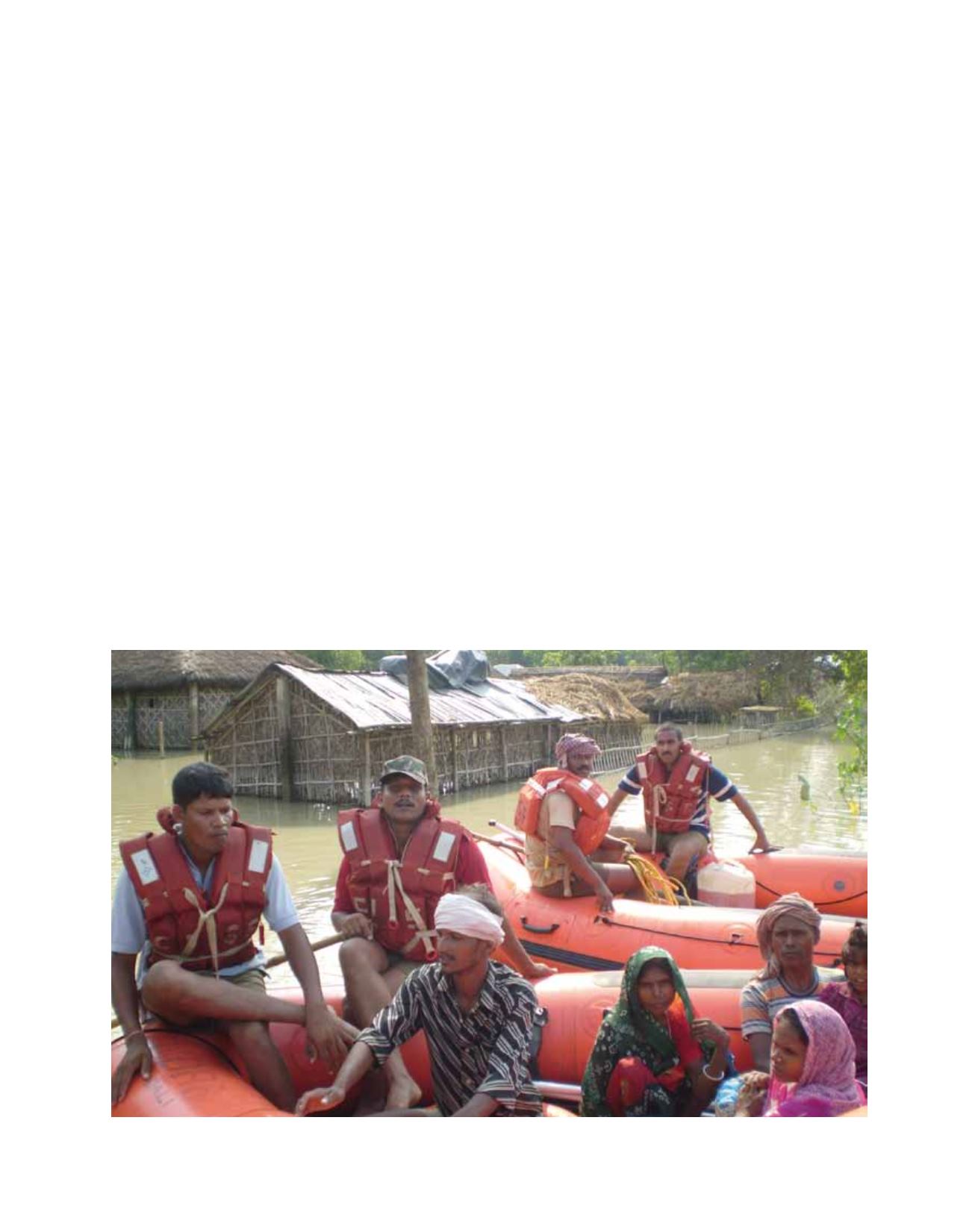
NDRF back in action in the aftermath of Cyclone Aila
Image: NDMA