


 118 / 168

[
] 118
You can’t use information you don’t have:
the role of data in reducing risk
Heather M. Bell and Ray Shirkhodai, Pacific Disaster Center
I
n order to make better decisions in any context, people need
access to timely, relevant, understandable information. Without
it, intentionally achieving desired outcomes is difficult, what-
ever the goal. If risk reduction and management decisions are
based on irrelevant, incorrect or incomprehensible information,
people – and the systems in which they are embedded – suffer.
Policy makers, disaster managers and the public make decisions that
affect disaster outcomes in every phase of the disaster management
(DM) cycle. For instance:
• What should we build? Where? How? Should we get rid of the
mangroves?
• What kind of scenario should we use in our exercise?
• Do we need to issue a warning? How?
• Do we need to evacuate?
• Where should we establish mass care facilities?
• Who needs assistance?
• What do we need to change?
The answers to these questions depend in part on the information
individuals and organizations have access to at the time. Data that
are not easily understood, integrated and applied are not
easily factored into decision making. It is impossible to
use information you do not have or cannot process. The
purpose and goals of questions determine what informa-
tion is required. The ways in which goals and decisions
are framed determine what, and who, gets ‘counted’.
If data on a particular population, system, resource or
relationship are not available when decisions are being
made, those elements are likely to become invisible and
unaccounted for. The result may be increased and more
inequitable impacts and a smaller range of perceived
options. Additionally, if available data are not timely,
accurate and of an appropriate scale and format, deci-
sions and actions may not reflect actual conditions, and
losses and suffering will increase accordingly.
Data collection: making the invisible visible
Creating the frame
Data collection is a means of making the invisible visible.
But how do we know what we don’t know? In order to
analyse, communicate and address disaster risk, we
2028
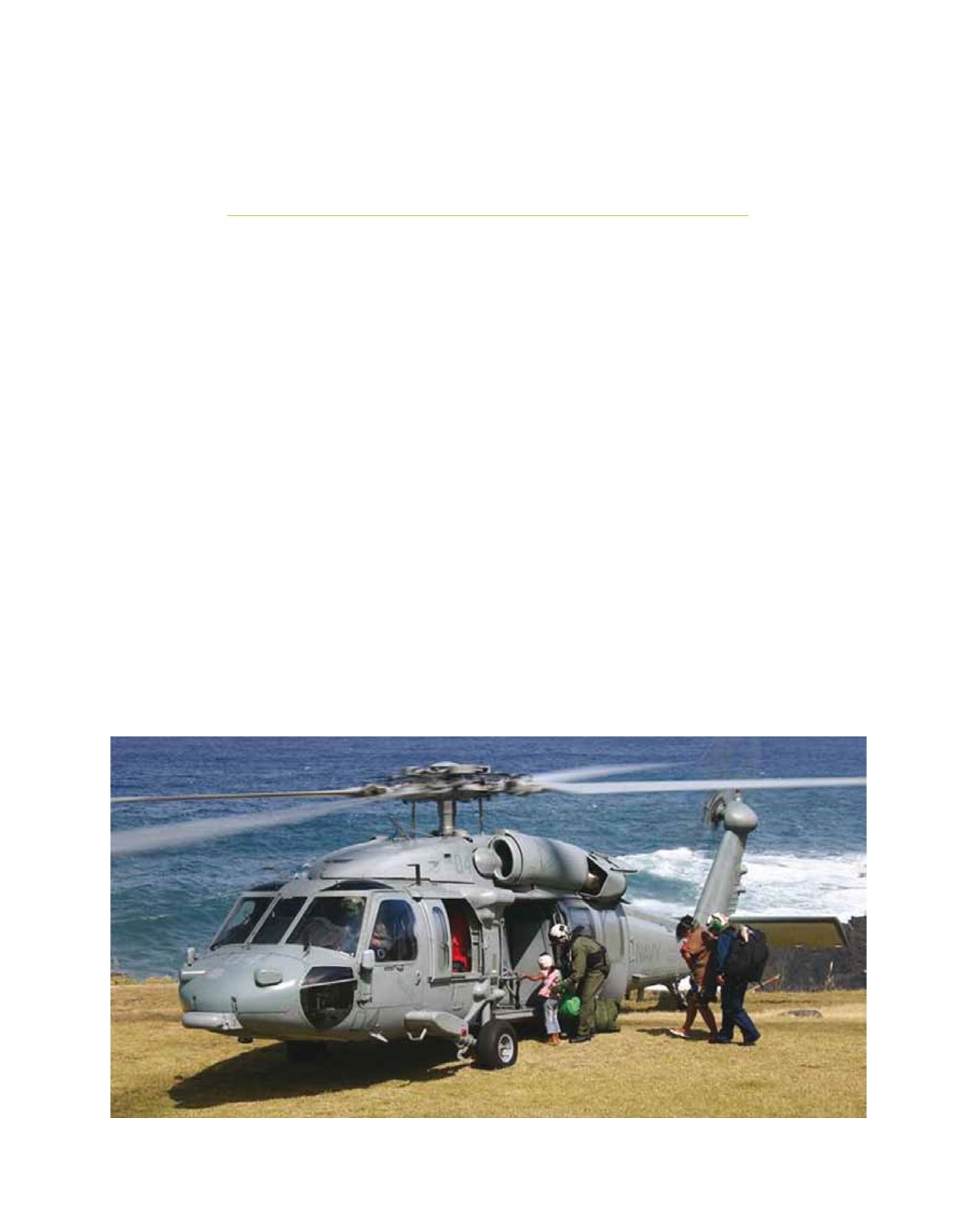
Search and rescue teams locate a remote, little known settlement in the path of super-typhoon Choi-wan, 2009
Image: PACOM 2009