


 117 / 168

[
] 117
Encouraging signs for the future
Projects such as these are integral to SDC’s mission to
enhance safety and disaster risk reduction in vulnerable
communities. According to Dr. Olivier Hagon, Swiss
Humanitarian Aid Unit: “The success of this ambitious
project owes a great deal to the good reputation enjoyed
by the LRCS and its capacity to bring together and pool
the energies available.”
This experience has also shown that the volunteer
status of the young Lebanese rescue workers is in no
way synonymous with amateurism. “Thanks to their
unwavering enthusiasm, the LRCS volunteers gave proof
of their determination to succeed in a perfectly harmo-
nious fusion of volunteer work and professionalism,”
remarks Béatrice Crettenand, Swiss Humanitarian Aid
Unit. Georges Kettaneh, the national director of EMS and
in charge of the new training course for volunteer rescue
workers, says: “The training programme has strengthened
our resolve to ensure that all Lebanese rescue workers,
regardless of which part of the country they work in, can
rely on the same system, the same resources and the same
working methods to carry out emergency missions to the
best of their abilities.” His assistant, Nabih Jabr, adds: “I
have already received lots of calls from volunteers who
were not selected the first time, but who were still keen to
find out how the course had gone and hope to train as an
instructor one day.”
The new instructors are now able to replicate the
training courses in all branches of the Lebanese EMS
throughout the country. With the adaptation to inter-
national standards in the domain of traumatology, the
progressive establishment of hospital care structures in
Lebanon and the ongoing interest of volunteers in contrib-
uting to EMS and DRR, these are encouraging signs for
the future.
• Volunteerism
• Proximity-based organization
• Organizational development based on a bottom-up approach
• Mainstreaming of the gender approach in all phases of the project
• Strengthening of partnership and coordination between authorities
and civil society.
Sustainability of the project and effective communication in disaster
situations are enhanced through good relationships between partners
that have taken strong ownership of the process. Knowledge is shared
on various levels among volunteers and the disaster risk reduction
(DRR) partners. An exchange programme has been set up between
SVP Morocco and NDV Turkey in order to share the lessons learnt. An
official Information and Communication Centre has been established
in the old medina of Fez, hosted by the union of local associations of
the medinas, one of the principle partners of SVP.
Emergency medical services in Lebanon
Since 1945, the LRCS has been mandated by the Ministry of Health to
carry out pre-hospital response and comprises 2,600 volunteers provid-
ing emergency services from 43 Emergency Medical Service (EMS)
stations across Lebanon. LRCS volunteer services include:
• Emergency response and first aid services
• Critical patient transport
• Home and EMS station care
• Mountain rescue
• Mass casualty incidents (e.g. bombings, air strikes, road accidents,
building collapses)
• Transportation of blood units and civilian evacuation
• Training for first response among the general population
SDC supports the LRCS in the effort to modernize and regulate the
pre-hospital health sector in order to enhance EMS for the popula-
tion. The ultimate goal is to reduce the loss of lives and the impact
of injuries, be it in normal day-to-day emergencies or in exceptional
circumstances such as natural disasters. Training of volunteers has
thereby been a key element of the project, which started in 2008 and
will conclude by the end of 2012. To this end, a new training curricu-
lum in line with international standards and adapted to the Lebanese
context was established.
The project consists of four phases. The first phase comprises 140
hours of modular theoretical and practical training for instructors
(training of trainers) on medical topics and pedagogy, validated by an
examination. Participants are volunteers with at least three years of
clinical experience as team leaders. The second phase focuses on trans-
fer of knowledge and skills by trained Lebanese instructors to trainers,
based on the reference materials developed and under the supervision
of Swiss trainers. In the third phase, transfer of knowledge and skills
by trainers to LRCS EMS volunteers takes place under the supervision
of Swiss and Lebanese instructors. The final phase is the evaluation of
both the Lebanese instructors and trainers and the trainees (LRC EMS
volunteers).
In December 2010, the first batch of 19 volunteer rescue workers
received their diplomas as instructors with the Lebanese EMS. The
graduation ceremony took place in the presence of the Lebanese
medical authorities and their foreign counterparts and represented the
culmination of a two-year training cycle under the direction of SDC,
in collaboration with the International Committee of the Red Cross,
Geneva University Hospital and Geneva Paramedical College.
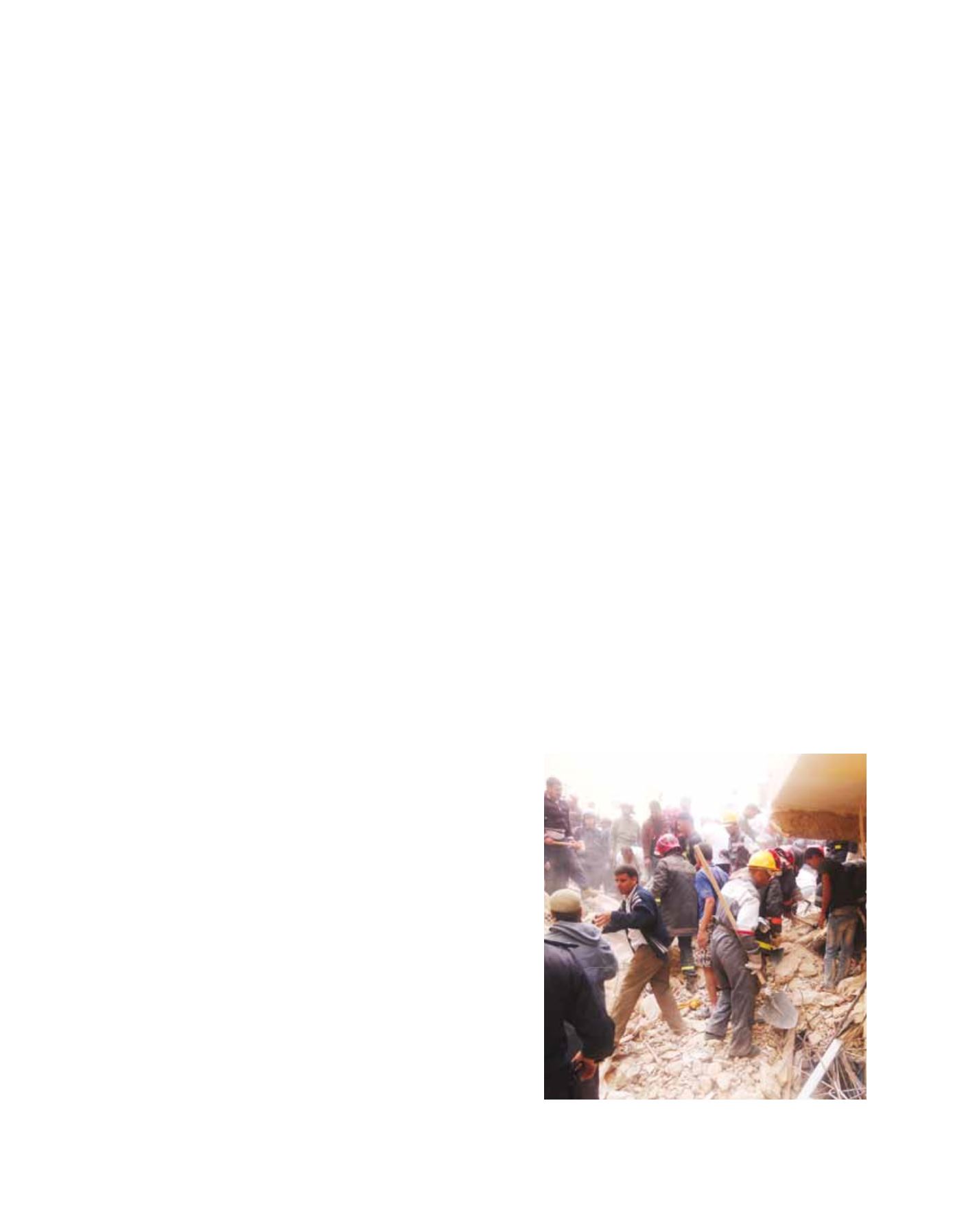
SVP intervention after the collapse of a house in Fez on 2 November
2010, involving rescue and recovery in collaboration with the DPC
Image: A. Dahmani, SVP Fez.