


 114 / 168

• improving compliance with earthquake-resistant building codes
• strengthening the techno-legal regime
• creating an enabling environment for institutional strengthening
and research and development.
NERMP also envisages carrying out the seismic strengthening and struc-
tural retrofitting of selected hospitals in high-risk districts.
Besides the above, NDMA has conceptualized mitigation projects
covering floods, landslides and a project for a dedicated National
Disaster Communication Network (NDCN), to ensure failsafe
communication. A demonstrative National School Safety Project is
being finalized that will empower students, teachers, parents and
other stakeholders in areas of school safety, knowledge of disasters
and development of life-saving skills.
Use of science and technology in DRR
In order to move away from reactive and response-centric disaster
management, NDMA is progressively inducting the best-known profes-
sionals from academia and premier research organizations in the country
to use science and technology for the proactive and holistic management
of disasters. The single most scientific tool that needs to be deployed
for this is vulnerability analysis and risk assessment (VA&RA) of the
people, their habitats, and infrastructures etc. with respect to various
natural hazards.
VA&RA calls for various scientific and technological inputs such as
the preparation of digital base maps at appropriate scales and contour
intervals, preparation of upgraded hazard maps, and development of the
Geographic Information System (GIS) platform. A further proposal is to
develop a knowledge-based National Disaster Management Information
System (NDMIS) to perform VA&RA to generate a decision support
system at national level so that value-added, actionable information can
be communicated over NDCN (being steered by the NDMA) to the right
stakeholder at the right time.
Urban flooding
As in most countries, rapid urbanization is going to be
reality in India. It is projected that over the few decades,
the urban-rural population ratio will be reversed, with over
1 billion people likely to inhabit urban areas. As urban
areas will be centres for economic development, flooding
in urban areas will be amajor problem, giving the increasing
trend towards high-intensity localized rainfall.
NDMAhas for the first time formulated separate guidelines
for the management of urban flooding. Some of the impor-
tant recommendations made include establishing a better
network for hydro-meteorological observations in general,
besides a local network of automatic rainfall gauges for real-
timemonitoringwith a density of one per 4 square kilometres
in all urban areas, and the establishment of a technical plat-
form for developing urban flood forecasting capability.
Weather reconnaissance: Aircraft Probing of Cyclones
(APC) facility
Lack of critical observations from the cyclone core environ-
ment is causing large track and intensity forecast errors. The
establishment of APC facilities for the cyclone core envi-
ronment can significantly address this critical data gap in
cyclone intensity and track forecasting.
AnAPC facility can also be used for the study of monsoon
systems in the South Asian region and research on climate
change. This will be a great asset for the entire region. The
facility, with a C-130J aircraft, is likely to be established in
the next two years.
There are also plans to develop an advanced forecast-
ing platform to strengthen existing capability at the India
Meteorological Department, enabling increased accuracy
and high reliability in terms of onset, landfall, intensity and
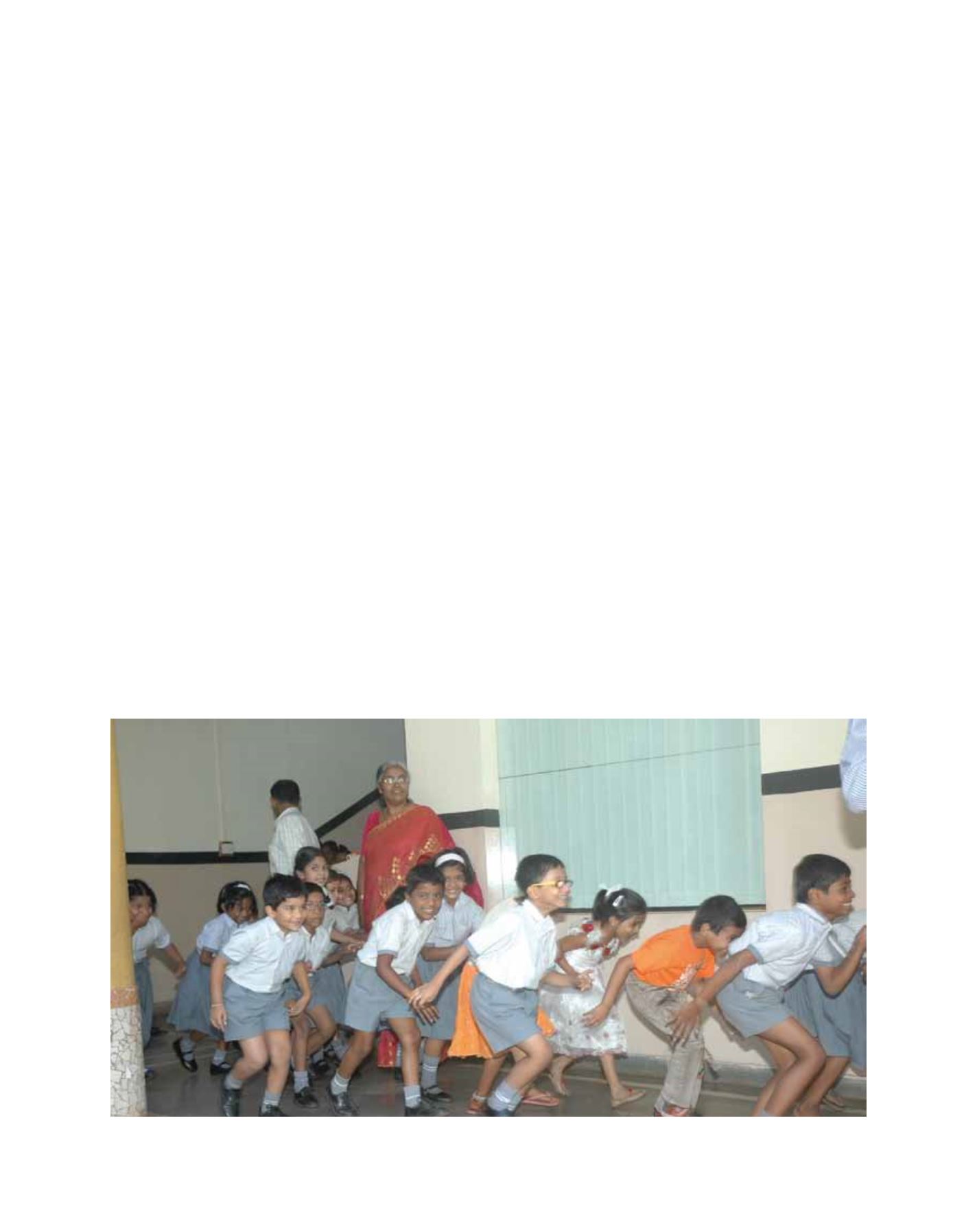
School children participating in mock drill at Bellary, Karnataka State, 17 June 2009
Image: NDMA
[
] 114