



 103 / 168

[
] 103
Similarly, recovery and development activities provide the foundation
for long-term programs focused on the prevention and/or mitigation
of disasters. Therefore, planning for recovery and development is best
undertaken in conjunction with response planning. This ensures that
short-termactivities undertaken during the response phase are congruent
with longer-term objectives.
Australia’s approach to disaster management requires departments and
agencies to understand each other’s capacities and the capacities of other
contributing partners. Australia recognises that its agencies themselves
cannot, and should not, work in isolation from each other and that the
national effort also should not be isolated but should be part of an inter-
national effort. Pre-eminent in this partnership is the Government of the
affected country.
Developing and implementing multiagency strategies
There are a number of strategies that will help ensure continuous
improvement in disaster management by promoting common aims
and objectives through shared understanding; developing
structure and processes that enhance preparedness; and
building collaborative relationships and organisational
understanding. These initial strategies, investing in prepar-
edness and developing measures of effectiveness, are just
the first of what is intended to be a continual development
of Australia’s national ability to operate effectively in the
disaster management field.
Preparedness is central to competent disaster manage-
ment, enabling strategies for prevention and/or mitigation,
response, and recovery and development, all of which lead
to disaster risk reduction, to be implemented effectively.
Preparedness improves decisionmaking and planning. The
benefits for Australia from investing in an ongoing program
of civil-military preparedness include:
• Strengthened collaboration and understanding of roles,
responsibilities, planning processes, capabilities and
modes of operation between departments and agencies,
based on trust and mutual respect
• Increased awareness between government and partner
nations and organizations (such as the United Nations)
involved in disaster management
• Development and refinement of collaborative multia-
gency working practices and procedures
• Closer multiagency coordination between the strategic
and operational levels.
The development of measures of effectiveness to enable
proper evaluation of the benefits of Australia’s contribu-
tion will need to be specific for each disaster response.
Measures of effectiveness also assist in providing the
baseline for conducting research and deriving lessons
learned, thereby facilitating continuous improvement
through organisational learning. Examining the success
of civil-military collaboration in disaster management
activities, and identifying and sharing key lessons across
departments and agencies, assists the development of
strategies and mechanisms for enhancing Australia’s
future approach. This evaluation process can include
lessons learned from the experiences of relevant multia-
gency organisations, including those of Australia’s allies
and its international and regional partners.
Conclusion
Australia is committed to improving its civil-military
capabilities in preventing, mitigating, preparing for and
responding to international disasters. It does this by devel-
oping common concepts, terminology and understanding
and through pre-disaster training and networking.
By strengthening civil-military collaboration at all
levels, decision makers, planners and managers will
be able to deliver better on-the-ground outcomes in a
coordinated and cost-effective manner. This is in itself
a positive disaster risk reduction outcome in that it will
reduce the impacts and losses of a disaster when they
occur, as they surely will.
The views expressed in this paper are not necessarily those of
the Australian Government or any of its agencies
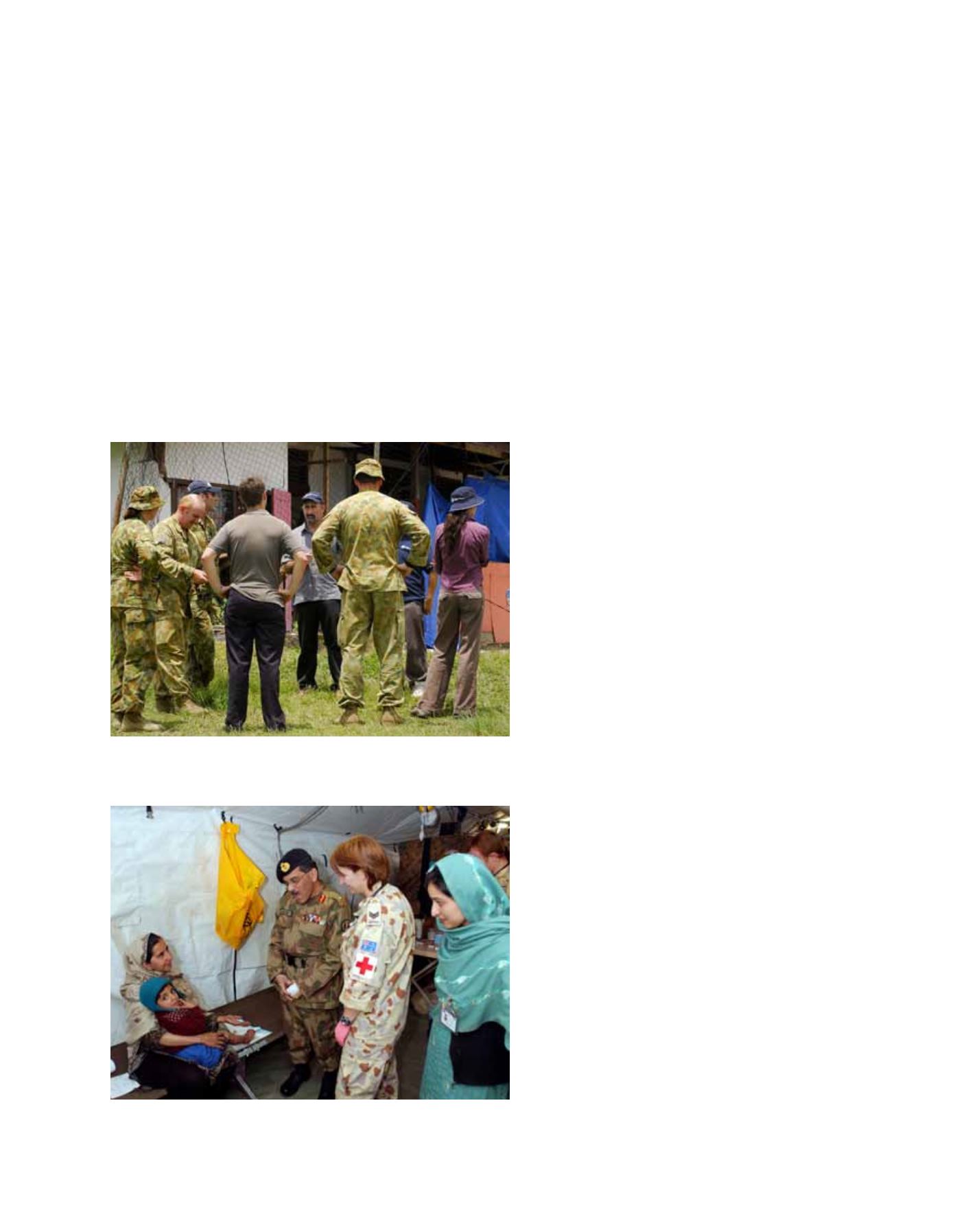
Major General Abdul Qadir Usmani, centre, chats with a local village patient and Sergeant
Maria Brown (second from right) during his visit to Camp Bradman, 10 February 2006
Image: Defence
Mr Alan March, AusAID’s Humanitarian Coordinator, briefs Australian Government
staff in Padang, Indonesia, October 2009
Image: Defence