


 100 / 168

[
] 100
has carried out research based on the 1995 Kobe earthquake, and
has also provided a training course for UDRR specialists from
developing countries in collaboration with Japan International
Cooperation Agency Hyogo and other DRR organizations estab-
lished in Kobe. Each participant has a specific background of DRR
on entry but following training, they all understand the impor-
tance of an alliance among the different sectors and disciplines in
their city.
Participants benefit from lectures and site visits to help
them learn about Risk Assessment, Risk Management and Risk
Communication during their two-month stay in Kobe. For Risk
Assessment, they study the fault rupture mechanism and how
to produce seismic hazard and risk maps based on geotechnical
information. For the Risk Management aspect, they study disas-
ter management and operations at local government level and the
recovery experiences and lessons of local communities affected
by the earthquake. By listening to the actual recovery experiences
of people who now serve as community leaders in the local area,
the participants can share the problems they had to overcome to
rebuild their community. Risk Communication study covers the
earthquake early warning system and the educational materials
that are used by the elementary and junior high schools in Kobe.
Stories in the educational material about how children helped their
families to bring water from the emergency water service point, or
how nearly 1.4 million volunteers came to help out in Kobe from
all over Japan, can teach the younger generation the importance
of self-help and mutual help in case of emergency.
The training course has produced nearly one hundred UDRR
specialists for the period 2004 – 2011, based on disaster research
and recovery experiences from the 1995 earthquake. Another
important factor is that the training participants clearly under-
stand that the given knowledge is based on the
particular case of the Kobe disaster and recovery
and there is a limit to how far they can apply this
knowledge in their home countries. As each city
in the world has different economic, demographic,
historical, cultural and other backgrounds, so each
has to establish its own UDRR strategy based on its
particular situation while using a common frame-
work of Risk Assessment, Risk Management and Risk
Communication.
Building for tomorrow
The Alliance for UDRR (AUDRR) needs to be built
by collaboration among stakeholders in different
sectors and disciplines in each city. For Kobe, the
local AUDRR is established by RCUSS. By having
a common framework for UDRR, a local, regional
and/or international collaboration among UDRR
specialists can be achieved more systematically by
identifying and evaluating the vulnerabilities of their
cities in each category through a common under-
standing. The RCUSS UDRR training has produced
an international network of former participants in
Asia, the Middle East and North Africa, and also in
the Latin American regions, with which they share
similar climates, cultures and sometimes languages.
By promoting collaboration among participants
in RCUSS training and/or those interested in the
RCUSS framework within each region, it is hoped
that a better and more coherent UDRR knowledge
and strategy may be developed for each region.
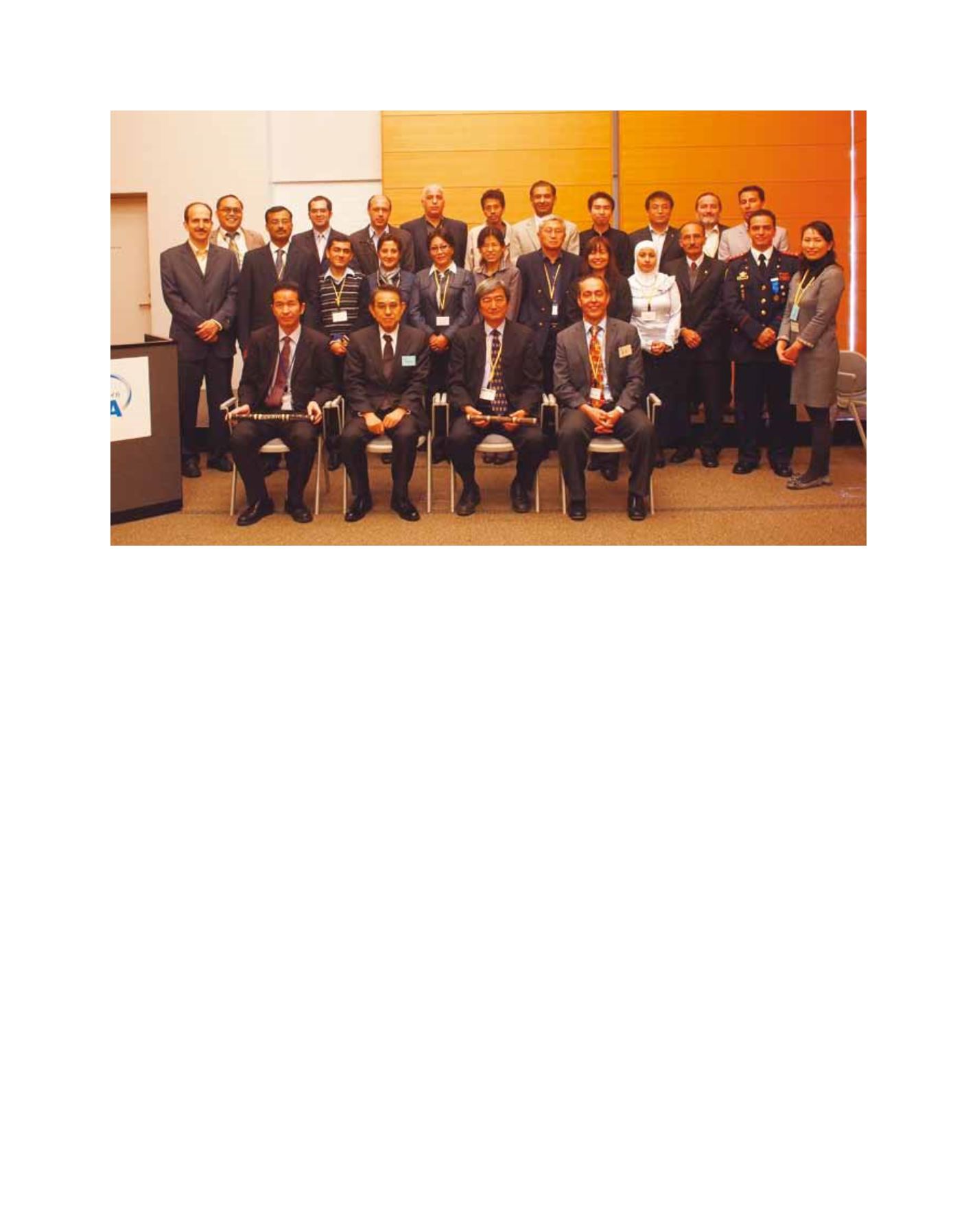
Regional groups representing Asia, Middle East, North Africa and Latin America were formed in November 2010 from former participants in RCUSS training
Image: RCUSS Kobe University