


 97 / 168

[
] 97
WMO, in cooperation with other UN and international partners
as well as its Members, through consultations with experts involved
in various national and local components of EWS during two inter-
national symposia and a number of regional and national events, has
developed a systematic process for documenting good practices in
EWS, including criteria for and examples of good practice around the
world. The two primary assumptions that guided this work were that
protection of citizens’ lives is a responsibility of the government from
national to local levels, and that the issuing of authoritative warnings
is a national responsibility. A detailed template for documentation
of good practices was developed, providing guidelines for systematic
documentation of the various aspects of the early warning system.
To date, good practices have been documented in seven early
warning systems for meteorological and hydrological hazards. These
include the Bangladesh Cyclone Preparedness Programme; the Cuba
Tropical Cyclone Early Warning System; the French ‘Vigilance’
System; the Warning Management of the Deutscher Wetterdienst;
the Multi-Hazard Early Warning System in Japan, the Multi-Hazard
Early Warning System of The United States National Weather
Service; and the Shanghai Multi-Hazard Emergency Preparedness
Programme as an example of good practice for mega cities. The
documentation of these examples was carried out by teams of experts
from relevant ministries and agencies in the respective countries and
will appear in a forthcoming publication (Golnaraghi 2011).
A detailed synthesis of the good practices documented has
revealed
ten principles
common to the implementation of all of the
cases, irrespective of the political, social and institutional factors
in each country:
1. There is a
strong political recognition
of the benefits of EWS reflected
in harmonized national and local disaster risk management policies,
planning, legislation and budgeting.
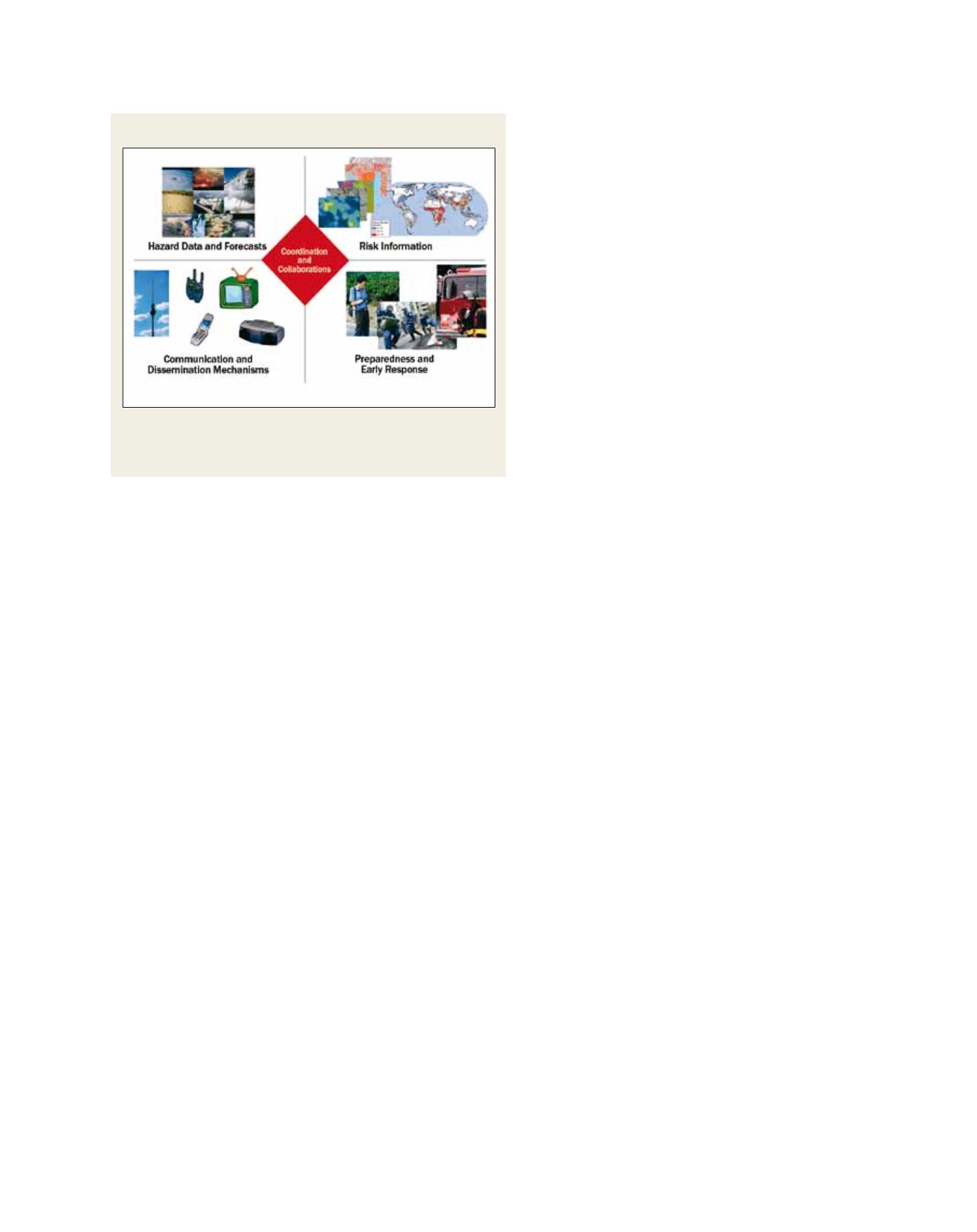
2. Each effective EWS is built upon
four components
: hazard detec-
tion, monitoring and forecasting; risk analysis and incorporation of
risk information in emergency planning and warnings;
dissemination of timely and authoritative warnings;
and community planning and preparedness with the
ability to activate emergency plans to prepare and
respond, coordinated across agencies involved in EWS,
at national to local levels.
3. EWS
stakeholders are identified
and their roles and
responsibilities and coordination mechanisms clearly
defined and documented within national and local
plans, legislation, directives and memoranda of under-
standing, including those of technical agencies such as
the National Meteorological and Hydrological Services.
4. EWS
capacities are supported
by adequate resources
(human, financial, equipment, etc.) across national and
local levels and the system is designed and implemented
to account for long-term sustainability factors.
5. Hazard, exposure and vulnerability information
are used
to carry out risk assessments at different levels, as criti-
cal input into emergency planning and development of
warning messages.
6
.Warning messages
are: clear, consistent and include risk
information; designed to link threat levels to emergency
preparedness and response actions (using colour, flags,
etc) and understood by authorities and the population;
and issued from a single (or unified), recognized and
authoritative source.
7
.Warning dissemination mechanisms
are able to reach the
authorities, other EWS stakeholders and the population
at risk in a timely and reliable fashion.
8
.Emergency response plans
are developed with considera-
tion for hazard/risk levels, characteristics of the exposed
communities (urban, rural, ethnic populations, tourists
and particularly vulnerable groups such as children, the
elderly and the hospitalized), coordination mechanisms
and various EWS stakeholders.
9.
Training
in risk awareness, hazard recognition and
related emergency response actions is integrated in
various formal and informal educational programmes
and linked to regularly conducted drills and tests across
the system to ensure operational readiness at any time.
10. Effective
feedback and improvement mechanisms
are in
place at all levels of EWS to provide systematic evalua-
tion and ensure system improvement over time.
The lessons learned from these good practices can be
adapted by countries that require multi-hazard risk
management. The specific design and implementation of
EWS strategies varies according to the specific history,
culture, socio-economic conditions, institutional struc-
ture, capacity and available resources for sustainability
of the system.
Figure 2: Four elements of an end-to-end early warning system
Source: First WMO Symposium on Multi-Hazard Early Warning Systems (May 2006,
Geneva) and Platform for Promotion of Early Warning System
End-to-end early warning systems must coordinate collaborative hazard data
and forecasts; risk information; communication and dissemination mechanisms;
and preparedness and early response efforts