



 94 / 168

[
] 94
Oriental. The project hopes to build the capacity of selected communi-
ties through awareness-raising and training of participants. Through the
formation of Disaster Preparedness Committees (DPCs), community
leaders have been identified to build community resources for long-
termmitigation and risk reduction. Through training and formation of
the DPCs appointed by the villagers, Mercy Relief and CDRC ensure
developmental initiatives remain sustainable and community-driven.
Practicality of DRR in complex or large-scale humanitarian crises
While most DRR strategies have been developed for implementa-
tion in rural and poverty-stricken areas during peacetime, measures
have to be effective in the advent of complex humanitarian situa-
tions. Most traditional DRR strategies are based on the perspective
that if disaster risk measures have been taken into account when
planning development projects, those projects are less likely to be
undermined by the impact of a hazard, and that if programme imple-
menters adopt a developmental approach to emergency relief, then
the capacity of that community will be built up.
However, this is of little relevance when countries and communities
have been crippled by disasters. For instance, after Sri Lanka and Pakistan
were swept with prolonged flash floods just months after the countries
had been resuscitated following an armed conflict, their governments
and aid agencies were economically unable to combat another disaster.
DRR has increasingly been seen as a growing area of policy and
programmatic investment for NGOs, including a greater focus on
partnerships and community engagement, and an increased aware-
ness on the part of development colleagues of the need for risk
reduction work in development programming. There is, however,
a general recognition that resources for DRR are still insufficient.
Although most countries have shown progress in terms of prepar-
edness and response in recent times, this has not matched up to the
increasing frequency and force of natural hazards.
For example, Japan, the world’s most prepared nation against
natural disasters, recently faced an extremely complex humanitar-
ian crisis – an earthquake that triggered a monstrous
tsunami which made landing on 500 kilometres of
coastline in less than an hour, and damaged nearby
nuclear power plants, exposing the world to a radia-
tion threat.
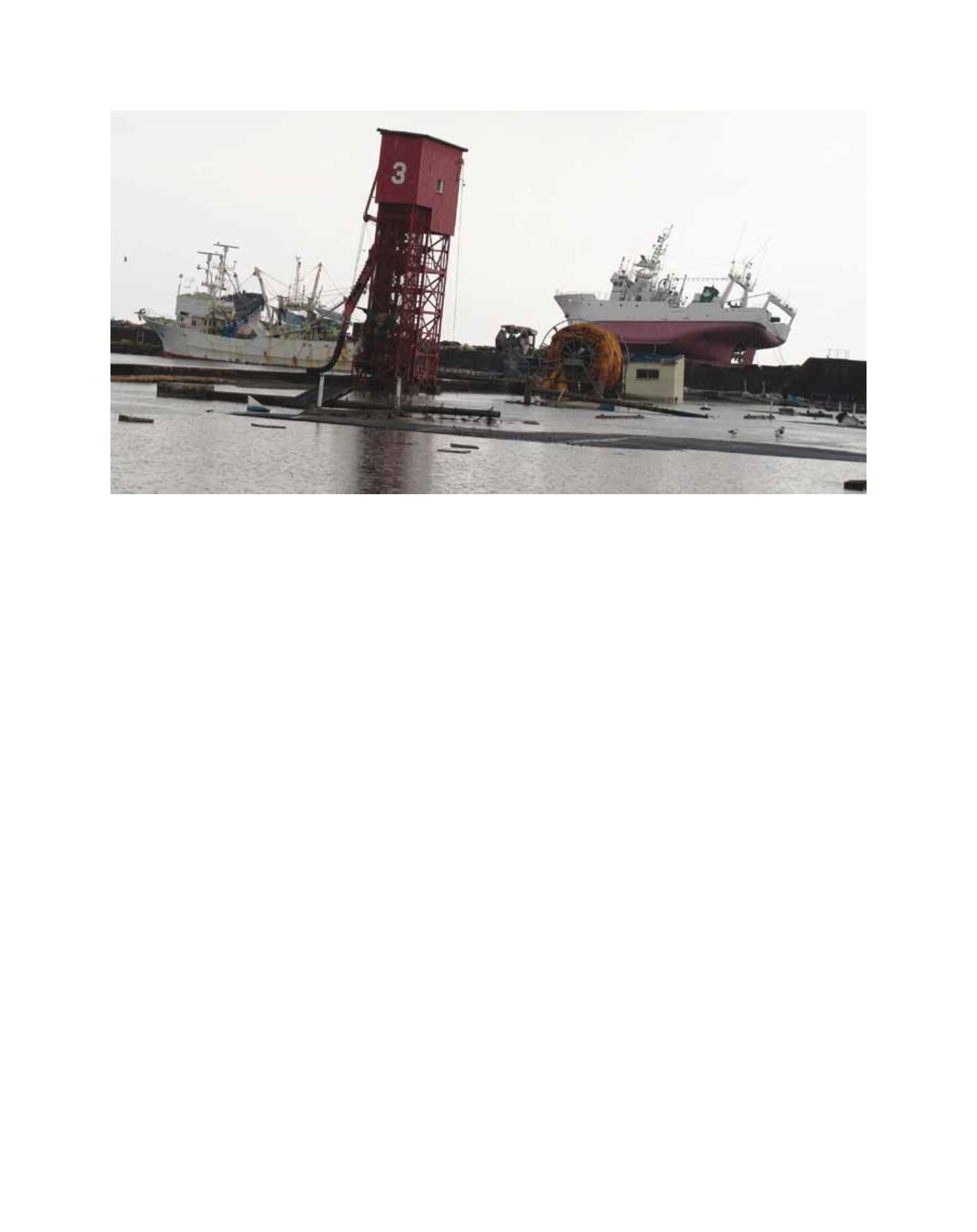
Mercy Relief response teams, which have been
working in the two worst-affected prefectures of Miyagi
and Iwate since the third day of the tsunami, found that
risk mitigation initiatives were well implemented by
the Japanese authorities, including a tsunami warning
system and solid breakwaters. Unfortunately, these
DRR mechanisms were breached and tens of thousands
of lives were lost due to the speed and strength of the
waves, with hundreds of thousands others displaced.
Despite Japan’s trusted records of impeccable
disaster risk reduction and management policies and
systems, such adversities affect even the most prepared
government and communities. The unprecedented
scale of disasters simply overwhelms seemingly
faultless risk reduction, mitigation and prevention
measures. In less serious conditions, proposed DRR
measures and subsequent response may be short-term
and time bound, and will not engage with the deeper,
underlying causes (political, economic or cultural)
of disaster, thus making DRR strategies as a whole
ineffective at critical points. Compared to their more
learned urban and economically well-off counter-
parts, rural and disadvantaged societies have not been
informed adequately, or worse misinformed, about the
evolution of DRR within their societies, indicating a
heightened need to formulate strategies that are rela-
tive and comprehensibly adapted to different target
communities with varied socio-economic capacities
and resource capabilities.
One of the many vessels left stranded on the solid coastal defence in Ishinomaki, Miyagi Prefecture
Image: Mercy Relief