


 89 / 168

[
] 89
officials. The situation has now been ameliorated by GOAL’s
DIPECHO-funded programme, which seeks to strengthen such
institutions. Several workshops and training sessions have been
carried out to enhance the capacity of VCPCs and VNRCs, includ-
ing coordination and communication protocol mechanisms. An
integral part of the programme was to come up with a community-
drawn vulnerability map. The Ndamera community did the hazard
identification and prioritization process as well as the vulnerability
list. They then participated as a community and produced a vulner-
ability map of the area using high-resolution satellite images. This
has led to community-driven initiatives like the establishment
and management of community tree nurseries, community forests
along riverbanks, river dredging, and follow-up visits for coordina-
tion and monitoring of mitigation works.
Main findings
The Ndamera community, through the DRR process, has partici-
pated very actively in the planning, design and implementation
of GOAL’s DIPECHO and ECHO-funded projects, thus ensuring
ownership. The community is well-equipped to maintain the estab-
lished structures since its members planned, designed and instituted
them. However, the flood mitigation works and forestry activities
done are just a drop in a bucket when one considers the whole
catchment area. The DIPECHO and ECHO-funded projects have
provided a balanced basket in terms of DRR programming. It is
important, with adequate funding, that a holistic approach be taken
in the whole Nyachilenda River catchment in future years, to do
land rehabilitation, soil conservation works and reforestation activi-
ties, including all the relevant software.
By looking at the example of the Nyachilenda River it is possible to
see how a holistic approach to addressing DRR issues can prove highly
successful. So far, in spite of receiving slightly more rain-
fall than last year, there are no reports of flooding along the
river thanks to the mitigation works, whereas floods have
been recorded in other areas of the district. While maize
crops were a write-off due to unevenly distributed rains,
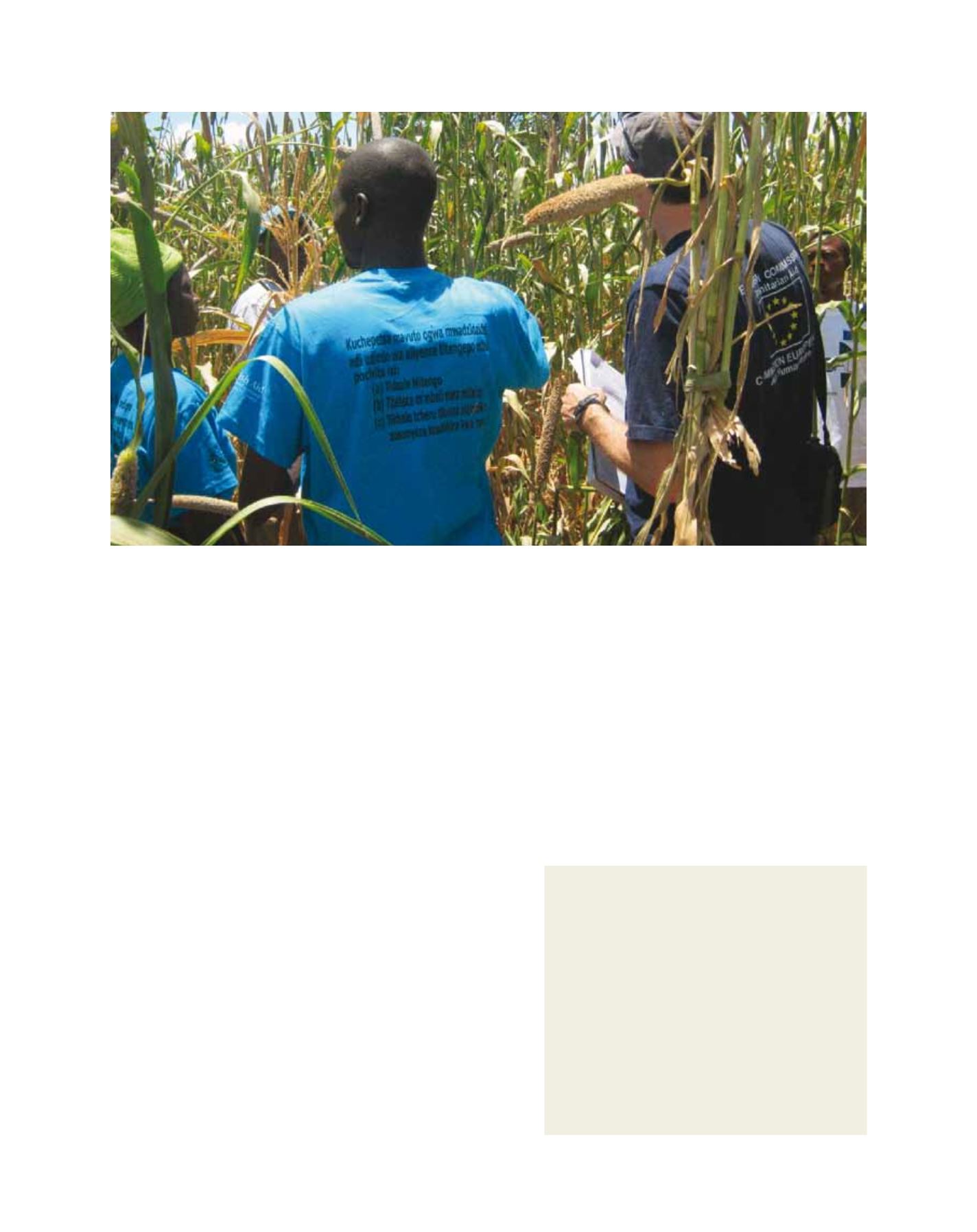
climate-shock-resistant sorghum and millet crops trialled
as part of GOAL’s ECHO-funded project withstood the
unpredictability of rains, thereby enhancing communities’
resilience. It is difficult now to measure the impact of this
year’s reforestation activities, but GOAL believes that in
two or three years, sites where this activity was conducted
will be protected from erosion and landslides, as is now
the case where trees were planted a few years ago.
A thriving pearl millet crop in Bambo Kanjira’s field in Ndamera, visited by an ECHO representative
Image: Malango Singini, 1 March 2011
“We used to have problems with most
donor-assisted programmes where
no consultations were done. Our
vulnerability would force us to accept
whatever was put on the table even
if we did not like it, lest we would be
abandoned. A person leaving the dentist
will insist, through painfully gritted
teeth, that they are just fine, thanks, lest
the drill comes out again.”
Group Village Head Ndamera (local leader)