


 87 / 168

[
] 87
The quantity of material to be dredged was very large,
prompting the hiring of a bulldozer. It would have taken
the whole Ndamera community nearly a year to dredge
by hand the material which the bulldozer cleared in 10
days. The community was actively involved as people
came in after the bulldozer to do the final shaping of
the cleared material to form a uniform dyke. A total of
189 people from the Ndamera area were engaged on
the project for three months as workers under Cash for
Work programming. Workers received MK200 (€1) for a
three-hour working day, with tasks-modality being used
where possible. Working hours were flexible to allow
workers to attend to their agricultural activities. The
programme was very popular as there was cash transfer
into a community which hardly uses cash as a medium
for trade. The project was executed during the lean
hunger period when the community faces its worst food
security challenges, so the cash transfers were primarily
used to procure cereals. According to GVH Ndamera,
people from his area would normally need to dig for
tubers (Nyika) on the riverbed of the Shire River, risking
attack from crocodiles.
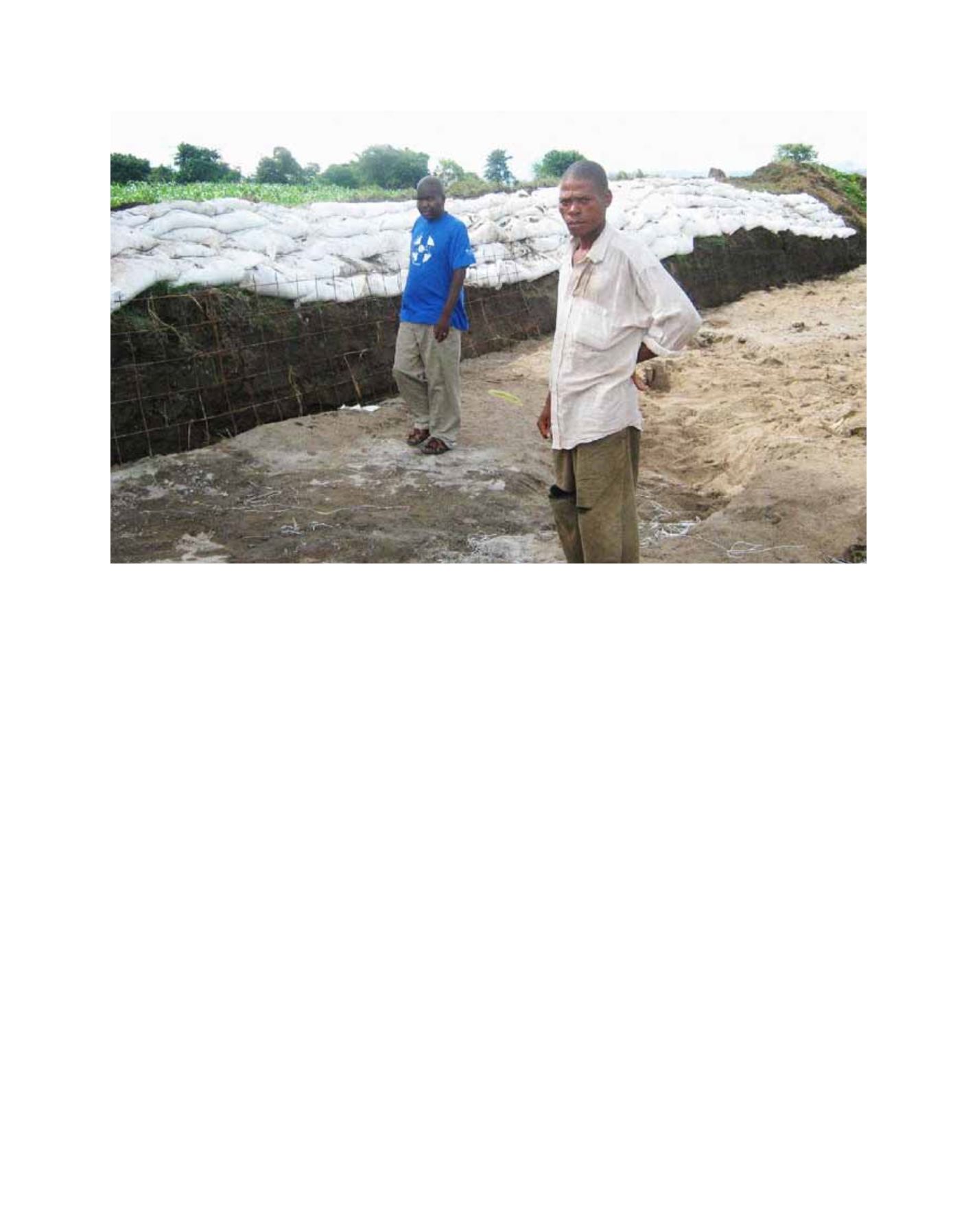
After shaping the dykes the workers planted local
grasses (runner grass, elephant grass) on the top and
land-side of the dyke to protect it from erosion. On the
river side of the dyke, properly staked cement-stabi-
lised sandbags were used to protect against erosion by
flowing water. Cement-stabilised sandbags were also
used to increase the height of the riverbank where there
was potential for floodwaters to overtop the existing
Livelihoods along the Nyachilenda River
The Traditional Authority of Ndamera is one of GOAL’s operational
areas. GVH Ndamera has nine villages, and almost all of them are
affected by climatic shocks and flash floods from the Nyachilenda
River. GVH Ndamera communities depend mainly on subsist-
ence farming complemented by fishing on the perennial Shire
River. However, dependency on maize as a staple food has severely
compromised crop diversity. The cultivation of sorghum and millet
varieties, which are both flash-flood and drought tolerant, including
other small-scale crops that are usually consumed as supplements to
maize, has declined over the years with some species virtually extinct.
This, compounded by the critical shortage of irrigation facilities that
would enable farming families to intensify their crop production and
produce outside the rainy season, has compromised food security.
Addressing vulnerability to flood and drought
Several approaches have been used to address the vulnerability to
flood and drought, including mitigation works, reforestation and
food security interventions, and capacity-building.
Mitigation works
The Nyachilenda River is one of eight problematic rivers being
targeted under GOAL’s ECHO-funded programme, ‘Improving Food
Security and Resilience to Natural Disasters in Nsanje District’. Some
areas along the Nyachilenda River have either no defined banks or
low-level banks, allowing floodwaters to overtop the banks and
flood villages and fields. At these vulnerable points the commu-
nity is working with technical assistance from relevant government
departments and GOAL to dredge the river, create dykes, increase
the height of banks and fortify unstable banks.
A GOAL engineer inspects the foundations of the planned gabion wire mesh reinforced concrete lining at Nyachilenda river
Image: Kingsley Khola, 16 March 2011