


 82 / 168

[
] 82
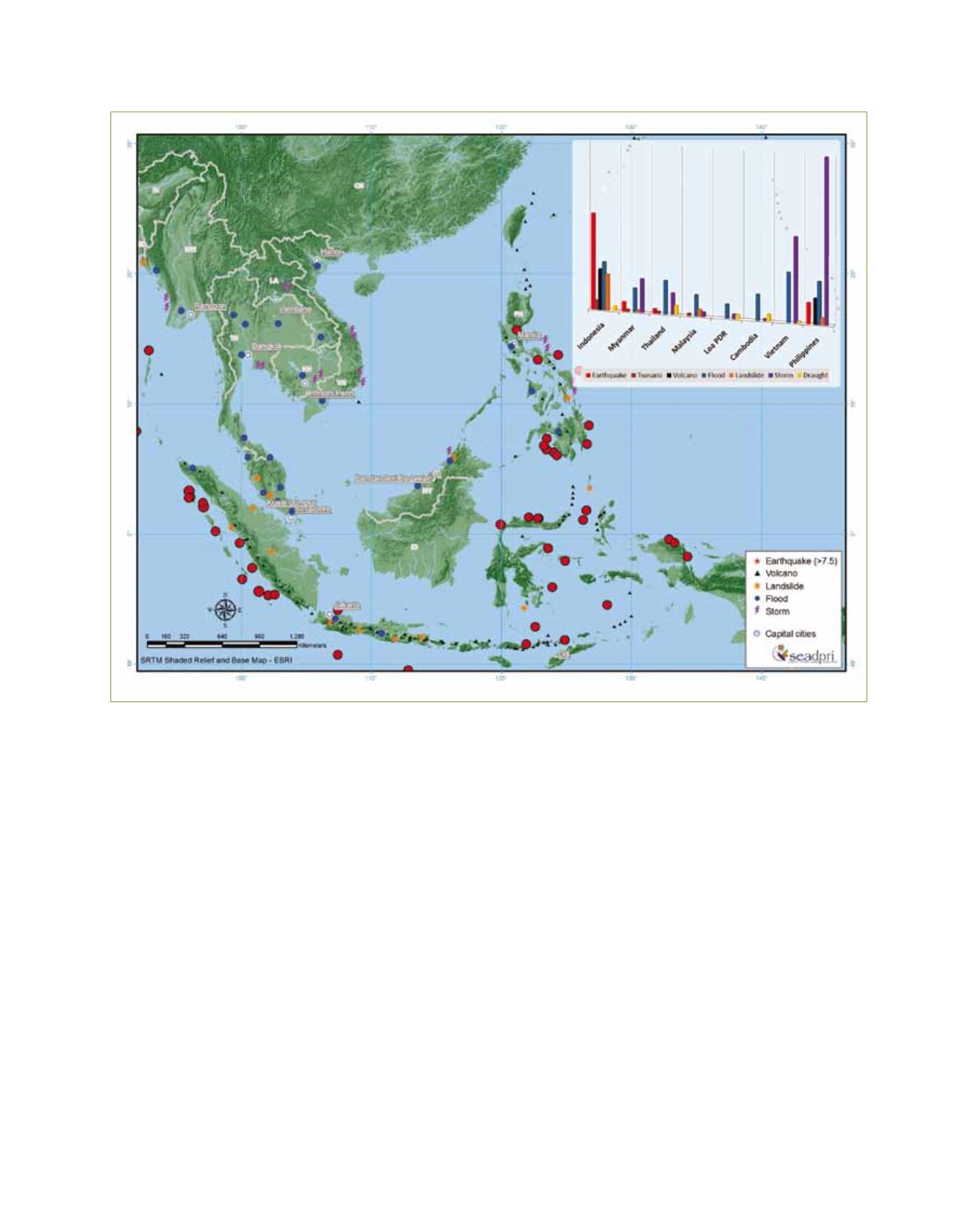
events from 1900 to 2011 have affected more than 35 million people,
including 6.1 million people in 1990, 4.8 million people in 2008 and
4.9 million people in 2009. In Vietnam, storms top the list of killer
disasters in the country, with 22 million people affected between
1900 and 2011. The droughts in Thailand in 1999 2002, 2008 and
2010 have had an impact on millions of lives.
Lessons from disasters in Southeast Asia
Regardless of the type of hazards, whether geological or climatic,
the impacts are enormous, and many areas are exposed to multiple
disaster risks. Major disasters, such as earthquakes, volcanic erup-
tions and storms, trigger other disasters such as landslides, floods
and tsunamis.
Disasters normally occur unexpectedly and communities are ill-
prepared, due to the irregular frequency of the events. Therefore
DRR needs to be mainstreamed into planning, implementation and
monitoring of development projects.
Currently, the approach for managing disasters in most countries
in Southeast Asia is sector-based, with different agencies handling
earthquakes, volcanic eruptions, floods, storms and landslides sepa-
rately and in isolation. This approach is not the most effective and
cannot provide comprehensive long-term solutions. Often disasters
occur in multiple hazard zones, and the implications
in terms of death, property damage and psychological
effects to the community are similar.
Therefore, an integrated approach is critical when
implementing DRR programmes. Some methods which
can be introduced to initiate such integrated manage-
ment include the following:
• Scientific research on disasters needs to be carried
out holistically, looking at the likely chain of
events – pre-disaster, during the disaster and
post-disaster – linking each to other possible
consequent events
• Disaster governance should emphasize policy
integration, especially in the context of multi-
disaster events and linkages between disasters
• Integrated implementation should be carried out by
all agencies through inter-agency coordination and
joint planning if necessary
• DRR approaches should be mainstreamed through
policy planning responses in each country, and
subsequently expanded to integrate programmes
among countries in Southeast Asia.
Distribution of natural disasters in Southeast Asia. Inset: Chart showing number of major disaster events in these countries
Image: SEADPRI