


 77 / 168

[
] 77
Learn from what is already being done
Exposure of Government officials and civil society organizers to
disaster preparedness work at national, state and regional levels is
essential since there is so much to learn from others’ experiences.
Awareness raising and use of multimedia
There is a widespread lack of awareness on disaster preparedness at
all levels of the community and Governments. There should be much
greater use of media, especially television and radio, in raising awareness.
Teaching children disaster preparedness
Schools should include disaster preparedness and awareness raising
about cyclones and their nature, especially at community and house-
hold levels.
Green belts protect communities
Forest and mangroves in the coastal areas help reduce storm
surge penetration, soil loss and flooding. They sustain marine and
brackish water fisheries and other ecosystems, and provide fuel,
fodder, building materials and livelihoods to coastal communities.
Therefore, their protection is important for the well-being of the
community.
Bangladesh
The Empowerment of Coastal Fishing Communities for Livelihood
Security (ECFC), an FAO/UNDP/Government of Bangladesh Project,
was implemented in Cox’s Bazaar district between 2002 and 2006.
One of the main components of the project related to strengthening
the capacity of the coastal fishing communities for disaster manage-
ment, focusing on cyclone preparedness measures. The objective of
this component was to facilitate and enable community access to
advance disaster warnings in order to prepare them to cope with and
recover from natural and other hazards at sea and on land.
One of the important lessons learnt from the project was that
disaster preparedness in real time should be driven by a sense of
responsibility. This was shown during the cyclonic
period in May 2004 by the fishing communities of all
the villages covered under the project. The role played
by Village Disaster Preparedness Committees (VDPCs),
change agents and volunteers (both men and women)
in alerting the communities was highly effective. These
groups shared responsibilities for disseminating door-
to-door weather forecasts and danger signals. The
teamwork shown by the community in taking prompt
initiative for cyclone preparedness was found to be
excellent and highly appreciated by people from all
walks of life.
4
Regional training
The South Asia component of the FAO Global Project
on Safety at Sea for Small-Scale Fisheries in Developing
Countries was implemented in the four member coun-
tries of the BOBP-IGO from May 2007 until December
2010. The project focused on training, education and
awareness for improved safety at sea. Various approaches
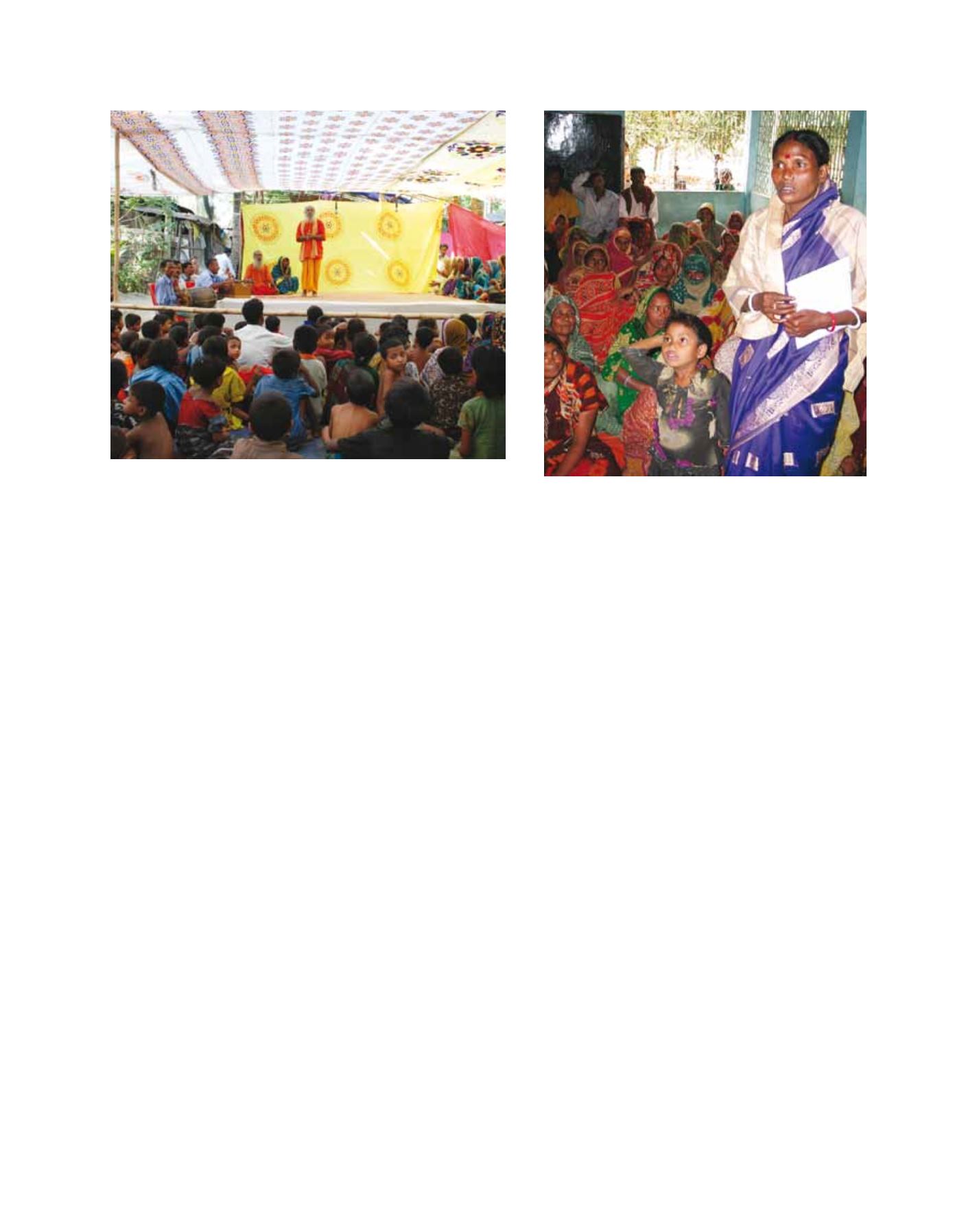
were used to take the message to the community. These
included colourful leaflets giving key messages on
subjects such as cyclone signals, folk songs and village
theatre, and video films in local languages.
Rising risk, prepared communities
With the increase in sea surface temperatures due to
global warming, there is likely to be an increase in the
frequency and intensity of tropical cyclones. In such
situations, community preparedness will be of immense
help. There is a pressing need to replicate the lessons
learnt from the above examples, not only within the
BoB region but also in other parts of the world, where
coastal communities face constant threat from cyclones
and other natural hazards.
Folk songs and village theatre are effective media for raising awareness
amongst communities
Gender mainstreaming is vital for success of disaster preparedness
Image: Yugraj Yadava
Image: Yugraj Yadava