


 73 / 168

[
] 73
bases are the most comprehensive as they are linked to geographic
information systems and to the databases of other central state
administration bodies, thus enhancing their efficiency.
Sharing of information at all levels is of utmost importance in
building the culture of safety. Science and education play an essential
role in this respect, as well as the development of interdisciplinary
networks for information sharing and networks within individual
regions, especially for the risks they have in common (for example,
for earthquake- or flood-prone areas). It is important to harmonize
disaster risk reduction terminology in all scientific and professional
disciplines to ensure understanding of terms and procedures and to
avoid misinterpretations. In raising public awareness it is important
to make disaster risk reduction part of national curricula, which
currently tend to neglect this area of study.
In this respect, cooperation with the media is especially important
to ensure access to the general public and to raise community aware-
ness of procedures and measures undertaken to reduce disaster risks.
Systematic involvement of the media in the work of the Platform
as permanent participators is still missing, as is media training in
disaster reporting in order to create a basis for good cooperation in
emergencies. However, a large step forward has been made regard-
ing the education of the population concerning this topic.
Another component of action plans is the protection of critical
infrastructure, which this year has become a systematic activity in
disaster risk reduction and strengthening of response capacities.
Through the Platform all participants must recognize their respec-
tive tasks in the development of response capacities and disaster
management at political, technical and institutional levels. The
protection and rescue system in the Republic is statutorily based
upon the principles of subsidiarity and solidarity, as well as continu-
ity of action of all participants. In practice, this means that response
(but also prevention and risk reduction) must begin where the risk
occurs, in the local community, with further expansion of operations
as appropriate up to the national level. The continuity
principle provides for all actors involved in protection
and rescue to fulfil their regular tasks unless such oper-
ations are a threat to their life and health. Through the
Platform, efforts are directed at raising public awareness
and responsibility, while fostering risk reduction activi-
ties before an emergency strikes.
Since disaster risk reduction activities and develop-
ment of response forces call for significant financial
means to be available at short notice, it is important to
develop and ensure awareness of investing in disaster
risk reduction as part of sustainable development costs,
both locally and nationally. The need to strengthen the
insurance sector in disaster risk reduction has also been
addressed in debates, as well as cost sharing related to
disasters and damages. In Croatia, as in other devel-
oping countries, only a small number of people insure
their property and the state is expected to cover most
damage, which is unsustainable, and there is a focus on
changing the existing situation in this segment.
The Republic has been active in a number of inter-
national projects related to disaster risk reduction
and response system development, including bilateral
projects with neighboring countries, as well as with the
Council of Europe, European Union and United Nations
International Strategy for Disaster Reduction.
The Platform as an evolving body has shown excellent
results but in order to achieve the final objective of making
disaster risk reduction a national priority, it has to operate
as a body which encourages continuous investments in
set objectives at high levels and produces results in plan-
ning and risk awareness, strengthening response capacities
where risks have been lowered to an acceptable level.
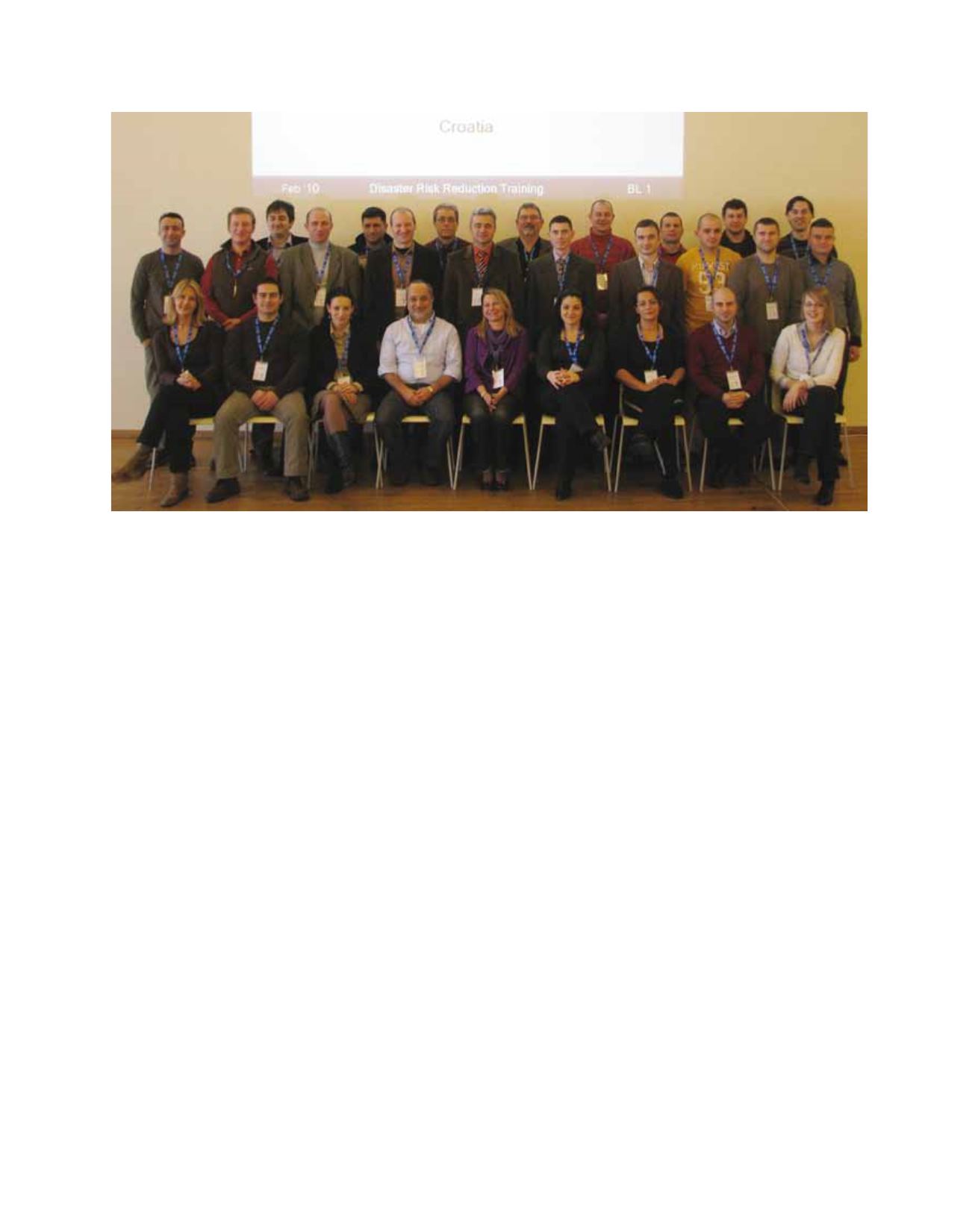
Disaster Risk Reduction training course, Croatia
Image: NPRD