


 69 / 168

[
] 69
resilience to disaster, so that preparation and response
become everyone’s responsibility. Also, it is well known
that the first and most efficient intervention is that initi-
ated by the members of an affected community, and it
can make the difference in terms of human life and mate-
rial losses. For that first intervention to be efficient, the
community’s members must prepare before a disaster
occurs. To integrate risk in the community’s life and to
create resilience, there are some instruments that can be
used in all of the phases of a disaster (prevention, prepar-
edness, mitigation, response and reconstruction) in order
to minimize negative effects afterwards.
In the first phase Romania takes into account
community awareness of prevention measures through
awareness campaigns. Examples include informa-
tion materials created by the General Inspectorate
for Emergency Situations, such as
Citizens
’
Guide in
Emergency Situations
or
Protective Measures in Case of
Earthquake
. Such campaigns were started in schools by
some institutions (Save the Children Romania, Ministry
of Education, Research, Youth and Sports, General
Inspectorate for Emergency Situations and High Group
for Romania’s children). A curriculumwas devised, along
with a handbook,
Let’s Learn to Prevent Disasters
, initially
in two areas affected by the floods in year 2006, and later
expanded to national level.
Preparedness is the key
For the preparedness phase, the General Inspectorate
for Emergency Situations created different materials to
train people how to act in case of disasters. The same
because there are other salt reservoirs in the same situation and
other people and houses could be affected by further landslides. The
Romanian authorities have evacuated people from this danger area,
but many of them refused to leave their houses. The authorities have
started soil stabilization works to reduce the risk.
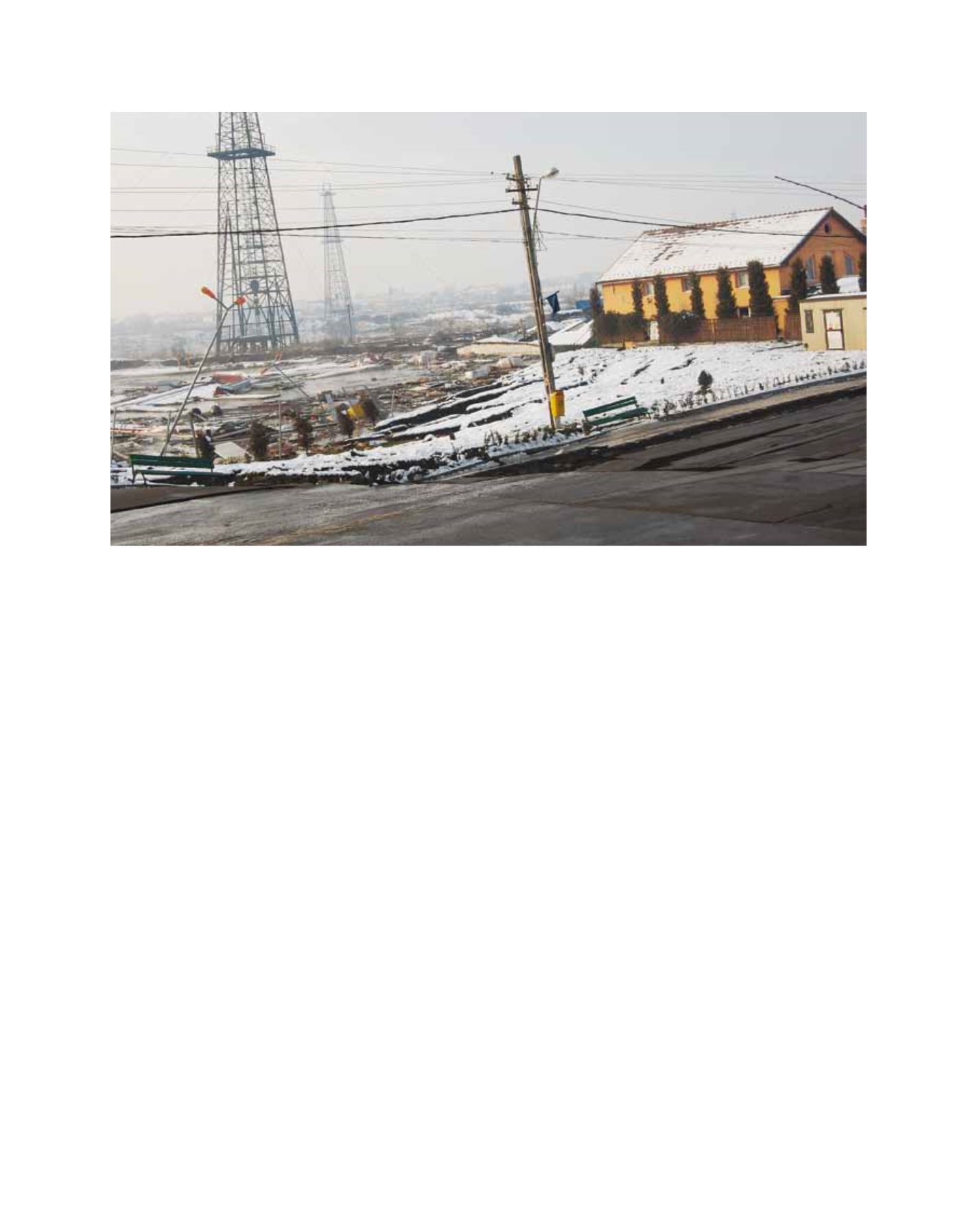
A similar case occurred in Ocna Mure
ş
, Alba County, where, as a
consequence of salt extraction and water infiltration, the salt deposit
melted, resulting in a landslide in 2010 that affected public build-
ings, a general store and a street. The other buildings nearby that
could have been affected have been evacuated. The more recently
constructed general store is an example of poor construction,
because of the lack of soil analysis that could have revealed the
danger.
Lessons learned
In spite of a prompt response for mitigation and intervention in
these cases from the General Inspectorate for Emergency Situations
(the main institution with responsibilities in disaster management),
and other governmental and non-governmental institutions that
have support functions in disaster management, there was signifi-
cant loss of life and property. From the lessons learned, we can say
that the response in case of disaster is not sufficient and we must
highlight the importance of preparation for all phases of a disaster
(pre-disaster, disaster and post-disaster) and also of the community’s
involvement in activities that can increase resilience and decrease
vulnerability in case of disasters.
Natural risks are a fact and ‘fighting risk’ is a battle that cannot
be won, so Romania has approached the idea of ‘living with risk’
through programmes for awareness and preparation.
This idea must be adopted by every member of the community
in order to increase involvement in activities aimed at improving
A house in risk of collapse because of landslides in Ocna Mure
ş
, 2010
Image: General Inspectorate for Emergency Situations