


 65 / 168

[
] 65
native evacuation routes; and producing self-help contingency
plans. This platform empowers grassroots leaders and residents
to start taking charge of safety and security issues within their
neighborhoods.
Firefighters and paramedics are vital actors in disaster operations.
The CBDRM also includes basic firefighting and lifesaving skills to
prepare communities to take appropriate action before help from
these services arrives.
Incident Command System
While it is crucial to strengthen preparedness at grassroots level,
enhancement of the response mechanism is equally important.
Under the ASEAN-US Programme on Disaster Management, Brunei
Darussalam is one of the two original pilot countries to adopt the
Incident Command System (ICS) in its national incident manage-
ment system. This collaboration with the US has provided a
framework as the basis for adaptation of appropriate models for
on-scene incident management. This two-year programme includes
a ‘training for trainers’ programme and on-scene disaster response
system using the ICS.
The ICS has increased capacity building by promoting interoper-
ability among multi-sector responders. In strengthening the existing
disaster response management system by standardizing coordination
amongst different agencies, the system also ensures that designated
responders at different levels are capable of handling different types
of emergencies and disasters.
The system has proven its effectiveness as it was used as the inci-
dent management system during flooding and strong winds in 2010.
It has enabled efficient and timely responses whilst minimizing the
impact of disaster losses.
A multi-sector approach has always been the strong-
est asset of the NDMC and this has proven to be an
effective mechanism in managing disasters in Brunei
Darussalam. With this body as the coordinating agency,
there has been excellent cooperation with the Fire and
Rescue Department, District Offices, Royal Brunei
Armed Forces, Royal Brunei Police Force, Welfare
Department, Ministry of Health and other relevant
agencies. This has contributed to ensuring the safety
and wellbeing of communities and their return to
normal life in the shortest possible period.
Ready for emerging risks
Brunei Darussalam acknowledges that climate change
may affect the country and new risks may emerge from
time to time. In this regard, the government has taken
many initiatives to prepare for and respond to disaster.
This involves taking into account worst-case scenarios
of both natural and man-made disasters such as oil
spills and gas explosions. Support for both the grass-
roots level and the responders is vital and this can be
achieved by conducting regular training and exercises
to ensure all involved are ready and able to respond.
While it is not possible to prevent disasters alto-
gether, it is worthwhile and cost-effective to mitigate
and reduce disaster risk. Every community has to live
with some risks and be prepared to reduce them. The
government will continue to ensure the safety and well-
being of the nation, thus strengthening capacity and
coordination between agencies.
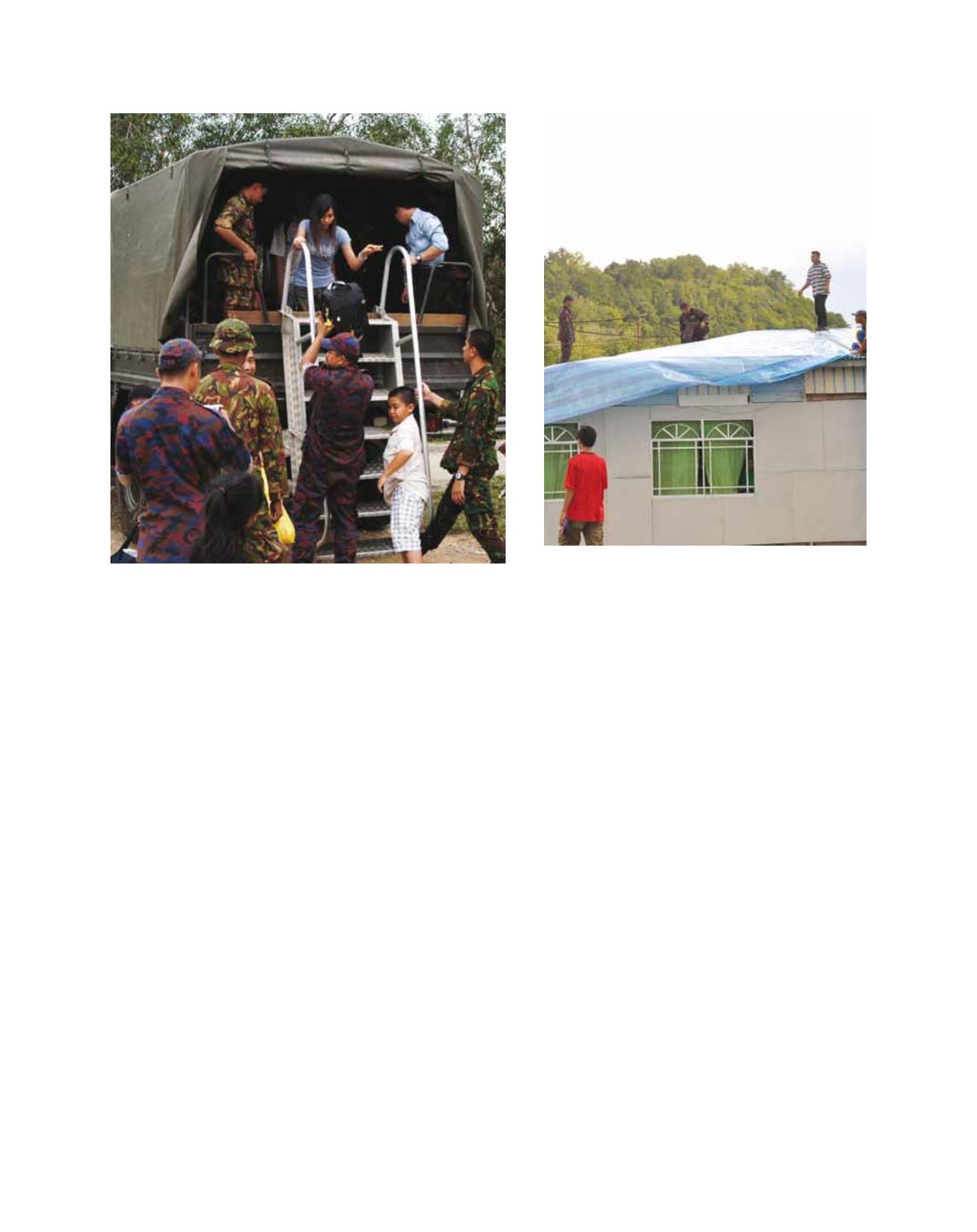
A multi-sector approach allows for quick action during and after disasters
The Incident Command System has helped communities survive
major floods and strong winds
Image: NDMC
Image: NDMC