


 63 / 168

[
] 63
Hazardscape: community
preparedness in Brunei Darussalam
Yahya Haji Abdul Rahman, National Disaster Management Centre, Brunei Darussalam
T
he climate in Brunei Darussalam is generally hot and wet
throughout the year. The wettest months are between
December and March, when the north-east monsoon
winds bring torrential rains. There is also rain from May to
July, when lowland regions, especially in flood plain areas,
are regularly inundated with water for several days. Brunei
Darussalam also experiences dry spells between the monsoons,
during which time bush and forest fires and regional trans-
boundary haze are common.
Because of climate change, the country is experiencing more
frequent and intense rainfall that leads to floods in areas normally
not affected. This has also triggered more landslides and other
secondary hazards, which have an adverse impact on Government
and public infrastructure and socioeconomic activities.
Government-led initiatives
In response to these threats, the government of Brunei Darussalam
has increased its efforts to ensure the safety and wellbeing of its popu-
lation. Since the establishment of the National Disaster
Management Centre (NDMC) Brunei Darussalam in
2006, serious measures have been implemented to
ensure that all aspects of disaster management – miti-
gation and prevention, preparedness, response and
recovery – are considered.
The NDMC has developed strategies for response and
preparedness with the main objective of building disaster-
resilient communities. In parallel to enhancing the disaster
response mechanism by using an Incident Command
System, the NDMC has embarked on a campaign to
increase public awareness through Community-Based
Disaster Risk Management (CBDRM). This shift from
reactive to proactive strategies is part of the NDMC’s
efforts to build the nation’s disaster resilience.
The CBDRM approach encourages active community
engagement in the identification, analysis, treatment,
monitoring and evaluation of risks in order to reduce
vulnerabilities and enhance capacity. Basic life saving
2014
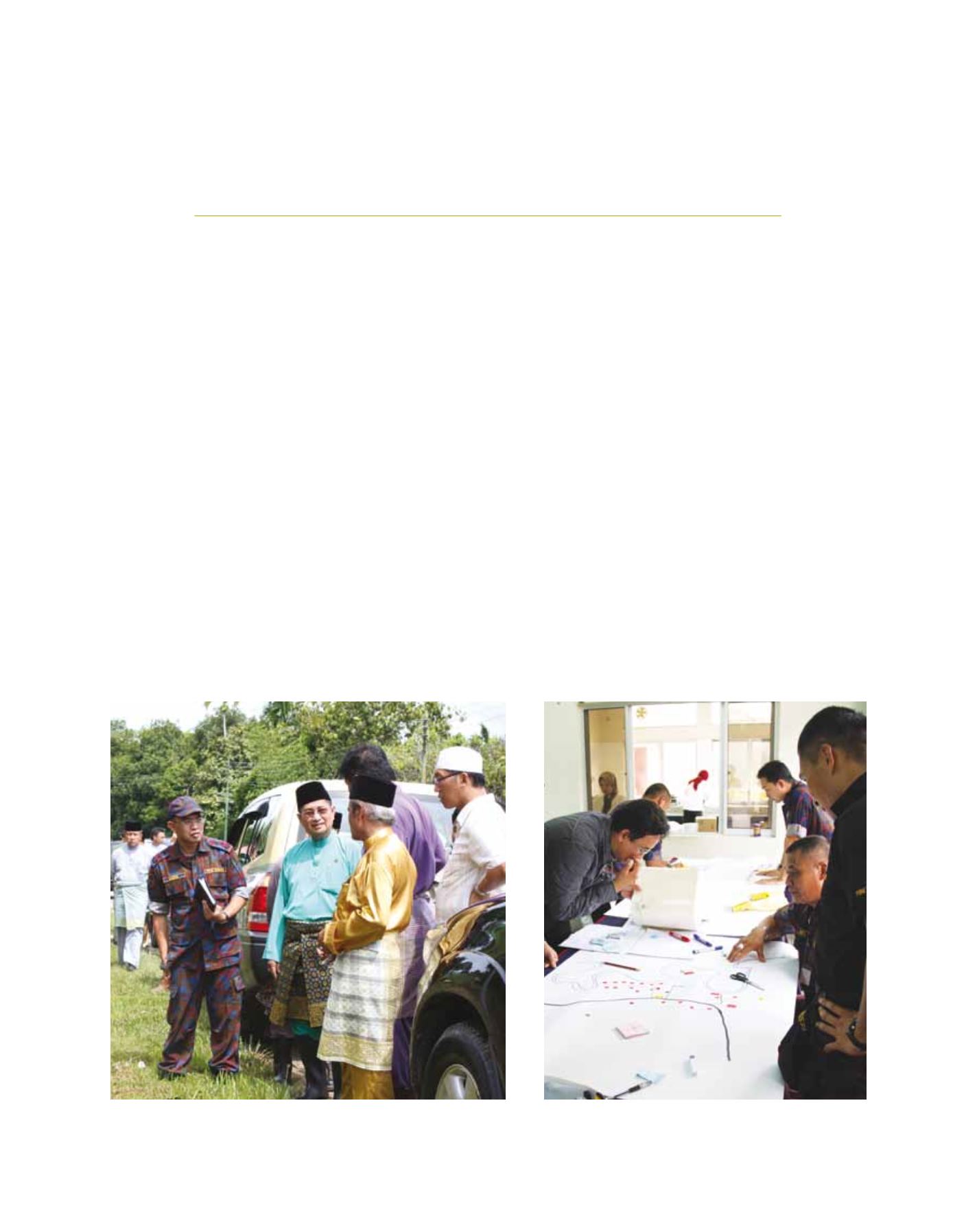
Minister of Home Affairs leads multi-agency coordination with
communities to build resilience
Trainers from Government agencies use historical data to
conduct risk assesments
Image: NDMC
Image: NDMC