


 61 / 168

[
] 61
istic outlook currently prevalent within the communities. To this
end, GOAL continues to form alliances with Government agen-
cies and other complementary funding programmes to continue to
integrate the results of the DIPECHO programme into sustainable
development programmes in the region.
For many vulnerable communities, initiatives in disaster prepar-
edness are often their first introduction to the basic concepts of
DRR. Activities completed in disaster preparedness need to be incor-
porated into the way of life of vulnerable communities. For example,
communities living in high-risk areas need to carry out regular evac-
uation exercises, in many cases for the rest of their lives. First aid
and search and rescue brigades need to put these skills into practice
regularly if these skills are to be available when needed. In addition,
there is a need to support the reintroduction of best practices and
the rescue of traditional coping strategies.
A key role for GOAL and other agencies in the future will be
facilitating a mechanism to fully hand over DRR initiatives to
communities with adequate support from local and national
government structures. This will involve strengthening capacities
primarily at local government level and at national level. In this
regard, many demonstrative models have been developed within
the DIPECHO programme, and in many cases minimal support
is required to maintain and replicate these models until a critical
mass is developed to ensure sustainability. For example, in Gracias
a Dios the technical unit of the Mancomunidad of Gracias a Dios
(Association of Municipalities of Gracias a Dios) is being strength-
ened to provide ongoing support to the department’s local and
municipal emergency committees. This will be financed through
a fixed percentage of the budget of each municipality. However,
GOAL would recommend that this initiative should be maintained
for a strategic period of 3-5 years in order to make sure it is fully
established and operational. This would include a minimal budget
to support simulation exercises and training events. This model is
based on a similar model developed by DIPECHO in
the Department of Colon in Honduras.
GOAL, in partnership with the EU Strengthening of
Local Natural Resource Management (FORCUENCAs)
programme, is supporting initiatives for Local
Emergency Committees (CODELs) in Gracias a
Dios, to be used as a vehicle to consolidate leaders
in the community by establishing Local Development
Committees. These committees will be active at all
times and not just in the case of emergencies. CODELs
are generally formed based on the natural leadership
in the community and ensuring the representation
of various sectors and vulnerable groups. This same
group of leaders is best placed to lead sustainable local
development. Activities of the Local Development
Committee will centre on sustainable local devel-
opment, including DRR as a transversal theme. For
example, the group could organize sports and cultural
events and include a simulation exercise as part of
the event. The group would also be responsible for
leading the community in the completion of other
community projects.
Planning local sustainable development
Municipal development plans are available in many
municipalities in Honduras, but there is often minimal
participation of marginalized poor communities.
Through DIPECHO Disaster Preparedness programmes
in Gracias a Dios, prevention and response plans have
been prepared by many communities. These plans
contain many of the elements that would be expected to
be included in a local development plan. GOAL, in part-
nership with the EU FORCUENCAs programme and
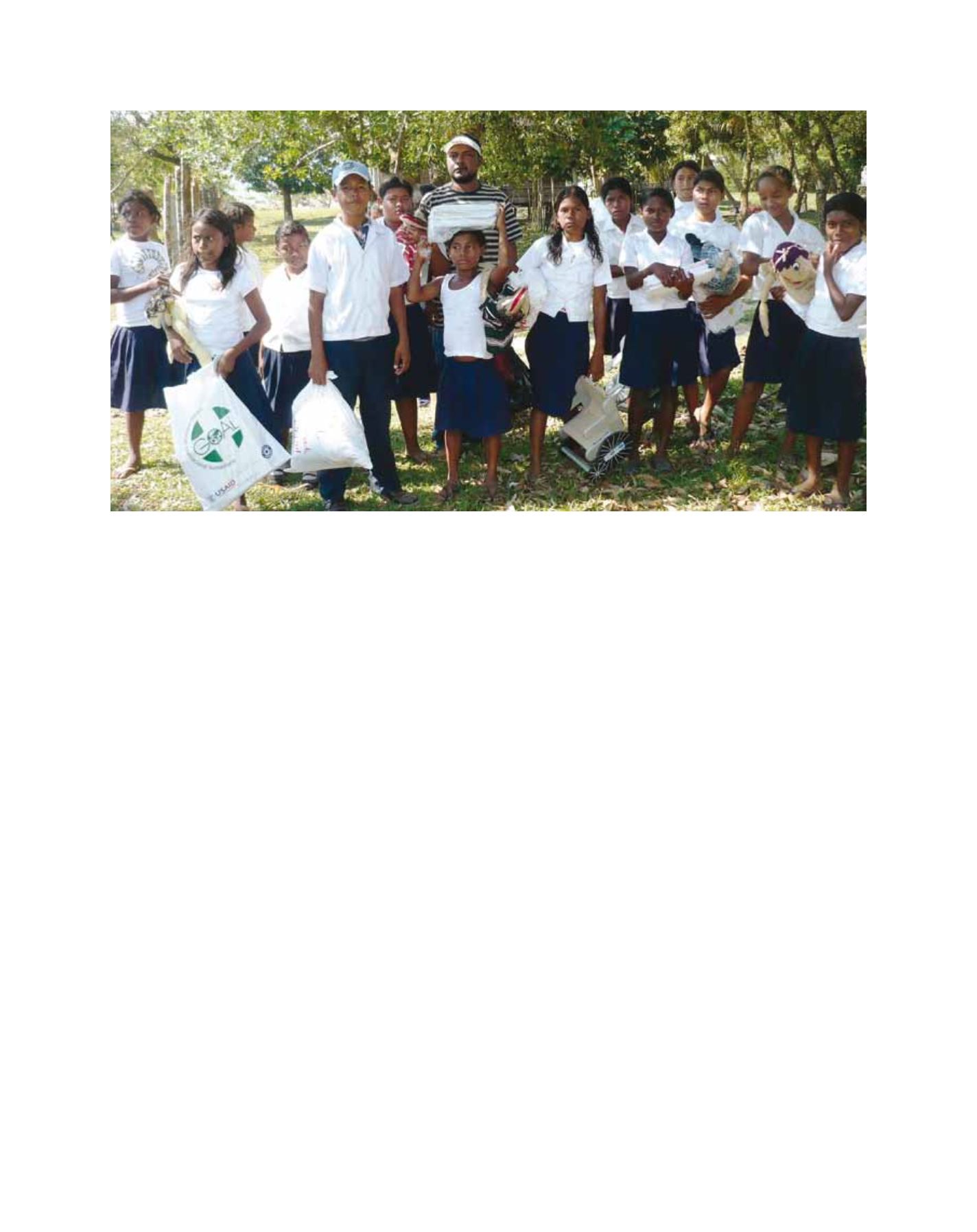
In Honduras, GOAL has supported an initiative to incorporate DRR within the national curriculum
Image: GOAL