


 68 / 168

[
] 68
Disasters – a part of life
Eugen Visan, Romanian Ministry of Administration and Interior, General Inspectorate for Emergency Situations
G
enerally speaking, disaster represents a great misfortune
that strikes a community – a catastrophe of enormous
proportions. Disaster also means an abnormal situa-
tion, hard to bear by the community, or a serious disturbance
in society’s normal existence.
These community disturbances, which determine a series of major
negative effects, are mainly generated by natural and technological
hazards. The risk of such events relates to the probability of nega-
tive phenomena occurring, combined with the vulnerability of the
communities affected: in other words their capacity to cope with
disasters.
Facing escalating risks
Lately, at a global level, there has been an important increase in risk
occurrence, generating disasters that tend to be part of communities
lives. The intensity and frequency of disasters is influenced mainly
by climate changes and the effects of industrialization.
Man-made disasters can be prevented by human actions, while
dangerous meteorological and geological phenomena like earth-
quakes and tornadoes that cause natural disasters
cannot be stopped by human actions. On the other
hand, in the case of landslides, for example, the risk
can be amplified by human action – as in the case of
massive deforestation – or reduced (by reforestation
and soil stabilization works). Natural risks are gener-
ated by dangerous meteorological and geological
phenomena that recur over a period of time. It is in
our power to learn to live with disasters and increase
communities’ resilience.
In Romania, natural risks generate disasters every
year. New natural risks, caused by the dangerous mete-
orological phenomenon of the tornado that has not
historically been prevalent in this area, struck many
communities for the first time in 2002 in F
ă
c
ă
ieni,
Ialomi
ţ
a County, and in 2005 many communities were
affected by this hazard. From 2005-2010, Romania
experienced major floods caused by heavy rains and
by the Danube River and internal rivers overflowing,
these floods affecting the nearby communities. In June
and July of 2010, following heavy rains, a large part
of Romanian territory was affected by floods. As a
consequence of early warning systems, 19,997 people
were evacuated from the danger area, while 23 people
died. The floods affected 3,936 houses, 443 kilometres
of dams, 5,257 kilometres of roads, 707 large bridges
and 2,729 small bridges, public utility networks in
the area and 147 public buildings. The total estimated
financial value of losses was €867,958 million. Most of
these losses were a consequence of poor preparation
of communities, ignorance regarding self-protection
measures, reluctance to apply protection measures
ordered by state institutions, bad management of rivers
and dams, houses built in flood-prone areas and lack
of involvement of local communities in activities that
could prevent significant losses.
Another serious situation arose in the town of Ocnele
Mari, in Vâlcea County, where in 1961 a salt reservoir
began to operate near the town. The method used for
salt extraction was water pumped from the reservoir,
followed by extraction of a saline solution for process-
ing, each well being designed to work individually. As
a consequence of a massive extraction of salt from this
area and because of water infiltration, after 1991, when
the process of extraction had been stopped, the remain-
ing salt deposit melted. This resulted in landslides in
2001 when many houses from that area were affected
and people evacuated. The danger has not passed
2009b
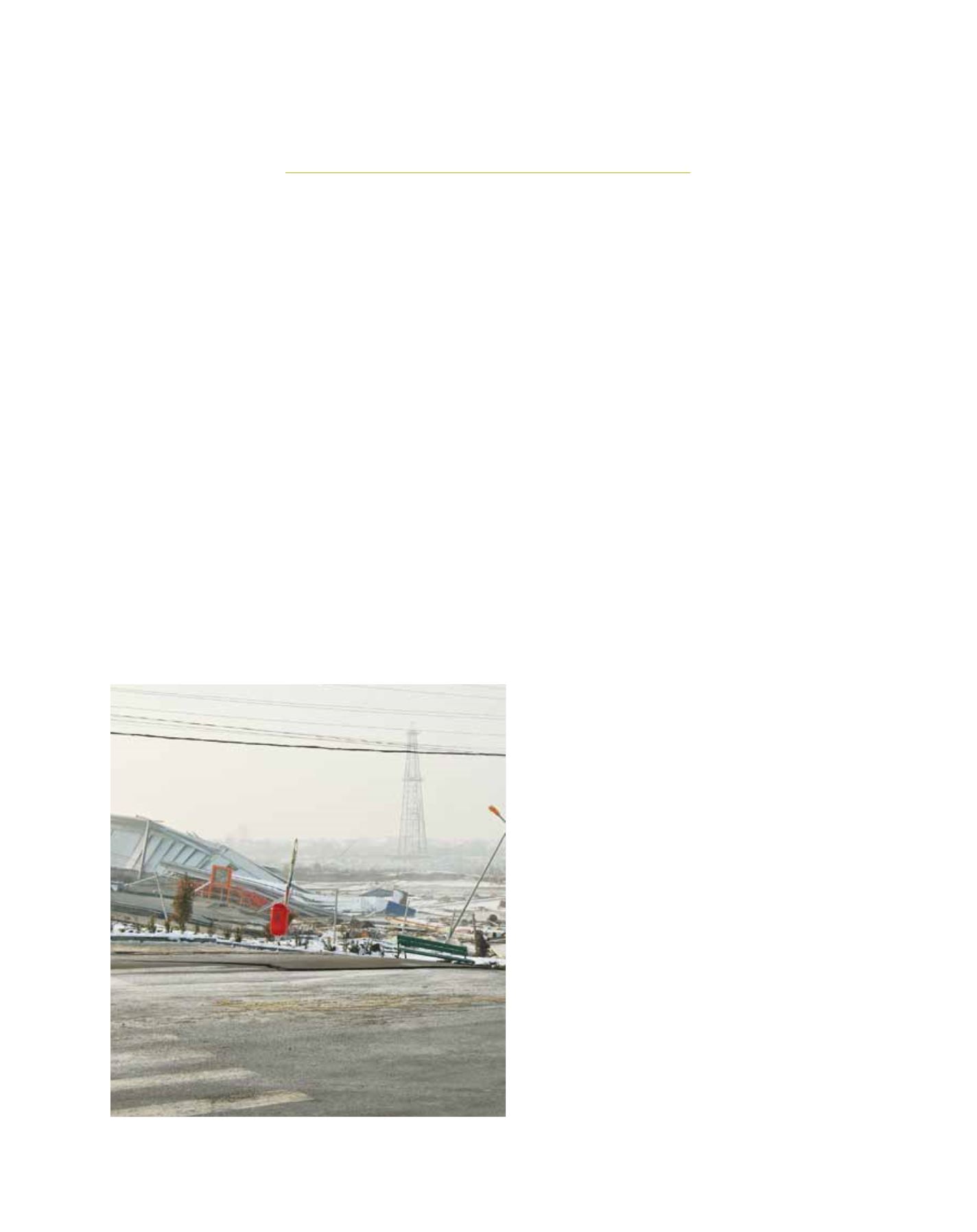
A general store affected by the collapse of land in Ocna Mure
ş
, Romania, in 2010
Image: General Inspectorate for Emergency Situations