


 70 / 168

[
] 70
stakeholders like civil society or private sector increases
efficiency and decreases the necessary time period for
response.
The reconstruction phase, representing the end of one
cycle (prevention, preparedness, mitigation, response
and reconstruction) and the beginning of another, is
important in order to decrease vulnerability and increase
resilience of the community to further risks by using new
methods for the reconstruction of the affected commu-
nity. Romania has used a number of methods and actions
like resettlement of houses built in floodable areas, resto-
ration of river flow and resizing dams.
Future strategies
In respect of the legal framework, a number of laws, strat-
egies and regulations have been adopted to reduce risk in
case of floods, earthquakes or dangerous meteorological
phenomena. Ministries that deal with environment pres-
ervation or safe development have projects to restore the
flow of rivers or to reinforce high buildings that are in
danger of collapse in case of earthquakes.
In conclusion, we can say that natural risks are a
part of our life, turning into disasters that disturb
the normal existence of a community – but fighting
against nature is a lost battle. The number of losses
in case of disaster is related to the vulnerability of the
community. Vulnerability and resilience represent
instruments that can be used in order to minimize
losses within a community. As much as risks return
and disasters strike again, at least we can help grow
the resilience of our communities.
institution has created, at county level,
Plans for Analysis and Hedging
Risks
to identify the ways in which scenarios and histories of exist-
ing risks can be used for warning, evacuating people, mitigation and
response to disasters, along with tests and exercises. In this phase,
early warning systems have an important role in risk monitoring. For
dangerous meteorological and hydrological phenomena in Romania,
there are two agencies (National Meteorological Administration
and National Institute of Hydrology and Water Management) that
provide meteorological and hydrological forecasts. The forecasts use
colours (green, yellow, orange and red) to highlight the gravity of
each phenomenon, where green represents normal conditions and red
represents very dangerous meteorological and hydrological phenom-
ena that could cause damage. These forecasts and warnings are very
useful for decision makers to help them initiate the necessary meas-
ures and also for communities to protect themselves.
For earthquakes, the National Institute for Earth Physics moni-
tors seismic activity. This institute has developed a warning system,
the Rapid Early Warning System, or REWS, for earthquakes in the
Vrancea area. REWS provides a warning of 25-28 seconds between
identification of the earthquake and the moment it strikes. This
system could not be called an early warning system because the time
is too short for people living in multi-story buildings to be evacu-
ated. Unfortunately, at this time, there is no early warning system
to provide forecasts or warning regarding earthquakes. Another
measure taken by the Romanian authorities in this phase was the
introduction of a requirement for people to acquire home insurance
contracts in order to facilitate the reconstruction process.
Intervention after a disaster is mainly the responsibility of the compe-
tent state institutions. Besides these, there are also in place voluntary
and private services for emergency situations that have the necessary
training to respond. Lessons learned teach us that involving other
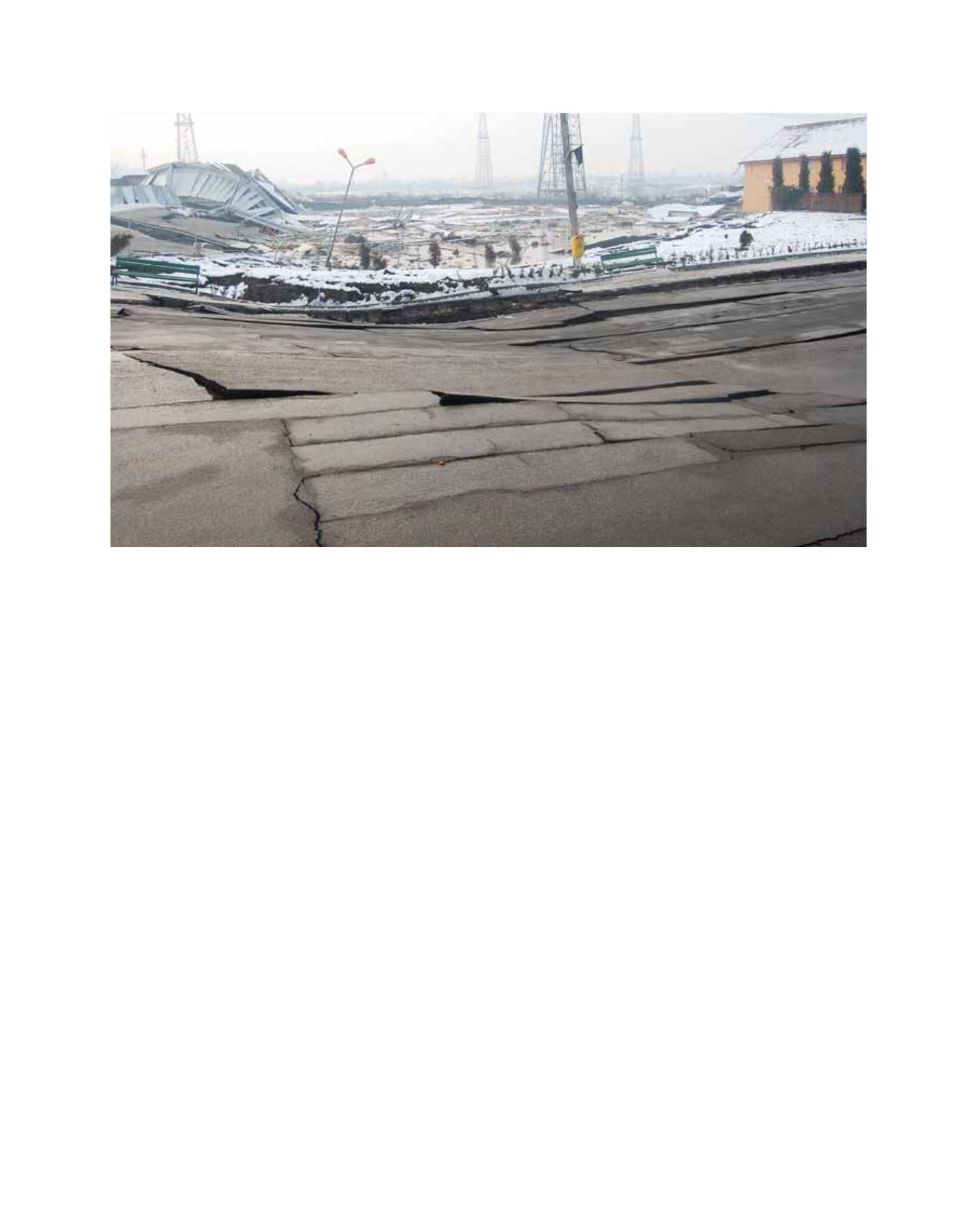
A main street affected by the collapse of land in Ocna Mure
ş
, 2010
Image: General Inspectorate for Emergency Situations