


 76 / 168

[
] 76
and issuing of tropical weather outlooks. Table 2 provides details
of the nodal organizations responsible for disaster management
in the four member countries (Bangladesh, India, Maldives, and
Sri Lanka) of the Bay of Bengal Programme Inter-Governmental
Organisation (BOBP-IGO).
Cyclone preparedness activities in the region
Key programmes on cyclone preparedness and vulnerability
reduction have been implemented in the four BOBP-IGO member-
countries, generating important lessons for the region.
India
On 6 November 1996, a tropical cyclone with a wind speed of
220 kilometres per hour and tidal surge of more than 2.2 metres
crossed the coast of East Godavari district in Andhra Pradesh, India.
Approximately 3,000 people perished in the cyclone and property
worth millions of US $ was destroyed. This cyclone focused attention
on the need to take a fresh look at disasters and their management
in India. Subsequently, in early 1997, the Food and Agriculture
Organization of the United Nations implemented a Technical
Cooperation Programme in association with the Ministry of
Agriculture, Government of India and the Department of Fisheries,
Government of Andhra Pradesh. This pilot project, implemented in
and around Kakinada, Andhra Pradesh, was aimed at investigating
and introducing measures that could reduce the vulnerability of
fishing communities to cyclones.
3
It yielded many important lessons
on effective cyclone disaster prevention and mitigation, which are
summarized below:
Cyclone forecasting and warning
For communities living in the coastal areas, survival is dependent on
• Early warnings that are timely, readily comprehensible and
perceived to be accurate and reliable for their locality
• Availability and effectiveness of evacuation measures
• Availability of cyclone shelters or other safe buildings.
Similarly, survival at sea is dependent on the capacity to
receive warnings as well as the capability of the vessel and
crew to escape, find shelter or ride out the storm. For those
who survive the immediate effects of the cyclone, timely
rescue and relief may be required to ensure survival in the
aftermath. At the community level too, there needs to be
considerable awareness and educational work on how to
best adapt forecasts and improve comprehension and trust
among communities. Such work should build on indig-
enous knowledge about cyclones.
Connection between development and disaster preparedness
For community disaster preparedness to be sustainable,
there needs to be long-term follow up by the Government
and non-governmental organizations. Further, to assure
sustainability the work needs to be interwoven with
other livelihood and developmental activities undertaken
by the Government and other civil society organizations
in areas such as sanitation, water supply, education and
housing, which are all vulnerable to disasters.
Gender mainstreaming
Gender balance is essential at all levels of disaster
preparedness as women are frequently the caretakers
and provide for basic survival. They also have a number
of particular problems and perspectives that are differ-
ent from those experienced by men in a disaster.
Creative approach to cyclone shelters
Such facilities in the coastal areas should have
multi-purpose functions and could serve as schools,
community halls, offices, etc., besides providing
shelter from cyclones in an emergency. They should be
constructed and managed with full participation and
involvement of the local community.
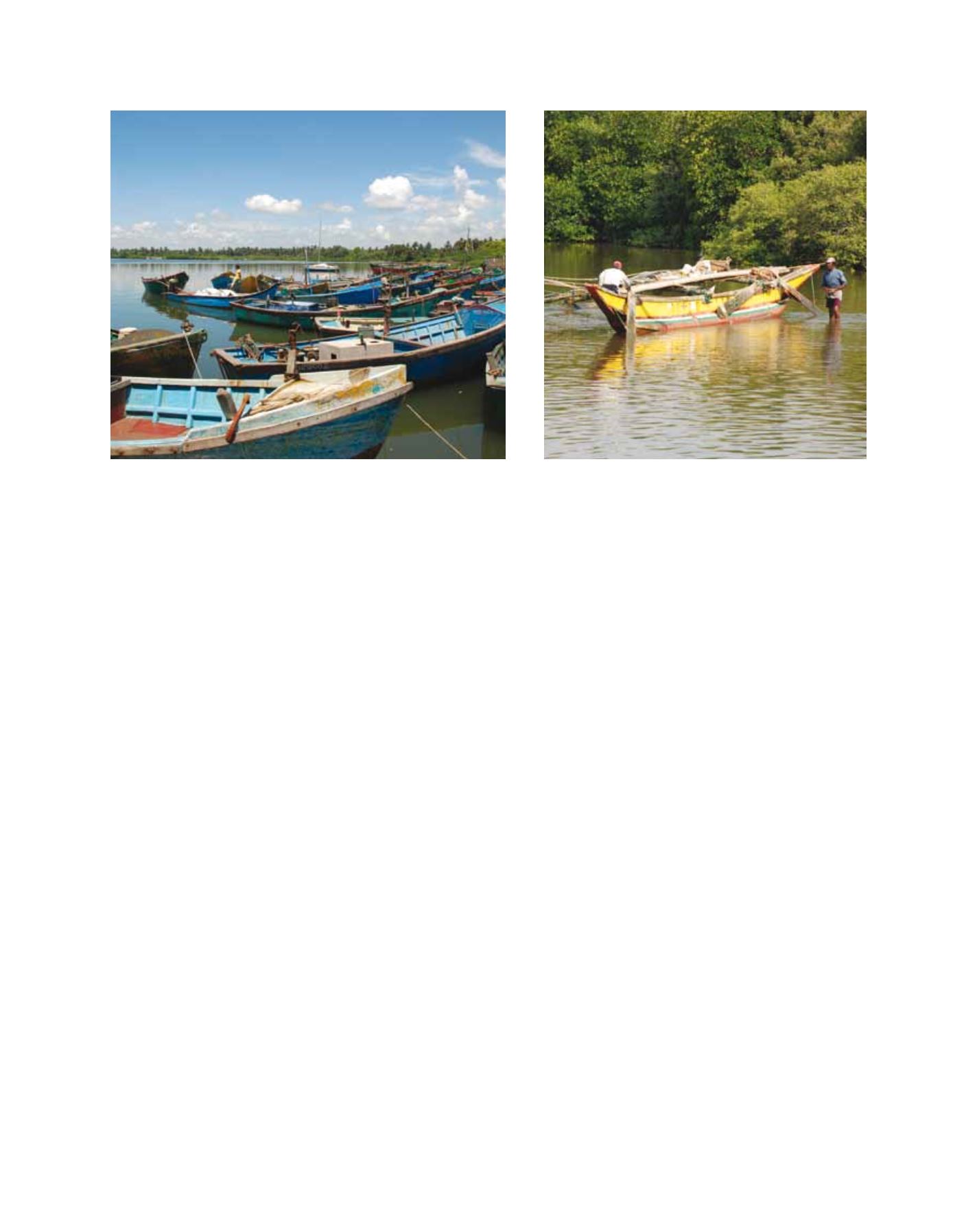
Safe anchorages and berthing places can reduce damage to boats
and gear during cyclones
Mangroves act as bio-shields and help in mitigating the effects of
cyclones and storm surges
Image: Yugraj Yadava
Image: Yugraj Yadava