


 71 / 168

[
] 71
Disaster risk reduction in Croatia
Damir Trut, General Director, Damir
Č
emerin, Deputy Civil Protection Commander and
Nataša Holcinger, Officer for Prevention Measures, National Protection and Rescue Directorate, Croatia
W
hile the term ‘disaster risk reduction’ has only
recently been used in daily policies and practices in
Croatia, interest in it has existed in the country for
many years at all levels.
A number of acts and legal documents in the Republic of Croatia
have addressed solutions concerning quake-safe construction, envi-
ronmental protection and physical planning that deals with risk
reduction, as well as preparation of capacities for disaster response.
Introduction and application of quake-resistant construction regula-
tions as far back as in 1964 considerably reduced disastrous quake
consequences in such buildings and today over 50 per cent of people
live in quake-safe structures. Embankments, retention devices and
other structures have reduced flood risk in densely populated areas
and industrial zones for almost 100 years, while physical planning
provides for construction zones, taking into account risks from
natural and man-made disasters.
Croatian National Platform for Disaster Risk Reduction
The Croatian National Platform for Disaster Risk Reduction has
been established as a forum for the exchange of information,
knowledge and achievements in various fields of natural and social
sciences, as well as for practical application. It has
gained a special momentum because its establishment
under the auspices of the Government of the Republic
of Croatia has articulated joint activities of this nature
as a national priority.
The Government of the Republic of Croatia decided
to establish the Platform in March 2009 as an instru-
ment for the implementation of systematic disaster
risk reduction. A committee was formed, constitut-
ing representatives of the National Protection and
Rescue Directorate, Ministry of Defense, Ministry of
Environmental Protection, Physical Planning and
Construction, Ministry of Foreign Affairs and European
Integration, Ministry of Economy, Labour and
Entrepreneurship, Ministry of Agriculture, Fisheries
and Rural Development, Ministry of Sea, Transport and
Infrastructure, Ministry of Health and Social Welfare,
Ministry of Regional Development, Forestry and Water
Management, Ministry of Culture, Ministry of Science,
Education and Sports, Meteorological and Hydrological
Service, and the Croatian Academy of Sciences and Arts.
Also involved in the work of the committee are
Hrvatski Caritas Croatia, Croatian Red Cross and
Croatian Mountain Rescue Service and, more recently,
the Croatian Seismological Survey and Croatian Waters
Company.
One of the achievements of the Platform is the organi-
zation of regular annual conferences where scientific
and professional papers are presented and after which
books of conference proceedings are published.
In addition to state administration bodies and other
institutions such as citizens’ associations perform-
ing protection and rescue activities, each conference
is attended by other central state organizations (State
Office for Nuclear Safety, State Office for Radiation
Protection, Croatian Environment Agency, State
Geodetic Administration), Universities of Zagreb, Split,
Rijeka, Osijek, and public companies including INA
Oil Industry, Croatian Railroad Company, Croatian
Electricity Company, Croatian Waters Company,
JANAF (Adria Oil Pipeline). Other guests include large
economic entities, associations involved in environ-
mental protection, and religious communities.
The First Conference of the Croatian Platform, held
on 9 November 2009, addressed the topic of disaster risk
reduction. More than 180 participants attended from
authorities, large economic entities, academia (Croatian
Academy of Sciences and Arts and several schools and
2007b
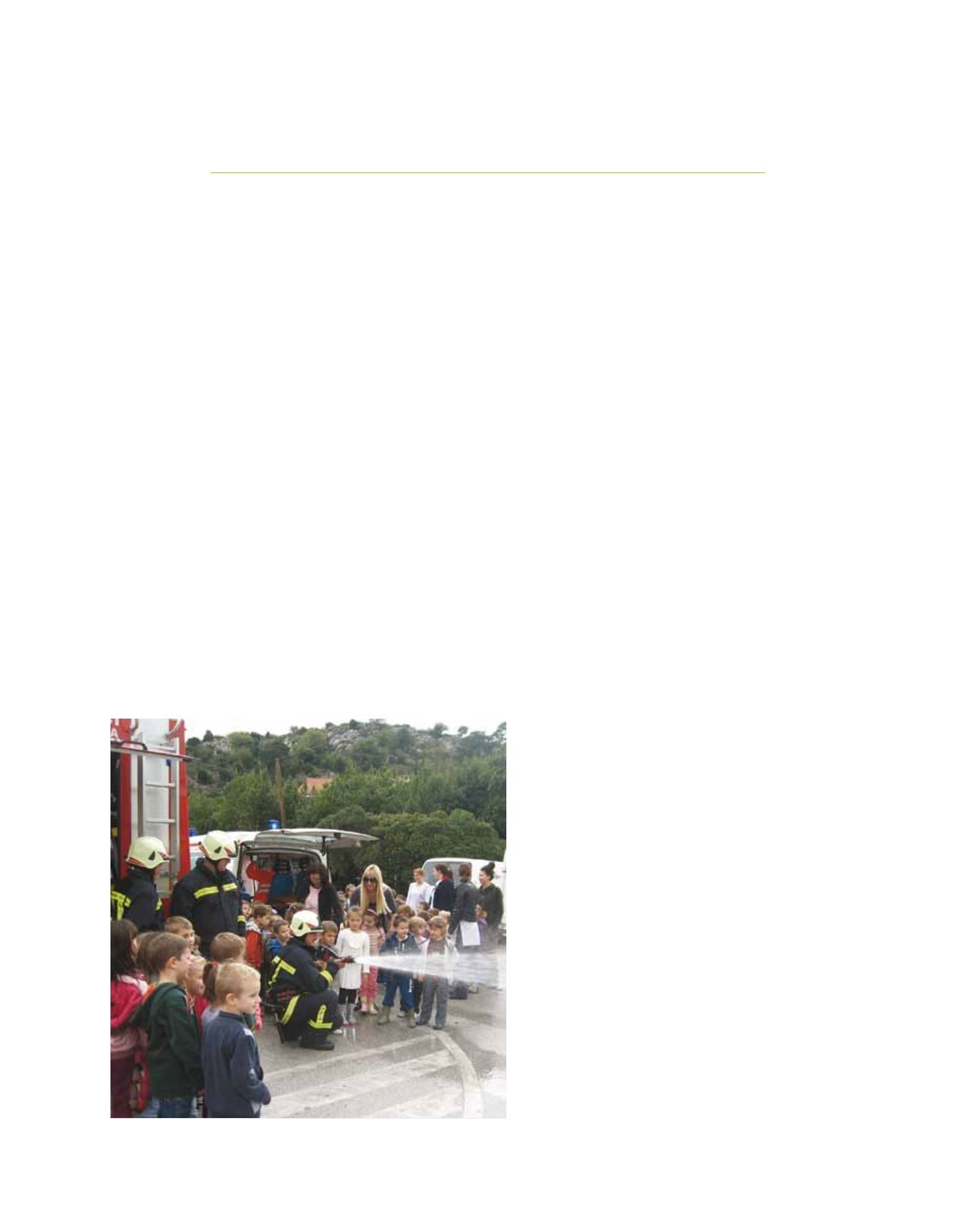
Disaster risk reduction in shcools, Dubrovnik, Croatia
Image: Goran Violic