


 75 / 168

[
] 75
heavily protected with concrete levees and afforestation
to create a green belt.
In the BoB Region, the Indian Meteorological
Department (IMD) is designated by the World
Meteorological Organization (WMO) as a Regional
Specialized Meteorological Centre for tropical cyclones
and is responsible for providing advice to neighbour-
ing countries. As a part of the WMO Tropical Cyclone
Programme (TCP), five regional panels have been
established, which coordinate the planning and imple-
mentation of measures to mitigate tropical cyclone
disasters on a worldwide basis. The main objective of
the panels is to promote measures to improve tropical
cyclone warning systems in the BoB and the Arabian
Sea through an effective operational plan. The plan
records the agreed arrangements for standardization of
operational procedures, efficient exchange of various
data related to tropical cyclone warnings, issuing of
cyclone advisories from a central location (Regional
Specialized Meteorological Centre), archiving of data
horizons of OOS in taking care of the safety and well-being of the
coastal communities in the region.
The most important aspect of OOS is the real time dissemination
of data, especially during extreme weather conditions. The shore
station is manned 24 x 7 and the data obtained from buoys are
disseminated in real time to the Indian National Center for Ocean
Information Services, Hyderabad for further processing. The data
is utilized by a wide spectrum of end users such as meteorologists,
oceanographers, environmentalists and offshore engineers in the
region and elsewhere.
In Bangladesh, a detailed programme for storm prevention was
implemented by the Government following the 1991cyclone. A
comprehensive Cyclone Preparedness Programme (CPP) is jointly
planned, operated and managed by the Ministry of Food and
Disaster Management and the Bangladesh Red Crescent Society. A
volunteer force of more than 32,000 people has been trained to
help with warnings and evacuation in the coastal areas. Around
2,500 cyclone shelters have been constructed on elevated platforms
in these regions, serving the dual role of schools or community
centres during normal weather. The Chittagong coast has been
Country
Bangladesh
India
Maldives
Sri Lanka
Nodal agency
Disaster Management and Relief Division (Ministry of Food and
Disaster Management)
Ministry of Home Affairs and Ministry of Earth Sciences/IMD
(for earthquake, cyclone and tsunami)
Ministry of Defence and National Security Services
Ministry of Disaster Management
Operational arm
Disaster Management Bureau
National Disaster Management Authority
National Disaster Management Centre (NDMC)
Disaster Management Centre of Sri Lanka
Table 2: Institutional arrangements for disaster management in the BOBP-IGO countries
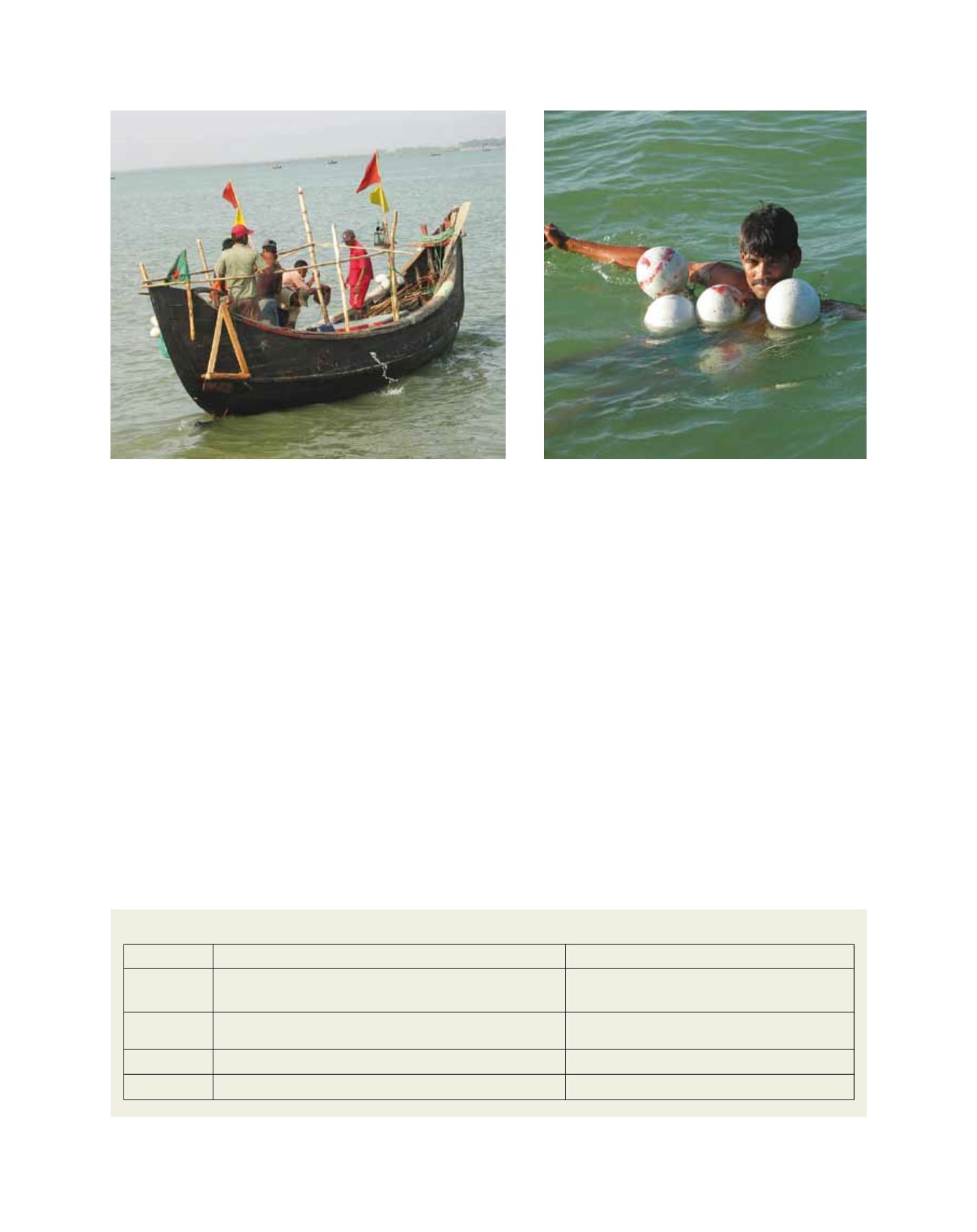
Small fishing boats that lack safety and communication equipment are
at risk during bad weather conditions
Cheap locally fabricated floatation devices come in handy
during emergencies at sea
Image: Yugraj Yadava
Image: Yugraj Yadava