


 84 / 168

[
] 84
This is an example of mainstreaming DRR in a recov-
ery project. The project also shows the importance of
keeping in mind a bigger picture. The aim of protecting
WASH services is to ensure users have the minimum
services required to survive and thrive, so the focus
should be on users rather than the services themselves.
Even though attention to WASH is vital, in any action
the links with other sectors (such as shelter, food secu-
rity, energy or health services) have to be considered
and priority given to the sectors that can maximize the
positive impacts on a society. In the project in India,
shelter, livelihoods and WASH were combined.
When looking at disaster risk, WASH services have to be
considered as part of the larger picture, a picture that looks
at the functioning and resilience of society as a whole.
There is space for the integration of DRR in WASH
in emergency response and early recovery as well as in
development interventions.
In emergencies, DRR will be limited in scope. In
relief, the focus will be on critical services, ensur-
ing users have access to enough safe water for their
survival needs. As such, DRR actions will be limited
to essential elements (safe location of emergency
systems, or ensuring sufficient stock and safe storage
of water treatment chemicals). The timescale consid-
ered will be narrow, ranging from hours to weeks.
Integration with other sectors and cross-cutting issues
will be more limited.
In the recovery phase, these boundaries are enlarged.
While elements covered in relief remain important,
services covered will be extended to less critical but
saline water. Five months after Aila, many villages were still inun-
dated, and needs in the community with regards to shelter, food,
and WASH services were very high.
Funded by the European Commission’s Humanitarian Aid
department (ECHO), CARE India implemented the Sundarban
Aila Recovery Project from February 2010-January 2011. This
project covered shelter, worked on strengthening livelihoods, and
supplied WASH services to a number of communities. The vulner-
ability of the communities to future flooding was obvious, and the
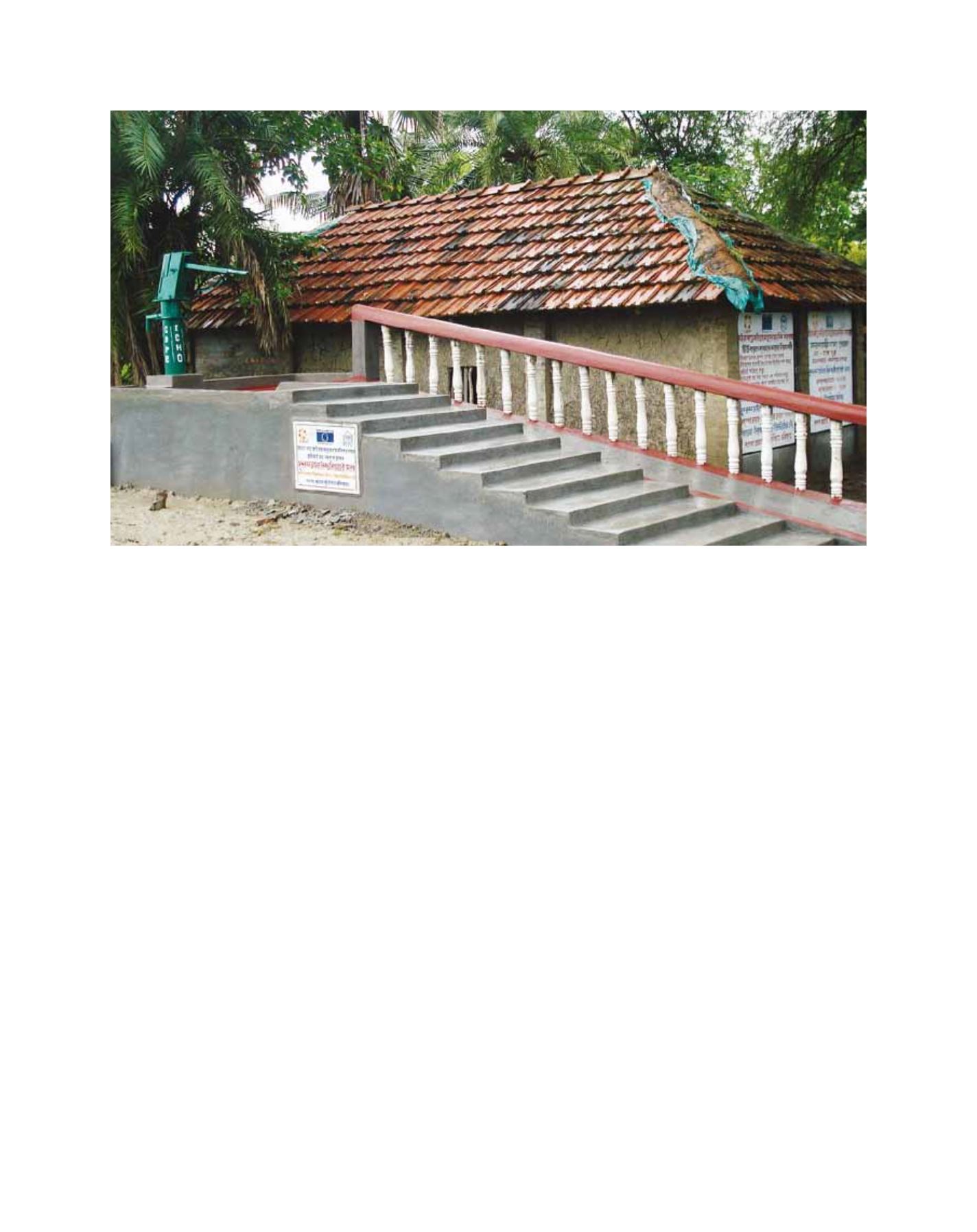
handpumps installed were raised so as to ensure they would not
be affected during flooding, and that they would continue to be
operational even if the surroundings were inundated. The raised
handpumps were made in such a way that disabled users could
also use them.
The project addressed the needs of the community in hardware,
software, and community organization. The raised handpumps were
installed in collaboration with the community. Potential users of
the system were involved in hygiene promotion activities aiming
to improve public health, and in awareness activities on the proper
use and cleanliness of the pump and its surroundings. Instructions
for the proper operation of the handpumps were also painted on
the platforms.
Users Committees, consisting of locally elected representatives,
and members of the community, were formed. These committees
were trained in the operation and maintenance of the systems, and
in basic management and administration tasks needed to keep the
systems operational.
Engagement of the community in the development of the project
was strong, which, together with a cost recovery system that will
cover the funds needed for operation and maintenance, will assist
in the sustainability of the systems.
Raised handpump installed in Gangapur Village; installations were made in close collaboration with the community
Image: © CARE India