


 88 / 168

[
] 88
bank. The Ndamera community is excited that since the erection
of the dykes it has not experienced flash flooding, despite the river
waters reaching levels which usually would flood the villages. The
people pray that the dykes hold strong, especially for the remainder
of this year when they have not yet gained significant strength.
Soils in Ndamera are uniformly graded which make them highly
erodible. Where there are defined banks they are collapsing due
to undercutting. Gabion baskets were used to protect these banks
especially where the river changes direction. Steep banks were bevel-
led to create gentle slopes which will promote re-colonization by
plant species. It should be noted that the Nyachilenda River flows
only when it is raining or when its source receives significant rains,
otherwise the flow is subsurface.
Reforestation interventions
Deforestation was a major problem for the Ndamera community,
which has undertaken a massive tree-planting drive since the mid-
1990s with support from the United Nations High Commission for
Refugees. Under this drive efforts were concentrated on planting
trees at homesteads for firewood, shade and wind breaks. However,
due to limited land at homesteads the community was advised by the
Department of Forestry to consider establishing plantations on the
riverbanks. Reforestation activities are spearheaded by the Village
Natural Resources Committee (VNRC) which works closely with
the local forestry officer.
The community has started realising the benefits from its
2-hectare plantation through harvesting timber and firewood.
The plantation has also fortified the riverbanks, reducing erosion.
Under GOAL’s ECHO-funded project 10,000 seedlings (Neem and
Acacia) have been planted on the banks of the Nyachilenda River.
The tree planting activities have the immediate benefit of curbing
stream bank cultivation, medium-term benefits of
providing timber and firewood, and long-term benefits
of negating effects of climate change. The community
intends to establish a saw-mill in the area to add value
to the timber as well as creating employment for future
generations.
Food security interventions
GOAL’s ECHO-funded programme has had a food secu-
rity component where 902 farming families in Ndamera
received short-cycle flash-flood and drought tolerant
seeds with technical assistance from the UN Food and
Agricultural Organization. Each participating house-
hold received sorghum, pearl millet, cassava cuttings,
sweet potato vines, carrot, garlic, onion and vegetable
seeds. It is pleasing to note that the seeds were distrib-
uted to a receptive and willing community as almost
all of them were planted. While the traditional maize
crop wilted, farmers were assured of realizing up to 80
per cent of the expected yield from sorghum and millet
crops. Having gone through seed multiplication train-
ing, participating farmers will now retain seed for the
coming season and plant it on time.
Capacity-building through training and workshops
Ndamera, like most areas in Nsanje district, has civil
protection structures which include Village Civil
Protection Committees (VCPCs) and VNRCs. These
committees report to the district and are voluntary.
Their operations in Ndamera were, however, affected
by lack of support and follow-up by the district
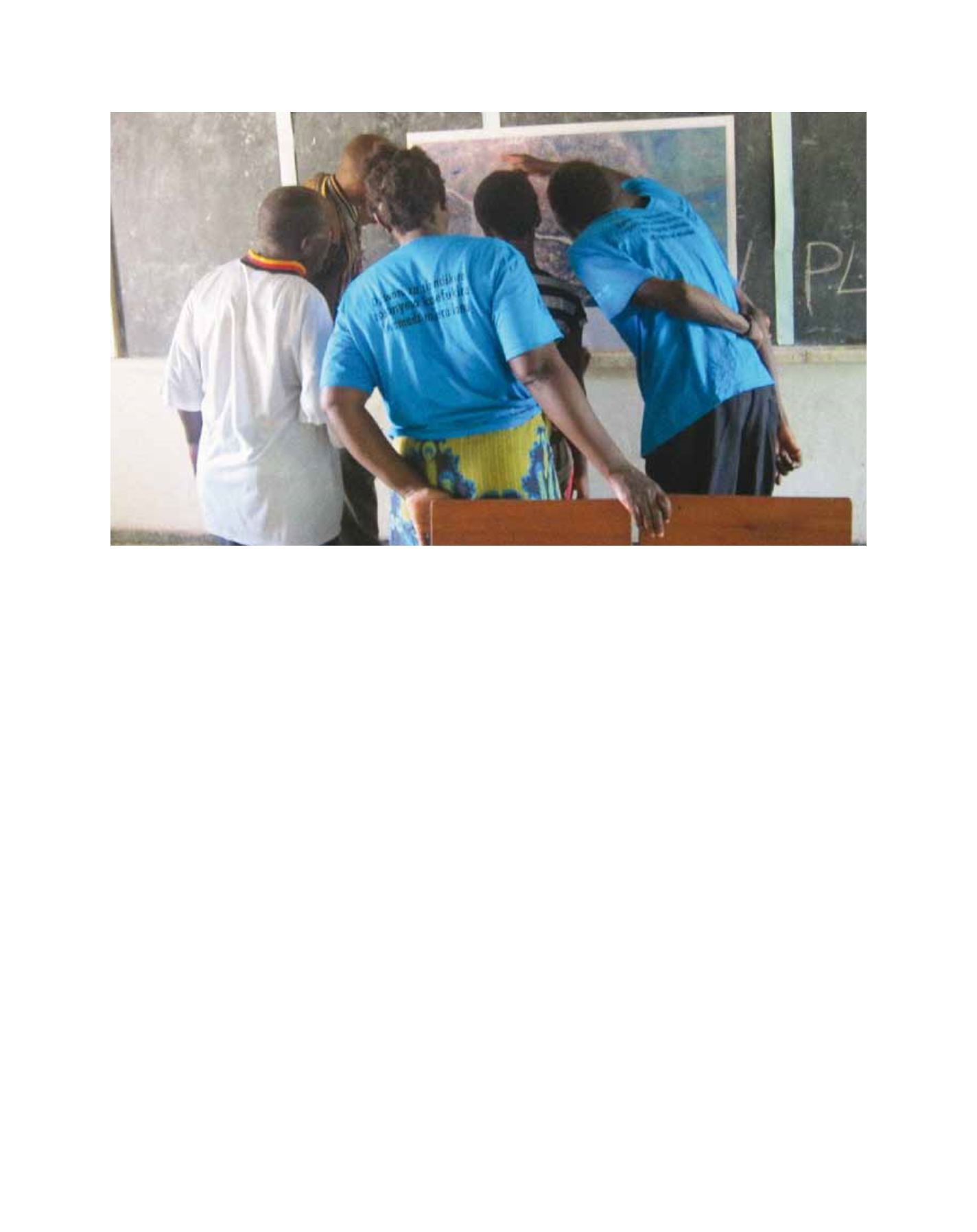
Members of the Ndamera community draw a vulnerability map of their area from high-resolution satellite images
Image: Evance Mandala, 3 March 2011