



 91 / 168

[
] 91
for the survival of the communities from disasters
or a barrier for effective DRR activities. In situations
where cultural factors influence behaviour of people
when facing a hazard (Oliver-Smith, 1996), research-
ers and field workers have observed that people not
only consider the danger they could encounter during
a hazardous situation, but give priority to factors
like social values, religious beliefs, traditions, and
attachment to a location. Consequently, the lack
of consideration of cultural aspects of the affected
community can hamper effective DRR strategies,
increasing vulnerability rather than reducing it. In the
formulation of DRR strategies, implementers should
explore measures that are compatible with the cultural
habits of targeted communities. To integrate culture
and DRR, positive aspects of cultural activities can be
highlighted, along with the provision of appropriate
scientific knowledge to increase community resilience
against natural disasters.
Proper engagement with culture is, therefore, vital if
implementers are to use culture as part of effective DRR
activities and vice versa. Accordingly, CBDRR activi-
ties are considered a better way of integrating cultural
aspects for effective DRR activities (Mercer, 2009).
CBDRR activities that promote participant empower-
ment and allow for transfer of ideas from community
to authorities will garner more support and gain due
acknowledgement. Ultimately, CBDRR activities need
to provide opportunities for affected communities to
contribute towards the development of DRR strategies
and measures, increasing commitment and sense of
belonging to for the disaster management activities that
they are involved in. The implementation of CBDRR
programmes needs to consider influential factors:
community-based DRR initiative to influence vulnerable commu-
nities to adapt to such changes. In locations where Mercy Relief
has successfully implemented a DRR programme stemming from
its post-disaster reconstruction and rehabilitation efforts after major
recent disasters in the Asian region, such amalgamation of risk
reduction and adaptation strategies could help vulnerable communi-
ties reap benefits from the burdensome environment they have been
accustomed to. By identifying appropriate technologies that can be
adapted for application in varying conditions and be used sustain-
ably to stimulate development of vulnerable and rural communities,
process socialization for adaptation of risk reduction strategies in
community-based environment would be well received by commu-
nities themselves.
As DRR propagates a set of activities carried out to minimize
vulnerabilities and disaster risks in a society, and avoid (preven-
tion) or limit (mitigation and preparedness) the adverse impact of
hazards within the broad context of sustainable development, it is
imperative that community-based disaster risk reduction (CBDRR)
interventions build resilience in a sustainable manner that inte-
grates participation across different demographics within targeted
societies. In line with the humanitarian sector’s perspectives, Mercy
Relief’s CBDRR efforts have been implemented with the objec-
tives of effectively empowering communities and enhancing their
capacities to deal with disasters by establishing management and
governance systems to identify risks and find solutions through
participatory exercises to create a conducive environment. This
is implemented with the recognition that for comprehensive risk
reduction programmes to be effective, targeted communities need
to understand simple and practical actions required to protect lives
and properties from natural hazard induced disasters.
Culture and disaster risk reduction
Culture has the power of increasing or reducing vulnerability of
communities towards disasters and may become either a factor
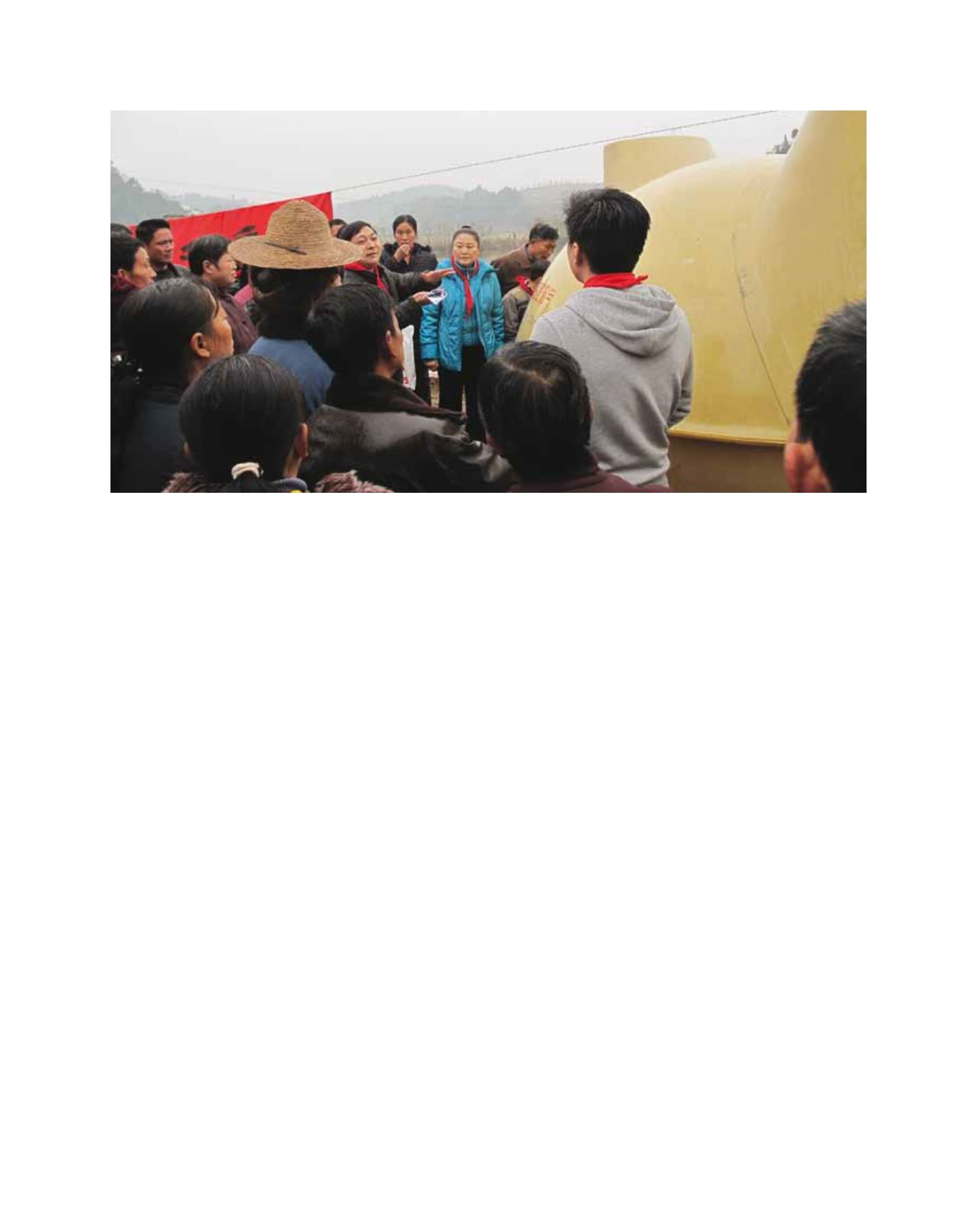
Process socialization: Mercy Relief’s staff visited communities in China to garner their support prior to the implementation of the development project
Image: Mercy Relief