


 92 / 168

[
] 92
culture, threat of climate change and practicality of efforts in the
advent of complex humanitarian situations.
Cultural belief: Mount Merapi eruptions, Central Java
Despite their destructive prowess, Indonesia’s volcanoes have played
an important role in feeding the soil – and have deep cultural influ-
ence. Agricultural productivity is a direct result of volcanoes like
Merapi. The short-term destruction of eruptions like the one now
occurring is more than outweighed by the long-term benefits of the
nutrients that ash falls bring to soils.
Due to their attachment to mythical beliefs, villagers living on the
slopes of Mount Merapi continued to trust the power of their cultural
leader, Mbah Marijan, the Gatekeeper of Merapi, who believes that
it is his duty to stay even when an eruption is imminent. Despite
the Government’s order for a full-scale evacuation, villagers will not
move until the Gatekeeper does. The fate of 500,000 residents of
Yogyakarta, a city 20 miles (32km) to the south, rests on Marijan’s
thin shoulders. It is his responsibility to perform the rituals designed
to appease an ogre believed to inhabit Merapi’s summit.
Marijan’s behaviour might seem suicidal anywhere else, but not in
Indonesia, an archipelago of 17,500 islands that straddles the western
reaches of the hyperactive Ring of Fire. It is a zone of geophysical
violence, a juncture of colliding tectonic plates that loops more than
25,000 miles (40,200km) around the Pacific. Geography has dealt
Indonesia a wild card: nowhere else do so many live so close to so
many (129 by one count) active volcanoes. On Java alone, 120 million
people live in the shadow of more than 30 volcanoes, a proximity that
has proved fatal to more than 140,000 in the past 500 years.
Given Mount Merapi’s characteristics, spewing or erupting once
every four or five years, local authorities have been trying to relocate
those communities between three and ten kilometres from the volcanic
mountain. Based on Mercy Relief’s experience with the communities
from its post-2010 eruptions relief and recovery efforts in Central Java,
while Merapi may have ceased erupting, the impact on the communi-
ties residing on its slopes remains, and the people remain
vulnerable to the onset of disaster. As well as reconstruc-
tion efforts to provide new communal water distribution
systems (which were damaged during the eruptions), a
comprehensive disaster riskmitigation (DRM) programme
has been implemented for the communities. The DRM
programme includes the provision of respiratory care
equipment for three health clinics where medical person-
nel will be trained in first response and respiratory care
management. Twomulti-purpose halls and improved sani-
tation facilities at two schools in the Dukun and Muntilan
sub-districts were also constructed, for conversion into
relief evacuation centres in the event of an emergency.
Along with the establishment of an early warning system,
educational workshops were held to prepare communities
for future eruptions. In this instance, it is hoped that if
communities go against the government’s disaster mitiga-
tion strategies and evacuation efforts by strictly sticking
to their traditional cultural beliefs, loss of lives could be
avoided as communities themselves are equipped with
disaster response facilities and knowledge on prepared-
ness. In short, CBDRR initiatives were embraced by the
people as they could still maintain, to some extent, their
cultural beliefs.
Ancestral knowledge: earthquake and tsunami, Simeulue Island
The tsunamis on 26 December 2004 and 28 March 2005
killed only seven people on Simeulue Island in Indonesia’s
Aceh province. Simeulue was close to the epicentre of the
2004 earthquake, but loss of life was surprisingly low,
mostly due to the impact of the earthquake rather than
the tsunami, because the people are familiar with the twin
disasters in the seismically active region. At Langi, on
the north end of Simeulue, which is 40km south of the
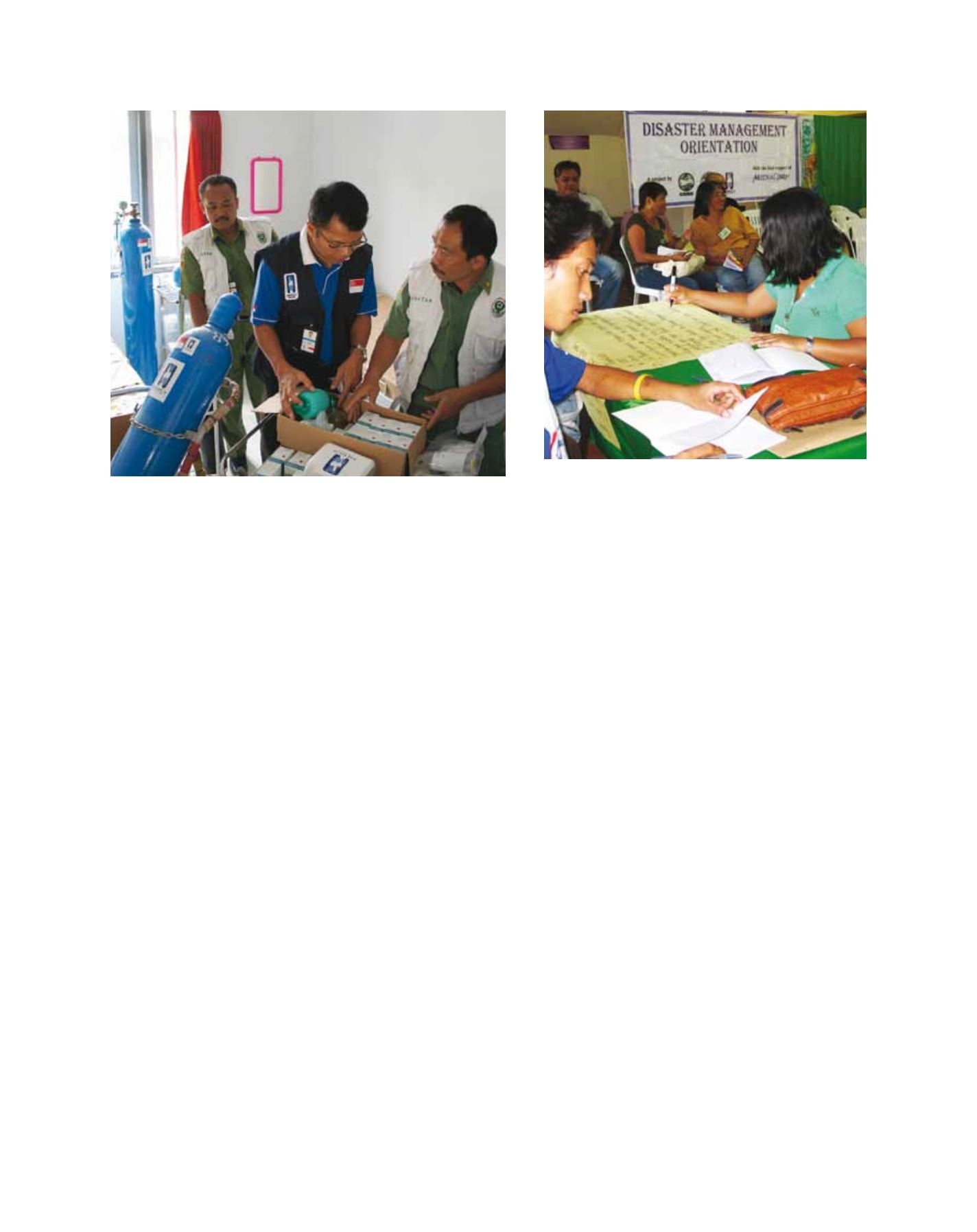
Provision of necessary medical equipment and supplies at the village clinic used by
evacuees during an eruption times Mt Merapi
As part of the DRR training programme in the Philippines, participants
were guided to prepare presentation materials to highlight disaster
risk factors present in their community and ways to counter them
Image: Mercy Relief
Image: Mercy Relief