


 93 / 168

[
] 93
December earthquake’s epicentre, maximum wave heights exceeded
ten metres less than ten minutes after the shaking ceased. In the more
populous south, wave heights averaged three metres and caused signifi-
cant structural damage, destroying entire villages. Oral histories recount
a massive tsunami in 1907 and advised villagers to run to the hills
after ‘significant’ shaking lasting one minute and when the sea waters
recede drastically. Simeulue survivors recounted the historical knowl-
edge and the necessary action to be taken. Simeulue’s ancient folklore
and knowledge provided an extraordinarily powerful mitigation tool
that saved countless lives where even a high-tech warning system with
a 15 minute response time would have been of much lesser help.
Processed socialization and alternative source of survival, China
Villagers living below the poverty line in rural areas of Shanxi and
Sichuan provinces have succumbed to exploiting nature to offset the
severe lack of resources and poor crop output. With numerous inci-
dents of landslides due to rapid deforestation after trees have been
largely sacrificed for energy use, development projects have been
implemented with due consideration to the communities’ socio-
economic needs. To address this situation, Mercy Relief programmes
look to pragmatic solutions to provide villagers with alternative
sources of energy. Anaerobic biogas digesters have been installed
to generate biogas for cooking and lighting. This helped cut down
expenditure on coal, as well as minimizing use of firewood – which
helps protect the environment and improve health. At the same time,
ecological sanitation was introduced to the villagers, that is, proper
toilets were built in homes, with the excrement collected treated by
the biogas digesters. This paves the way for effective and hygienic
management of domestic waste, and the residue from biogas extrac-
tion also provides the villagers with natural fertilizer for their crops.
Besides the economic benefits of saving on fuel by using biogas for
cooking, it is a more environmentally-friendly and healthier alterna-
tive to using coal or wood. The savings generated present the villagers
with livelihood investment possibilities.
Community-based DRR, Philippines
In a country where between ten and twenty typhoons
mercilessly slash its land every year, the lives of large
communities across the Philippines are made worse by
chronic poverty, a lack of economic diversification and
environmental degradation. When Typhoon Morakot
hit Zambales province in August 2010, those living in
the municipalities of Botolan and Palauig were crippled
as they saw river channels being damaged by the lahar
build-up around it, submerging their villages. Although
the Philippine Government had spent more than
US$19.6 million to build a series of dikes to prevent
further lahar damage, there had been little efforts
to maintain them. To prevent more casualties from
future typhoons and rains, the people in Botolan had
been asked to move to the highlands. However, being
mostly fishermen, they have no means of livelihood on
the slopes of Mount Pinatubo, increasingly barren from
the slash-and-burn hunting methods of the indigenous
Aeta people. Thus, the village community needs either
a means of sustaining its livelihood (fishing) or diversi-
fication into other sources of income that could increase
its resilience in the face of disasters.
To tackle this, Mercy Relief started a few livelihood
projects aimed at increasing the resilience of the coastal
communities to damage by seasonal monsoons and as well
as increasingly-common disasters such as typhoons and
accompanying flooding and tidal surges. To ensure that
developmental efforts are followed through during disas-
ter times, Mercy Relief, with its local partner, Citizens’
Disaster Response Center (CDRC) came together to launch
a community-based DRR programme in 24 landslide and
flood-prone communities in the provinces of Negros
Oriental, Negros Occidental, Iloilo, Sarangani andMisamis
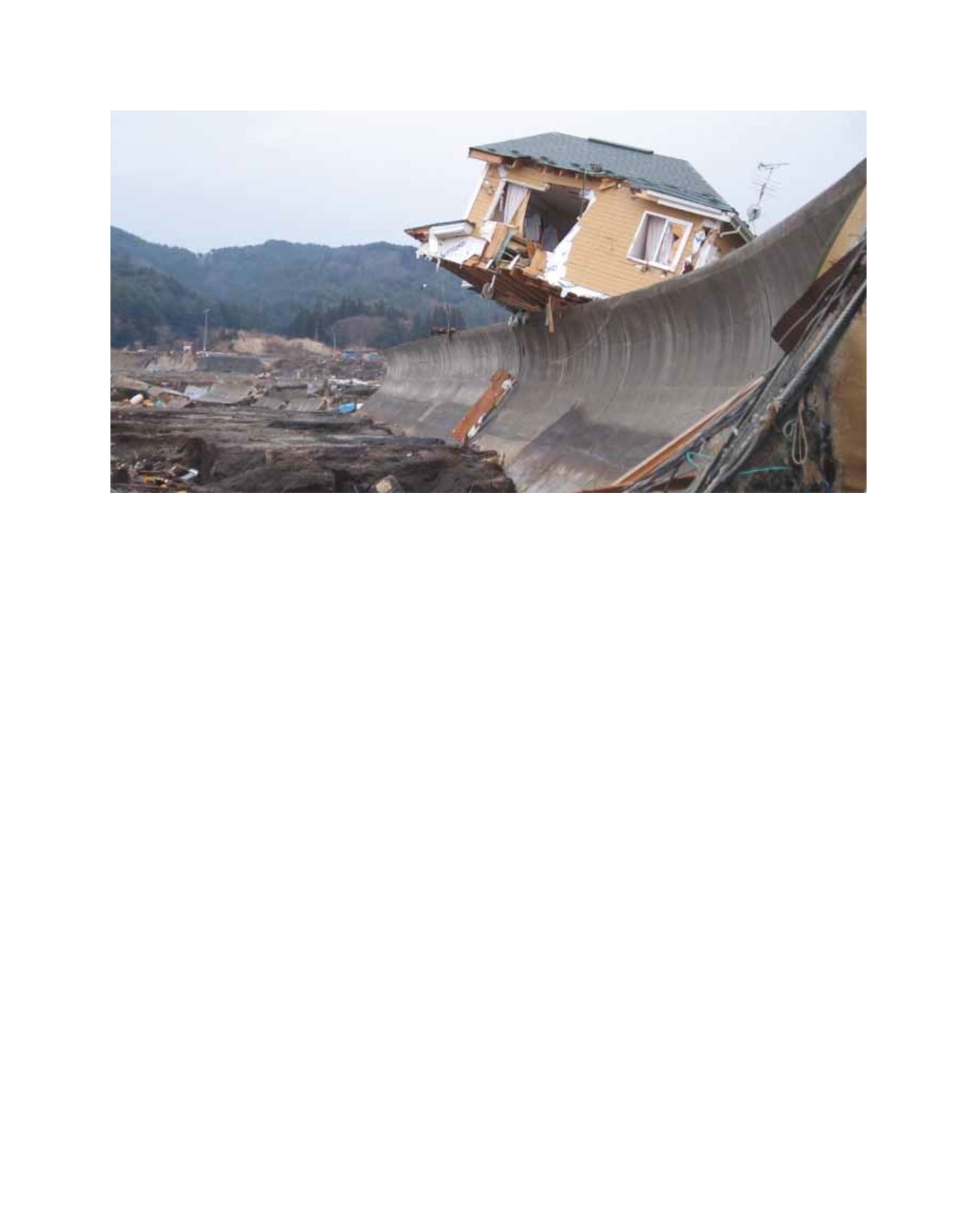
False sense of security? A house deposited at the concrete breakwater by the retreating tide at Otsuchi, Iwate Prefecture
Image: Mercy Relief