


 98 / 168

[
] 98
Strategy and Alliance for
Urban Disaster Risk Reduction
Professor Yasuo Tanaka, Director, Research Center for Urban Safety and Security, Kobe University
A
t 5:46 am on 17 January 1995, Kobe City (with a popu-
lation of over 1.5 million) and nearby cities in Hyogo
Prefecture were violently shaken by the rupture of a
50km fault at a depth of about 16km. After the quake, which
had a peak acceleration of 80 per cent of gravity and lasted
less than 20 seconds, there was a moment of silence in which
survivors tried to grasp what had happened and to reach out
to families and friends. Human losses of 6,343 people and
economic losses of over US$100 billion resulted from a mere 20
seconds of shaking.
The process of recovery started immediately with swift responses
by fire stations, emergency medical officers and local government
emergency sections. However, the extent and magnitude of damage
meant that only families, friends, neighbours and local communi-
ties could work immediately and effectively to save the lives of
those buried under the collapsed houses and buildings. Official
manpower and equipment for rescue were insufficient for such
widespread incidents.
Inability to expect and imagine that such a catastrophic quake
could attack the modern urbanized city led to:
• Delays in calling external rescue forces due to a
failure of the immediate damage assessment system
• Inability to effectively incorporate volunteer work-
forces into immediate recovery units because of lack
of provision in disaster laws
• A very long wait of more than three years for the
disaster victims in obtaining monetary support
because of no such national system being estab-
lished previously, and many other problems.
The root cause of the difficulties encountered in the
1995 Kobe earthquake is in highly complicated soci-
etal vulnerabilities unique to the densely populated and
industrialized urban areas of Kobe and its surroundings
in the face of catastrophic disaster. The safety of the urban
population depends upon engineered infrastructures and
societal and monetary systems for effective functioning,
and – most importantly – upon family and community
activities in the area. Urban society requires an integra-
tion of multi-sectorial, multi-disciplinary, inter-sectorial
and inter-disciplinary activities.
2005
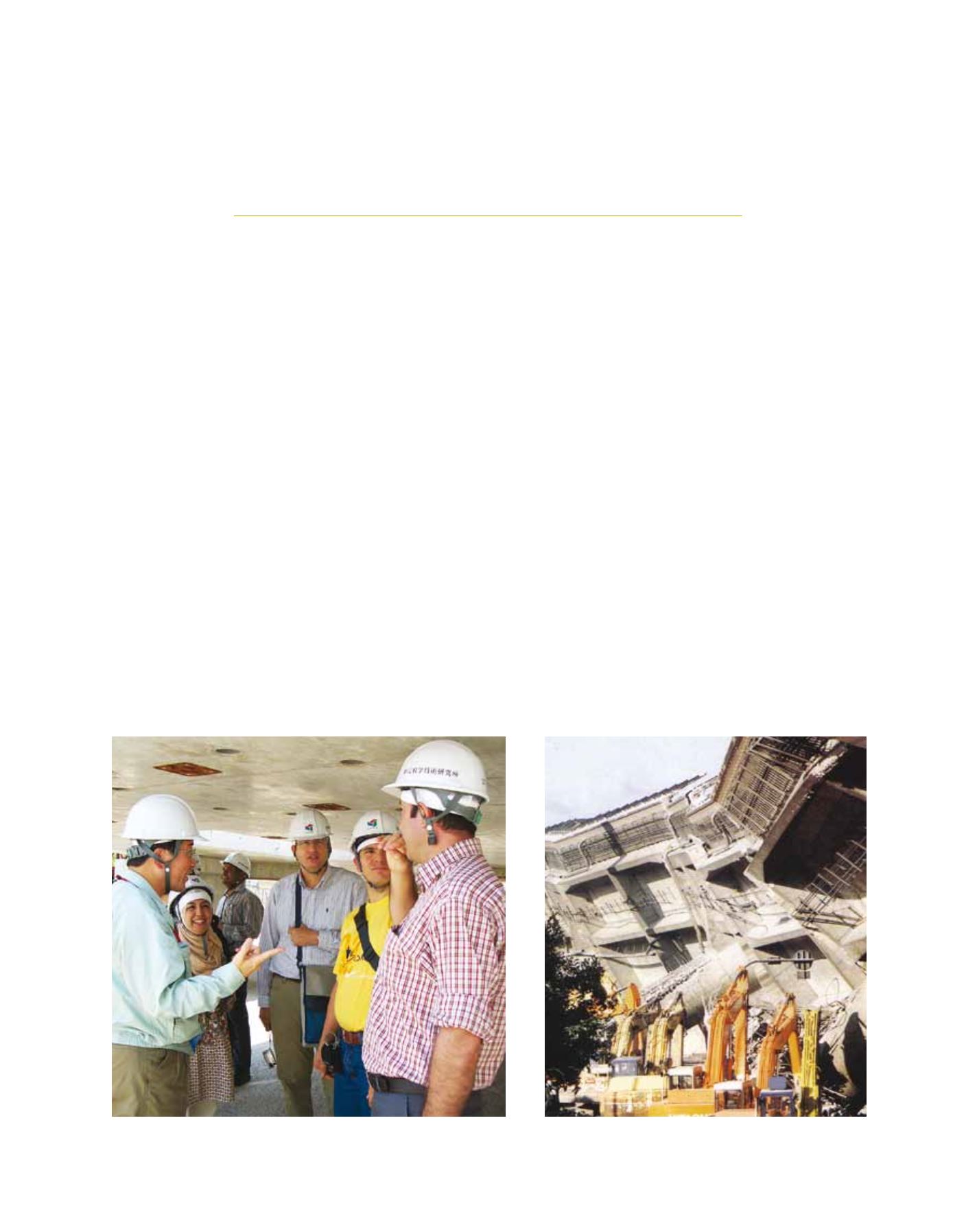
Collapse of Hanshin Expressway
Image: RCUSS Kobe University
Discussing how to build a prototype model for shaking table test at NIED Miki
Image: RCUSS Kobe University