


 102 / 168

[
] 102
There has been a significant growth in the frequency
and impact of disasters, which cause death and suffer-
ing and impede economic growth. Each disaster
displays unique characteristics, preventing the prepara-
tion of pre-determined or ‘templated’ plans that can be
applied universally. Nevertheless, a good understand-
ing of the nature of disasters provides a sound basis
for multiagency training/exercising from which general
contingency plans can be constructed, and enables the
application of flexible and innovative approaches that
optimise outcomes.
The disaster management spectrum covers the contin-
uum of prevention and/or mitigation, preparedness,
response, and recovery and development, all of which
are interconnected. Each may appear to be the domi-
nant strategy at a specific point in time and to occur
sequentially but, in reality, prevention and/or mitigation,
preparedness, response, and recovery and development
strategies need to be applied continuously.
For instance, prevention and mitigation strategies are
also applicable in post-disaster environments. In these
situations, it is important that early attention is given
to disaster risk reduction mechanisms, based on capac-
ity building programs that are ‘owned and operated’ by
national Governments and communities. Failure to do this
risks a repeat of otherwise preventable casualties in future
crises. Accordingly, Australia gives increased emphasis
to capacity building programs designed to decrease the
vulnerability of regional governments and societies to the
catastrophic consequences of disasters, and to build their
national capacity to respond where required.
tion sources, including the development of technology platforms to
enhance interoperability and information management.
Promoting a shared understanding across government is achieved
through:
• A commitment to agreed information management principles
• The development of agreed approaches for managing and sharing
information
• Moving from a ‘need to know’ paradigm to application of a ‘need to
share’ philosophy
• Common language usage, avoiding jargon, acronyms and contested
terminology.
Preparedness is also critical to continuous improvement. Activities such
as exercises, training and education – designed utilising best practice
models and incorporating lessons learned– assist departments and agen-
cies to adapt to changing circumstances, thereby continuously improving
Australia’s approach to disaster management.
Promoting multiagency understanding
Australian agencies adopt a four-tracked approach to promoting multia-
gency understanding of disaster management. They seek to understand:
• The complex nature of disasters, characterized by chaos and
uncertainty
• The elements of the disaster management spectrum – prevention
and/or mitigation, preparedness, response, and recovery and
development
• The contribution that each department and agency brings to disaster
management
• The multiple roles and responsibilities of the key actors with whom
Australia works – host Governments, the United Nations, regional
bodies, allies, NGOs and the private sector.
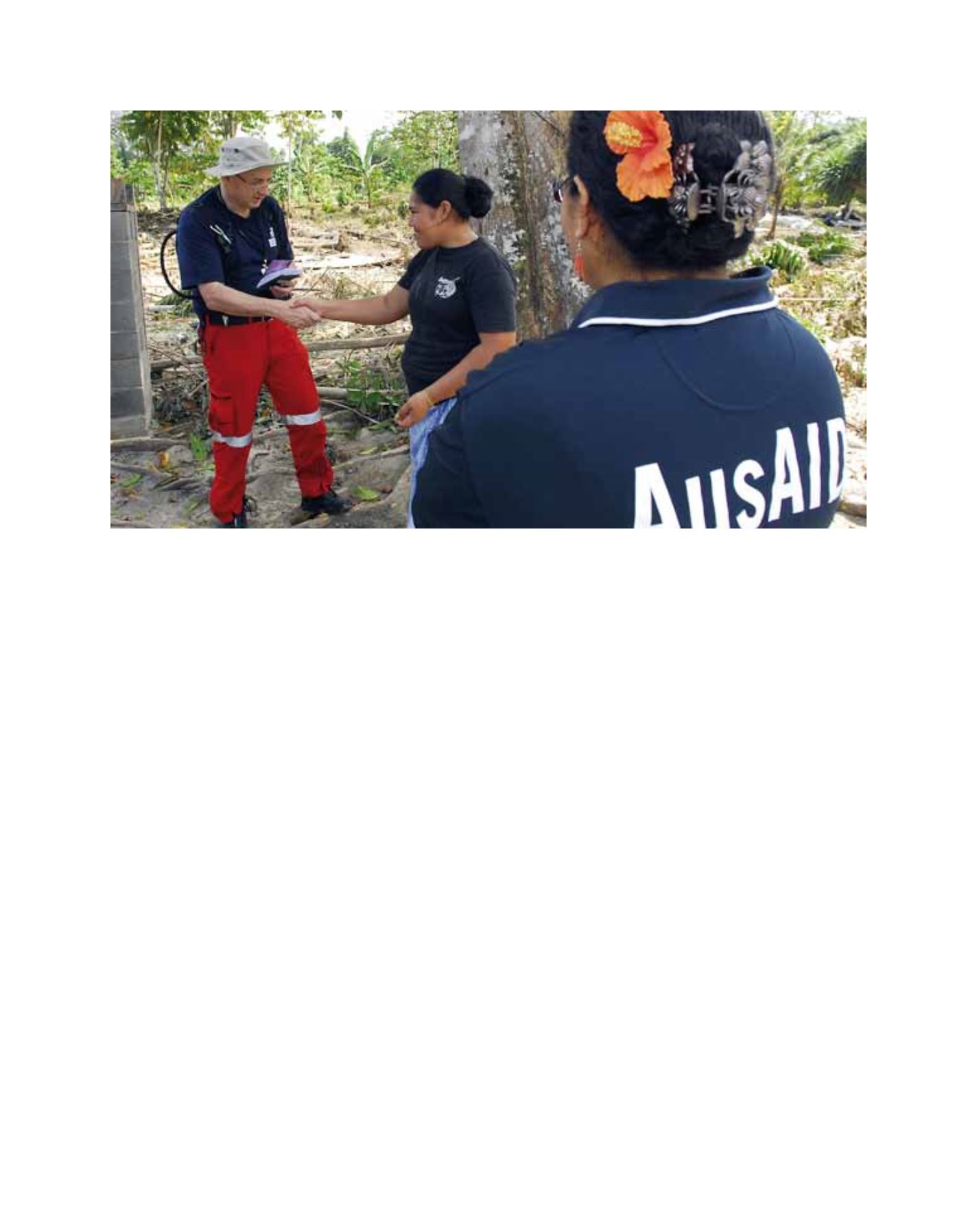
South Australian Dr Bill Griggs shakes the hand of a local Samoan mother, Nika Luamuanu, who is helping to clean up Coconut Beach Resort, after the Samoa tsunami.
Valma Galuvao, AusAID Senior Program Manager in Samoa, looks on, 2 October 2009
Image: AusAID