


 99 / 168

[
] 99
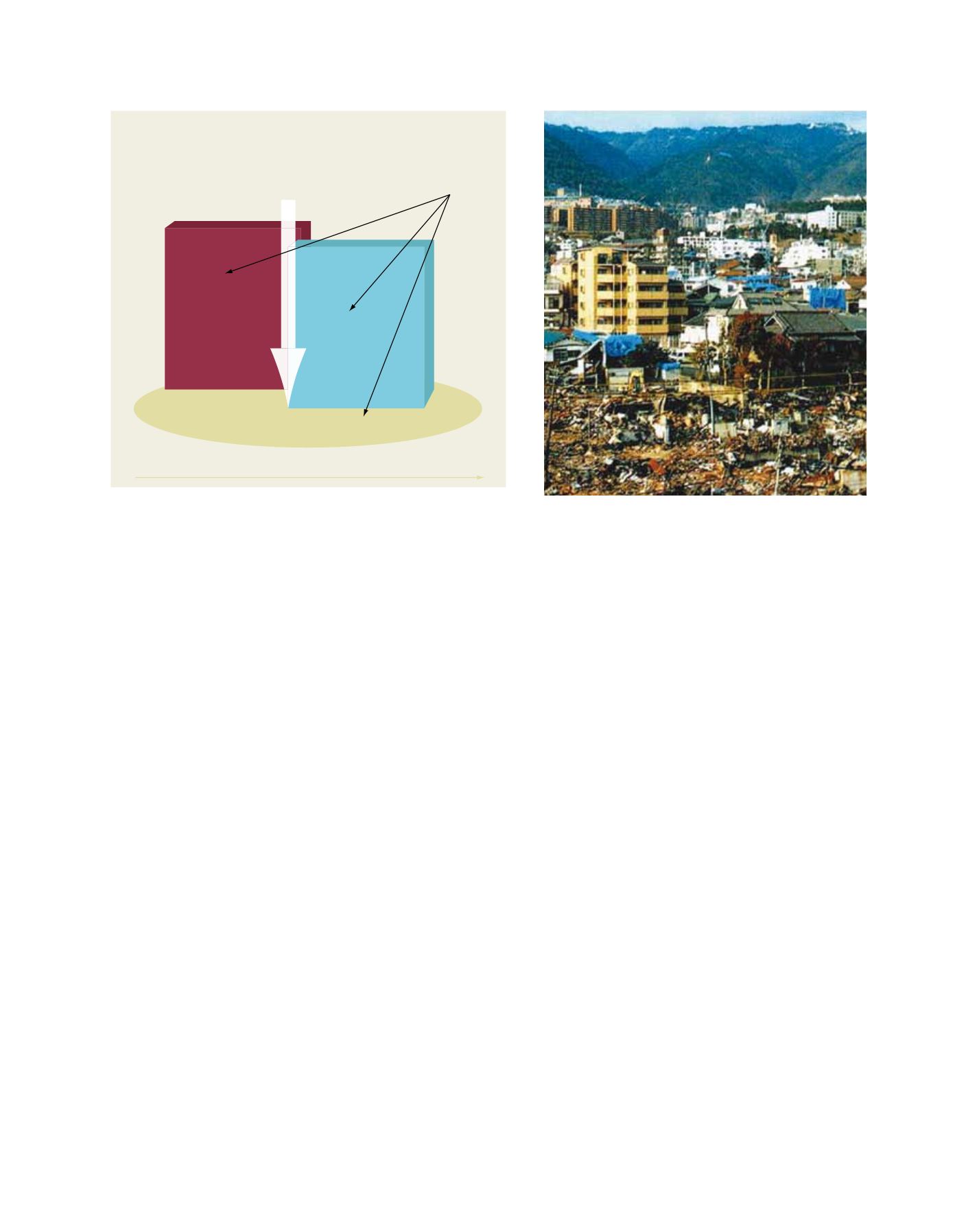
RCUSS has proposed a framework for Urban Disaster
Risk Reduction (UDRR) strategy to integrate multi-
sectorial and multi-disciplinary stakeholders of social
and technical DRR specialists by basing communi-
cations across generations and stakeholder groups.
The UDRR framework consists of three compo-
nents: Risk Assessment, Risk Management and Risk
Communication.
Risk Assessment
The aim of Risk Assessment is to reduce vulnerability
in urban society by examining the most threatening
hazards. Vulnerability relates not only to physical and
technical aspects but also to societal and financial issues.
Risk Management
The Risk Management phase involves building and
preparing social and technical systems for immediate
rescue and response and also for mid- and long-term
recovery and reconstruction in the face of most poten-
tial disasters. The terminology of disaster management
is used to cover a whole spectrum of disaster processes,
but here Risk Management defines the process during
and after the disaster.
Risk Communication
In the Risk Communication phase, the primary aim is to
foster a culture of communication about disasters through
education and training, and also to build a system for
communication to share disaster-related information.
Initiatives by RCUSS
By using the UDRR framework of Risk Assessment,
Risk Management and Risk Communication, RCUSS
Strategy for Urban Disaster Risk Reduction
The earthquake posed a number of multi-faceted urban disaster
problems, starting immediately after the event. In 1996, Kobe
University (the only national comprehensive university in the
epicenter area) decided to establish the Research Center for
Urban Safety and Security (RCUSS) to conduct integrated urban
disaster research. RCUSS has investigated disaster causes and
recoveries in the intervening years while witnessing the recov-
ery processes in Kobe and surrounding cities. The outcome of
individual specific research on such vast urban disasters often
tends to be fragmentary, but to achieve the goal of creating a
safe and secure urban society based on the research outcomes,
a systematic and comprehensive strategy for urban disaster risk
reduction has to be established.
The lifecycle of disaster – immediate rescue and response, recov-
ery, reconstruction and preparedness – is often used to build a
concrete action plan for disaster risk reduction (DRR) strategy.
However, for DRR in urban society, one key issue is how to cope
with a rapid change of generation or of residents in the urban popu-
lation. For example, in Kobe after 15 years, already more than one
third of the population has not experienced the 1995 earthquake.
Without a common understanding regarding how people feel and
respond during catastrophe, any action plan for DRR would fail.
Thus, understanding or communication across the generations and
sectors should form the basis for a good strategy.
The DRR strategy needs to be proactive and holistic, as has been
emphasized by the Hyogo Framework for Action. Urban activity is
complex and multi-disciplinary and therefore a simple framework is
needed for integrating such a wide spectrum of stakeholders. Also,
a wide gap still exists between social and technical specialists in
dealing with disaster. For example, a very sophisticated numerical
method is being used for the seismic response analysis of structures
while there remains a need to tackle social and financial issues on
retrofitting of existing houses of the elderly or the poor.
Damage near JR Rokko Station, looking towards Kobe University
Image: RCUSS Kobe University
Risk Communication
Time
All proactive plans
Risk Management
Risk Assessment
Disaster
UDRR framework
Source: RCUSS, Kobe University