


 33 / 168

[
] 33
support informed decision making. Developing a comprehensive
understanding of New Zealand’s hazardscape is an essential step
in identifying and prioritising risk reduction activities, alongside
readiness, response and recovery planning.
A current initiative is the government funding of the Natural
Hazards Research Platform, which brings together researchers from
across a range of physical science, social science and engineering
disciplines from the public and private sector, to work collabora-
tively, in partnership with research users.
10
New Zealand also has a national natural disaster insurance scheme,
managed by the Earthquake Commission, designed as provision for
the financial costs of repairs to disaster-impacted residential prop-
erties. All residential property owners who purchase fire insurance
from a commercial provider automatically acquire the Earthquake
Commission’s insurance cover.
11
The central decision making body of executive government that
addresses emergency management is the Cabinet Committee for
Domestic and External Security Coordination.
12
This committee is
chaired by the prime minister and includes ministers responsible
for departments that play essential roles in such situa-
tions. To support that process, there is a committee of
government department chief executives charged with
providing strategic policy advice and working together
to ensure coordinated action across Government.
The lead agency for managing planning and response
to a national crisis will vary depending on the type of
emergency. For example, the Ministry of Civil Defence
and Emergency Management (MCDEM) is the lead
agency for responding to a civil defence emergency
resulting from an earthquake, flooding or other (mostly)
natural hazard events. The Ministry of Health is the lead
for a human pandemic, and the Ministry of Agriculture
and Forestry for bio-security risks.
Community-based action: a case study
The ability of a community to cope with a disaster is based
to a large extent on the risk reduction or readiness meas-
ures it takes. However, getting communities to participate
in actions that reduce risk or enhance preparedness and
create resilience to disasters has proven to be a significant
challenge to the New Zealand civil defence emergency
management sector.
13
Engaging the community, so that
it becomes an integral part of decision-making, and
development of arrangements for disaster risk reduction,
is an essential part of generating resilience. An engaged
community will be more likely to participate actively in
managing its own risks, creating the capability to success-
fully manage a crisis when it occurs, absorb and reduce
disaster impacts, and aid recovery.
An example of an engaged community is Taupo Bay
in Northland, in the upper North Island.
14
Residents
recognised a significant tsunami risk to their commu-
nity and with a large influx of holiday makers over the
summer period understood their community would
be vulnerable. With the support of their local district
council emergency management officer, volunteers
from Taupo Bay developed their own community
response plan. This plan included hazard information,
contact information and evacuation information.
The volunteers decided an important part of their plan-
ning process was to raise the awareness of the hazard
within the community, and especially for the significant
population of summer visitors. One awareness-raising
action was to produce a one-page summary of the commu-
nity response plan, which was displayed in each household
in the bay. The community developed its coping strategies
through articulating roles for volunteers in an emergency.
The Pacific riskscape
New Zealand’s Pacific neighbours are also vulnerable to
an array of natural hazards including cyclones, floods,
earthquakes, tsunami and volcanic activity. Pacific Island
Countries (PICs) are straddled by the Ring of Fire, a zone
of high earthquake and volcanic activity that encircles
the Pacific basin, and these hazards, along with weather-
related events, can devastate lives and livelihoods,
destroy environmental assets, wipe out years of hard-
won development gains and severely impact struggling
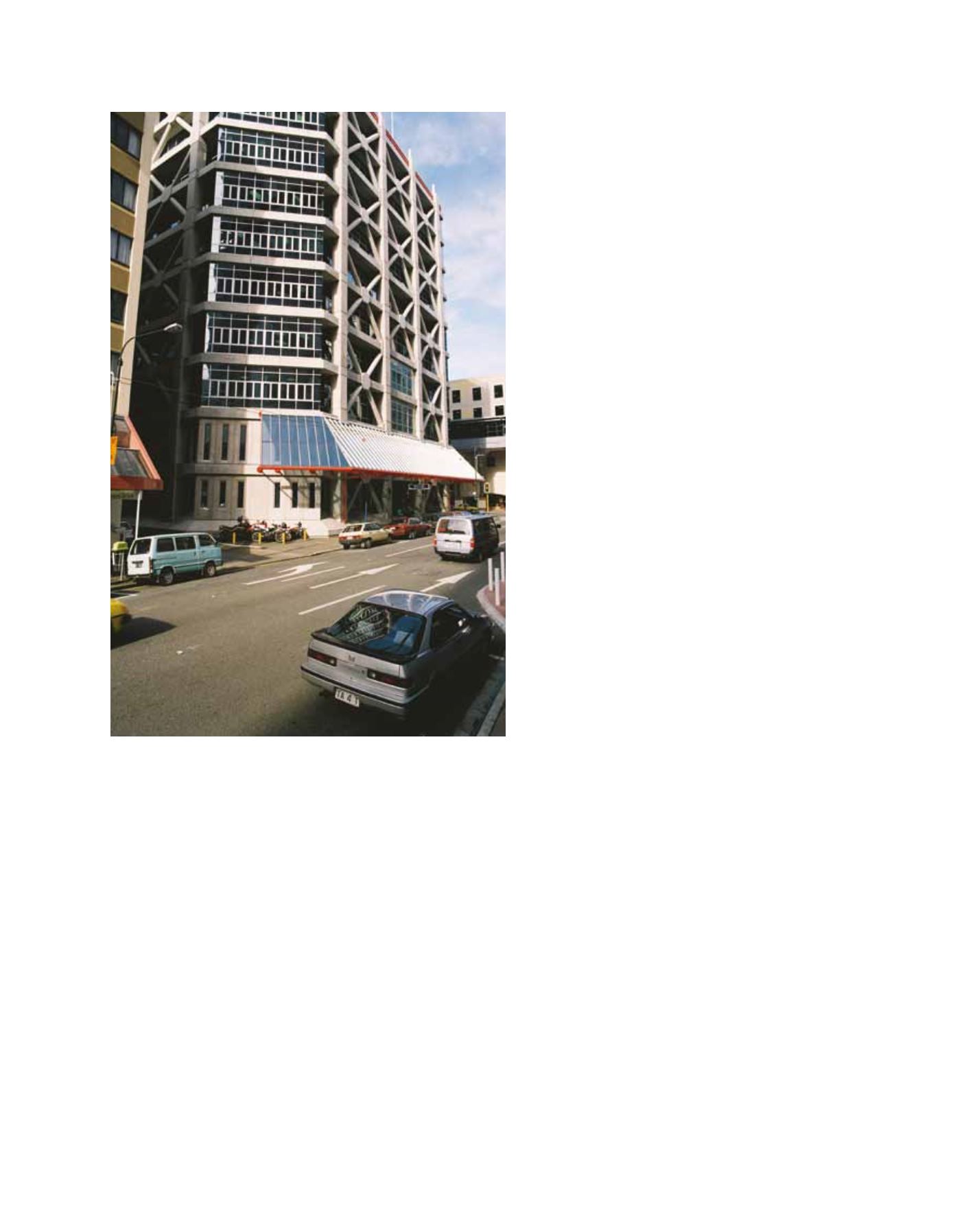
The New Zealand Police Headquarters, Wellington, an example of seismic
design for a critical facility
Image: GNS Science