


 29 / 168

[
] 29
of sustainable development. This entails the integration
of DRR and CCA policy options in urban development,
land use planning and physical planning, the decou-
pling of the increase of hazard exposure from economic
growth, and the incorporation of risk reduction consid-
erations in planning, zoning and building regulations.
Currently, Governments and international/regional
organizations have been engaged in deliberation on how
to keep all the promises made in the Incheon Regional
Road Map on DRR through CCA in Asia and the Pacific
(REMAP) and its associated action plan.
HFA implementation in the Asia-Pacific region
More than six years have passed since the adoption of
the HFA in January 2005, but ‘the substantial reduction
of disaster losses, in lives and in the social, economic
and environmental assets of communities and coun-
tries’ as envisaged in the HFA has not been achieved so
far. Countries have been pursuing the goals of the HFA
in their own ways with rather mixed results, showing a
remarkable contrast between priority areas.
HFA Priority 1 (ensuring that DRR is a national and
local priority with a strong instructional basis for imple-
mentation) has shown good progress, most notably in
the development of new policies and legislations, and in
strengthening multi-sector institutional systems. However,
HFA Priority 4 (reducing the underlying risk factors)
seems to be the most challenging. Progress on other prior-
ity areas indicates mixed results.
A closer look at areas where progress across HFA
priorities is reported reveals that there are still many
gaps and challenges causing stagnation. Various synthe-
ses and country reports show some of the reasons
behind this.
mental organizations and international organizations can review
the progress made toward the implementation of the HFA and can
follow up on and prepare for the Asian Ministerial Conferences on
Disaster Reduction.
The Asian Ministerial Conferences as regional platforms
In addition to various regional and sub-regional schemes, the coun-
tries of the Asia-Pacific region started a series of biennial conferences
of their own. The first in this series was held in Beijing, China in
September 2005. The second was held in Delhi, India in November
2007, renamed as the Asian Ministerial Conference on Disaster Risk
Reduction (AMCDRR) and expanded as a regional platform. The
third conference was held in Kuala Lumpur, Malaysia in December
2008, highlighting such emerging issues as public-private part-
nerships, advanced technology and scientific applications, and
approaches to engaging the media.
Most recently, the fourth AMCDRR was held in Incheon, Republic
of Korea in October 2010 highlighting the theme of ‘Disaster Risk
Reduction through Climate Change Adaptation.’ The Incheon
Declaration on Disaster Risk Reduction called for actions to be taken
to raise awareness and build capacity for disaster risk reduction
(DRR) and climate change adaptation (CCA); develop and share
information, technology, sound practices and lessons learned in
climate and disaster risk management; and promote integration of
DRR and CCA into development for green growth.
The first theme was based on the recognition that the number of
disasters can be considerably reduced if people are well informed
and Government and technical agencies pay high attention to
capacity-building at all levels. The second theme underscored the
importance of sharing information on past experiences, knowledge,
tools and good practices to help policy makers and local communi-
ties and improve their capacity and resilience in the disasters.
The third theme is most challenging as it tries to bridge current
gaps existing between different policy sectors within a broad context
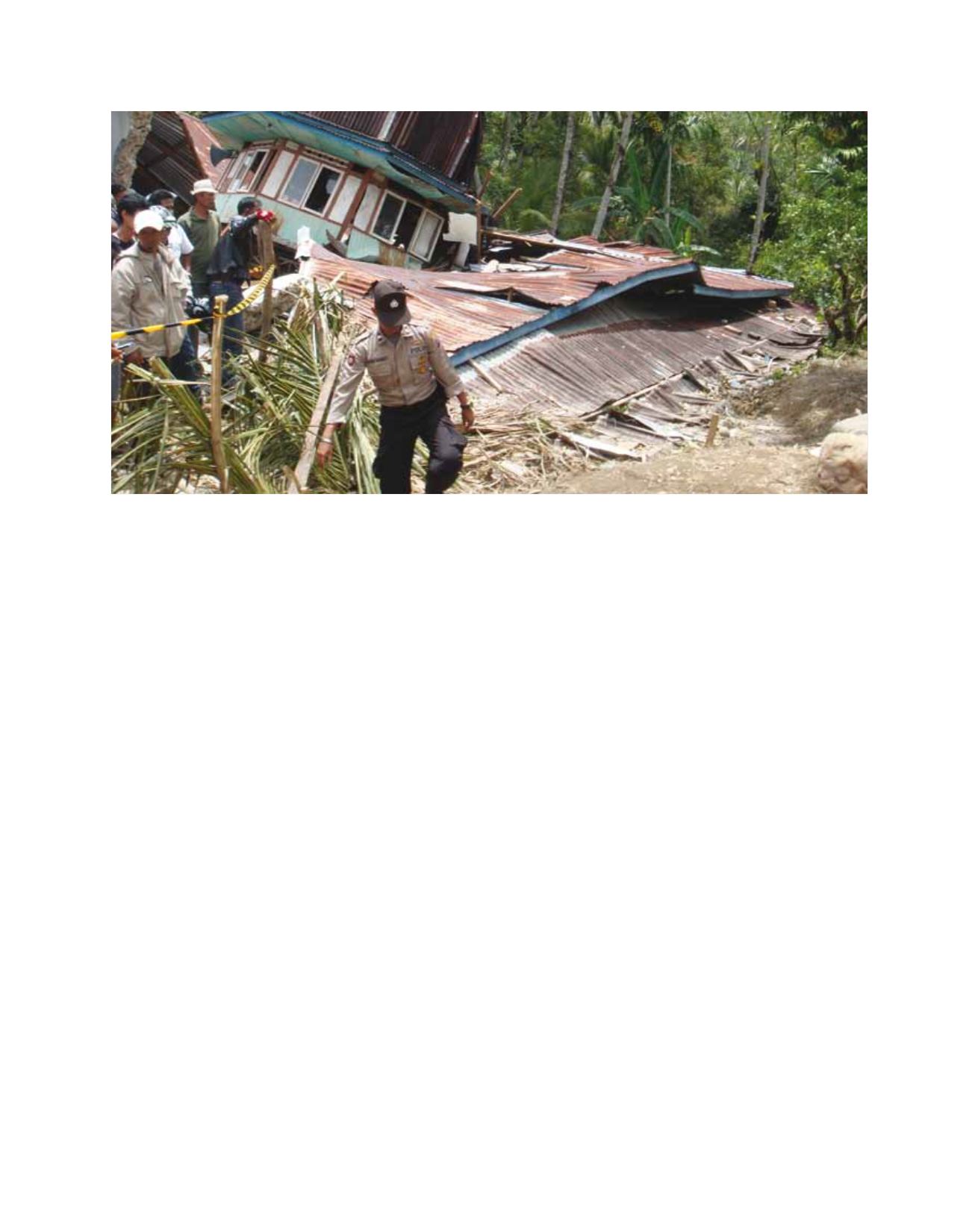
Padang earthquake, Indonesia, September 2009
Image: ADRC