



 26 / 168

[
] 26
includes guidance for Governments, the construction
sector, the finance and insurance sectors and homeown-
ers, with in-depth information on construction techniques,
standards and materials.
9
Post-disaster planning should aim to ensure effi-
ciency and public safety and take place swiftly so as
to preserve social and economic networks. From the
outset, authorities should be concerned with equity,
since those with the fewest resources generally get less
attention from aid organizations, and get it later. People
who are better integrated into economic and social
networks will recover faster.
In China, following the Wenchuan earthquake, plan-
ning for restoration and reconstruction started soon after
the event. Starting early allowed both development and
disaster managers to identify the problems and enable
decision makers to allocate the resources to meet short-,
medium- and long-term needs. The process was led
by the National Development and Reform Committee,
which worked with 45 ministries, provincial govern-
ments and state institutes to prepare a recovery plan,
while also seeking good practices and advice from the
international community. When the consultations were
completed, the authorities started to implement overall
planning for restoration and reconstruction.
Financing recovery
The scale of financial resources available for recovery,
especially from non-governmental sources, generally
depends less on need and more on media attention.
High-profile disasters such as the 2004 Indian Ocean
tsunami will attract much more funding than small
or medium-sized disasters. Governments need mech-
anisms to allocate financial, human and material
resources and they should focus on the activities most
likely to reduce poverty and vulnerability.
It is, however, possible for Governments to offer
more resources of their own by rearranging their
This creates a window of opportunity to remove barriers and create
new and enforceable regulations.
For example, following a major cyclone in 1991, the Bangladesh
authorities reassessed their risk reduction strategies. They rede-
signed cyclone shelters, enlarging them and relocating them closer
to current population centres, taking into account cultural traditions
and behaviour with accommodation for economically important
domestic livestock. Shelters and all new official buildings were in
future to have two elevated stories to protect families displaced
by floods. Shelters also primarily took the form of schools, health
dispensaries or other public facilities to ensure that they were well
maintained and, more importantly, that the public associated them
with disaster preparedness. Over the years, these community cyclone
and flood shelters have become an integral part of an overall local
risk reduction strategy that has further developmental benefits.
7
The recovery process can also be used to accelerate pre-existing
development initiatives and incorporate stronger elements of disaster
risk reduction. Again, Bangladesh provides an example. The largest
non-governmental organization (NGO) is the Bangladesh Rural
Advancement Committee (BRAC), which works with some three
million poor individuals, mainly women. Following flooding in 1998,
BRACwas able to use its presence in 55 districts to assist 850,000 flood-
affected women from landless and marginal farming households. The
strategy was to help people get back to their own homes with regular
income-generating activities, so most of the activities also fed into
longer-termdevelopment programmes that BRACwas already running.
8
Planning for recovery
Countries can achieve more sustainable recovery if they have effective
pre-disaster planning. National and international actors can make efforts
to predict disasters while having in place recovery policies and strategies.
Planning should also involve preparing for ex-post recovery. In Latin
America, the Organization of American States Unit for Sustainable
Development and Environment has undertaken ex-ante planning
for housing reconstruction to ensure adequate materials are available
following a disaster and that builders, homeowners and Government
agencies are aware of damage reduction measures and construction
techniques that can result in more hazard-resistant housing. This
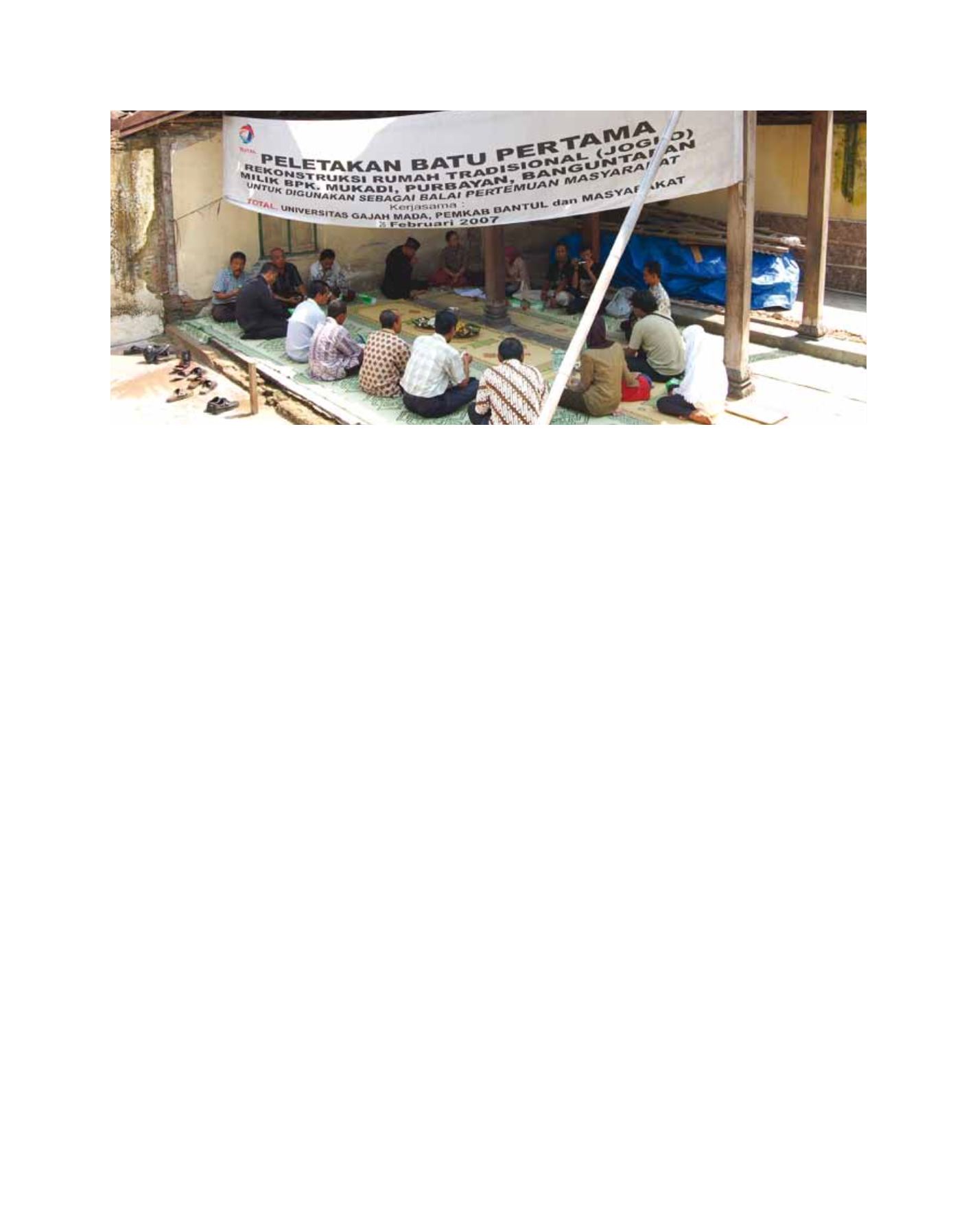
Community-driven livelihood recovery in Kotagede, Yogyakarta
Image: © Muhammad Natsir, Kanthil Foundation 2006