


 32 / 168

[
] 32
Management Act 2002; the Resource Management Act;
the Building Act 2004 and the Local Government Act
2002.
5,6,7,8
These, and other legislation, underpin a wide
range of national strategies, plans, policies, regulatory
codes and practices supporting risk reduction at central
and local government levels. Specific examples include
the Building Code and compliance regime (with its
emphasis on earthquake and storm resistance), resource
consent processes, and the New Zealand Coastal Policy
Statement.
Government agencies also contribute to disaster risk
reduction outcomes through the services they deliver
locally on a daily basis, including providing social
welfare, education and health services that aim to build
capability and lessen individuals’ and communities
vulnerability to disaster risks.
In recognition of the critical role that network ‘life-
line’ utilities (water, energy, telecommunications,
transport etc.) play in supporting economic activity
and social wellbeing, and the strong dependence of
community disaster resilience on infrastructure, the
CDEM Act 2002 requires network providers to ‘func-
tion to the fullest possible extent’ in a disaster. Network
providers are therefore strongly encouraged to under-
take their own business continuity management, and
to work collaboratively at a national and local level to
reduce disaster risk.
9
Another important contribution of central
Government to risk reduction is through establish-
ing priorities and funding national research into
hazards, risks, vulnerabilities and disaster resilience, to
on the management options suited to their specific situations, for
example through land-use planning and building control activi-
ties. The ‘bottom-up’ approach aims to build a resilient and safer
New Zealand with communities understanding and managing their
hazards and risks.
3
Central to DRR at the local level are Civil Defence Emergency
Management (CDEM) Groups.
4
These are consortia of local authori-
ties based on regional council boundaries, working in partnership
with emergency services (police, fire, health), infrastructure provid-
ers, science providers, government departments, non-governmental
organisations, and others.
Sixteen of these groups across New Zealand are primarily
responsible for assessing and managing local risks, consulting and
communicating about risk management with their communities,
developing and implementing plans, managing the consequences of
emergencies in their area, and assisting other groups in planning and
response. Funding for local risk reduction, readiness, response, and
recovery activities comes from a local property-based rating system.
Central Government funding (from general income tax) is limited
and aims to provide the minimum level of assistance required to
restore community capacity for self-help and to support develop-
ment of sustainable solutions.
Disaster risk reduction: national
New Zealand risk reduction policies, programmes and services
across central government aim to support local government, busi-
nesses and individuals to reduce risk at the community and personal
level. One of the key ways it achieves this is developing and admin-
istering a broad framework of legislation that underpins sustainable
hazard risk management and resource planning. Key legislation that
addresses hazard risk reduction includes the Civil Defence Emergency
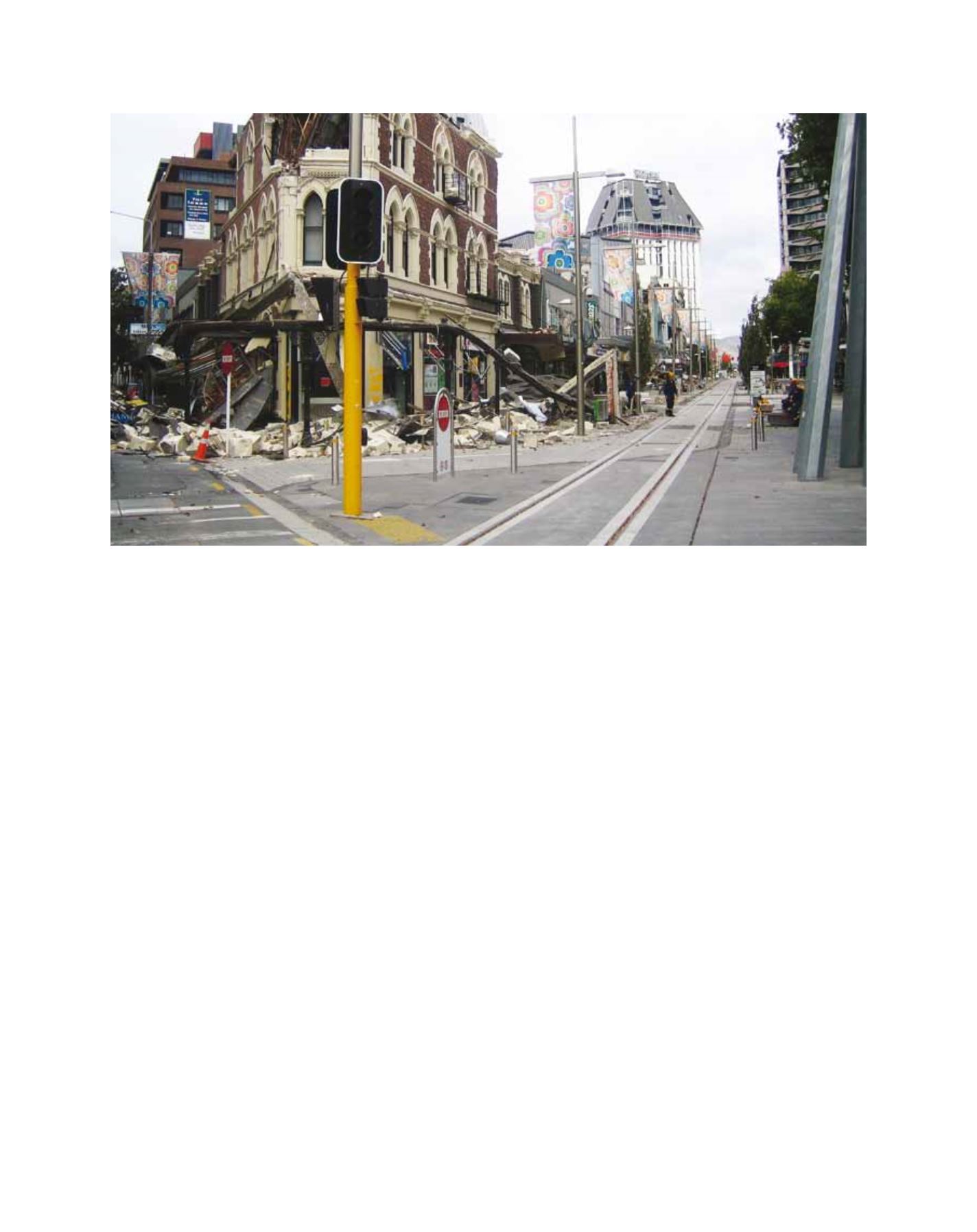
Ground shaking in the 22 February 2011 event was the largest ever recorded for a New Zealand earthquake and resulted in significant damage to buildings
Image: Anita Komen