



 27 / 168

[
] 27
national development priorities. They should also be able to rely on
funds from local government and communities. For example, after
the 2006 Yogyakarta and Central Java earthquake, the first housing
reconstruction programme for the people of Kasongan village came
from the government of the province of Bengkulu. Since these funds
were not sufficient to meet the housing needs, the community met
to determine a fair way to distribute them. They decided to use the
funds to purchase construction materials and rebuild the houses
themselves, organizing neighbours into self-help labour groups.
Members of each group worked together to rebuild each other’s
houses, one at a time, giving priority to houses that were in poor
condition and to those with elderly family members or children
under five. As a result, funding initially intended for 40 houses was
used to build 70.
10
Another option for financing recovery is to twin provinces or
municipalities. This involves pairing an economically strong local
government with a less developed one. China, for example, has
introduced a twinning programme that involves allocating one per
cent of the annual income and technical capacity from an economi-
cally strong province to fund recovery projects in a less developed
one for three years. For example, after the 2010 earthquake,
Shandong Province and Shanghai Municipality provided assistance
to Beichuan County and Dujiangyan City. They supplied funds to
rebuild schools and hospitals to higher standards and upgrade their
management and professional capacity, deploying some of their own
staff to the newly built institutes to provide on-the-job guidance
and bringing teachers, doctors and managers to receive training.
Twinning projects like this one are best established before disasters,
however, so as to be part of ongoing development programmes.
Building on cultural and social resilience
People and communities make decisions every day that influence
the inherent risks they face. Their choices are influenced by their
available livelihood opportunities, their living arrangements, their
treatment of social inequities, and the type of buildings they live in.
Some people will be more vulnerable as a result of social exclusion
or marginalization – or of cultural attitudes and a lack of capacity
to interact with government and the outside world.
Fatalistic thinking can also hamper preparation efforts – but
a disaster may offer an opportunity for people to change the way
they think if they are offered sufficient information and
options. In Indonesia, for example, up to two-thirds of
people living in earthquake zones considered this and
other major disasters to be ‘takdir Tuhan’ (‘pre-ordained
by God’). Government and NGO representatives from
faith-based and secular organizations have concluded,
however, that such beliefs are not lasting constraints,
but rather coping strategies. And even if a disaster is
considered pre-ordained, this does not imply that
mitigation is impossible. When religious leaders take
responsibility for explaining this, and governments
perform their proper duties to the community in a
transparent and accountable manner, perceptions can
soon start to shift.
11
Recovery thus provides an opportunity not just to
reconstruct physical infrastructure but also to build on
communities’ inherent cultural and social resilience. For
this to happen, however, those affected need to be involved
very early in the recovery process. Governments therefore
should develop standards and strategies for commu-
nity participation and input, based on social mapping
and a close understanding of community strengths and
weaknesses, so that programmes can capitalize on local
leadership and latent capacities, especially of women.
This community-driven approach to post-disaster recov-
ery requires significant investments of time and human
resources but results in greater client satisfaction, quicker
disbursement and local empowerment.
12
Recovery for resilient development
Resilient recovery means compressing decades of devel-
opment into a few years while reducing future risks. But
disasters themselves also offer opportunities – driven
by (albeit often short-lived) changes in attitude, techni-
cal and financial resources and political support. For this
reason, despite the stresses after a disaster it is still impor-
tant to step back and plan a resilient recovery based on
local capacity and the needs of the affected population.
Recovery offers the opportunity to address the underlying
risk factors from multiple hazards and ‘build back better.’
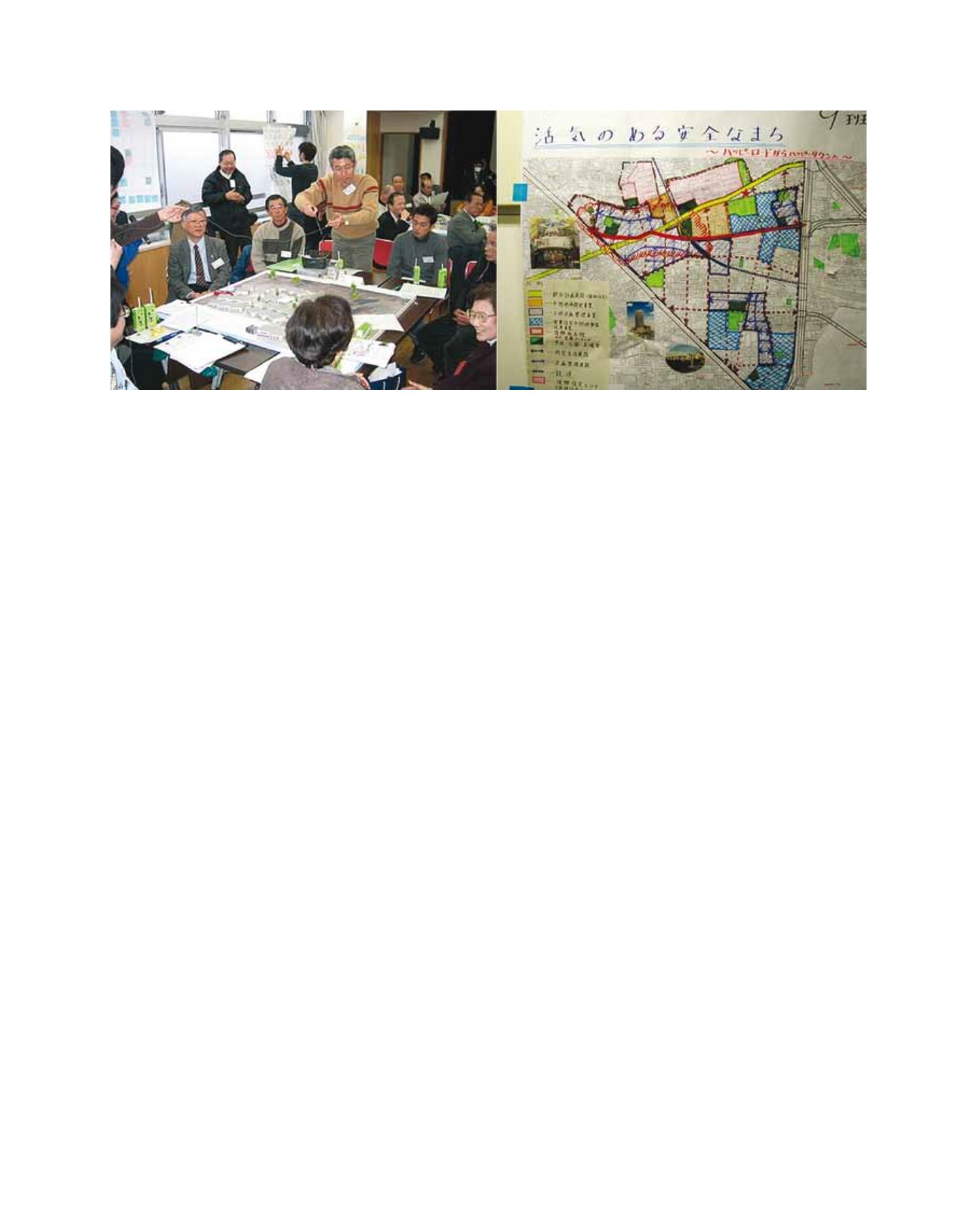
Pre-disaster recovery planning exercise at community level promoted by the Tokyo Metropolitan Government
Image: © Junichi Hosobuchi, International Recovery Forum 2011